
Fictional towns of the early 1960s. Middle America, great places to be a kid. All of these places begin with letter “M” for some reason. When these television shows or films were popular, America was about to undergo some pretty radical changes. In these fictional places, the real world was kept out, thankfully.
Even viewers knew then that these fictional places idealized middle class life into a squeaky-clean reality. Yet we still yearned for life to be so predictable, fixable and kind. It’s where we wanted to be. This was many years before the Hallmark Channel rescued us.
Many of us look fondly at our childhood: our friends, activities, favorite teachers, traveling to new places, gaining new skills or mastering challenging, and so on. It was a time we might have dreamed big, felt unconditional love, saw each new day as an adventure, and felt safe. Not every child has those memories, and that’s sad. Not all of us had the same advantages, opportunities or memories. Not all children look back on those times with fondness. Our families, obviously, have so much impact on our growth and experiences. Our communities do too. Our communities tend to be collective memory buckets of our childhoods: both good and bad.
Television and film in particular tended to idealize and sanitize life in America for public consumption. Few people lived like the Cleavers, the Bradys, the Partridges, the Nelsons or most characters in Disney films. That wasn’t reality, but we wanted to feel that degree of love, acceptance, support and safety.
I look back many decades now and marvel at how life is different today. I grew up in a great community, small and safe. That community is still highly valued as a place people want to live. The trouble is, the more it grows and loses the informality of neighbors, the less it retains the qualities that attract people. Still, we seek what seems to fill our dreams, real or not.
The film Pleasantville took the ideal life another step and blurred fiction and reality, with a little help from Don Knotts as the befuddled TV repair man. Back to the Future, Blast From the Past and Peggy Sue Got Married showed the disconnect between the warmth and safety of black & white, and the confusion and unpredictability of color technology.
Mayberry
Mayberry was popularized by The Andy Griffith Show, and later, Gomer Pyle and Mayberry RFD. Mayberry was a town in North Carolina, patterned after Mount Airy, NC. In the early years, Mayberry residents seemed naive and backward, or at least some of them were. Everybody seemed to know each other, the town was so small. Characters like Ernest T. Bass, the Darling Family, Otis Campbell and Gomer Pyle didn’t help the image.

Mayberrians were prideful of their community and kind to neighbors. They knew of the image of small town America to outsiders: dim, uneducated, old-fashioned, unhip. At first, the show played up the stereotypes, except for Sheriff Andy Taylor, who had some smarts and rose above the hick image.
In later years, Mayberry residents were mostly portrayed as “with it” and not country bumpkins. They were showing outsiders that Mayberry also had big city thinking and style, although it wasn’t flashy or fake.
Mayberry had very little actual crime. Just bootlegging, public drunkenness, outsiders making trouble or Ernest T. Bass breaking windows. Mostly, Sheriff Taylor mediated disputes between neighbors or dealt with spoiled outsiders passing through town.
Mayberry was very homogeneous: White and Christian, same as how America was portrayed at that time. There were few poor or rich people. Women worked in the home unless they taught school, waitress, was a nurse or the occasional professional (Ellie the pharmacist).
Mayberry is synonymous with virtue, compassion and helping a neighbor. While you might not be able to buy a fancy sports car there or have a swanky restaurant, you still wanted to live there.

Filmed on a forty acre “backlot,” that belonged to RKO Pictures and later Desilu Productions. The way the site was organized, a variety of television shows filmed exteriors on the lot.

Mayfield
Mayfield was where Leave it to Beaver took place. The show was less about the town and more the Cleaver family. Mayfield was a small city in some unnamed state. The references to Mayfield were vague and often conflicting with past comments in shows. We’re they near an ocean? There was no particular accent native to a specific area of the country.
The few occasions where downtown was shown, it looked nondescript with office buildings and shops. There were parks, upscale stores, movie theaters and of course, schools. It could have been any medium-scale American city. Naturally, there were never any poor or dilapidated areas shown.
The Cleavers were a pretty milquetoast family. June Cleaver was a housewife who cooked and cleaned wearing fashionable dresses and pearls. Ward made a good living.

Ward Cleaver, the dad, had an executive position with an unnamed company. He wore a suit to work and they had a company magazine. I’m guessing a city of 120,000 people, which in 1960, would place it the 100th most populous city, ahead of Greensboro, North Carolina and below Kansas City, Kansas.
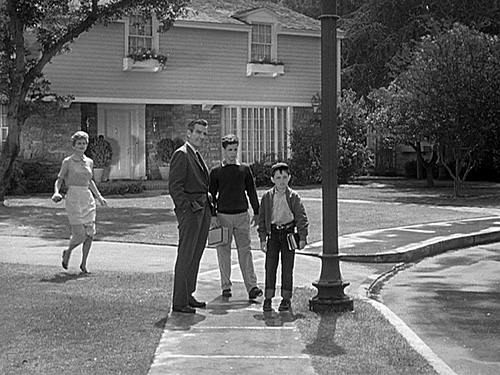
There were two Cleaver houses during the series. The first house was on the Republic Studios lot. The second house was on the Universal City Studios lot and appeared in many television shows and films, including Marcus Welby, MD. The facade was changed many times and the houses on those streets were moved to a different section of the backlot.


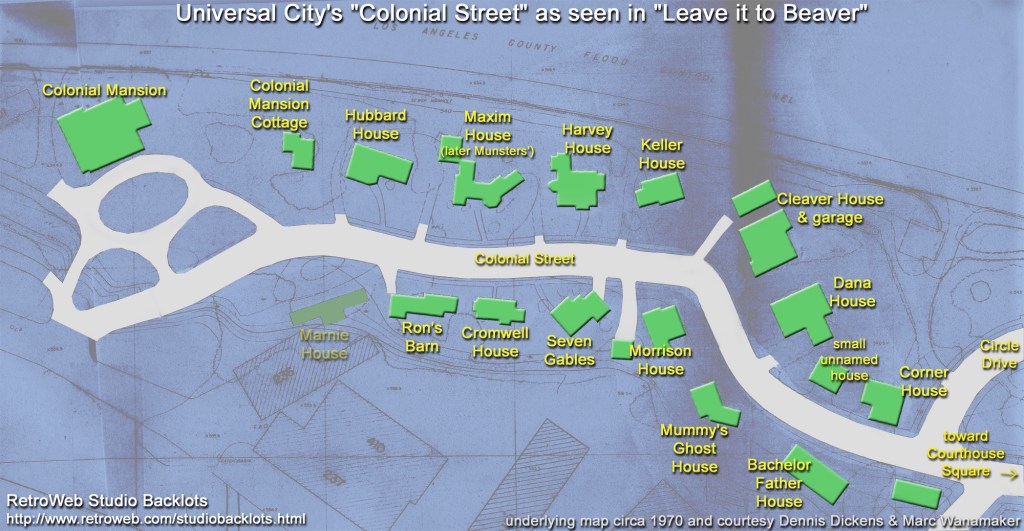
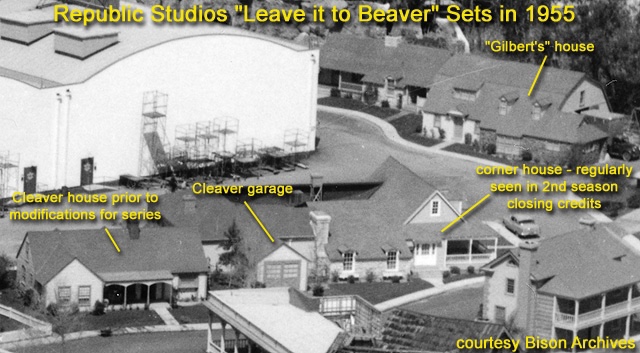
If you wanted a small town, Mayberry was it. A small to medium sized city, Mayfield. If you wanted to attend a zany college, apply to Medfield College.
Medfield
Medfield was a Walt Disney device, patterned after the real town of Medfield, Massachusetts, but the Disney was a work of fiction. Medfield was the home of the fictional Medfield College, the setting for a number of Disney comedies that focus on college students or faculty. Interestingly, other Disney films use fictional colleges for films. Midvale College (The Misadventures of Merlin Jones), Godolphin College (Blackbeard’s Ghost) Merrivale College (The World’s Greatest Athlete) and Huntington College (Superdad).
It all started with Professor Ned Brainard, educator and inventor at Medfield College. There were two Flubber films and then a remake. Then there were three Dexter Riley films, following a student at Medfield College. In 1976, The Shaggy DA takes place in the town of Medfield, but not the college.
Medfield College was a great place for Prof. Brainard (a cool name for a professor), a bit of a maverick and totally absorbed in his work. Medfield seems always on the brink of a financial problem and has an inferiority complex next to other state colleges, particularly in athletics. Brainard was an institution at this institution.
The town of Medfield has a character in Alonzo P. Hawk, a robber baron of sorts, who is a loan shark and villain in these films. Thankfully, he’s there for comic relief. Even though Medfield is a small city, it is presented as having a small town vibe. Two city cops are minor characters but have hilarious interactions with various characters in the films. In the Dexter Riley films, the villain is A. J. Arno, who tries to use Dexter to his financial advantage, but loses every time.
Films about Medfield or Medfield College:
- The Absent-Minded Professor
- Son of Flubber
- The Computer Wore Tennis Shoes
- Now You See Him, Now You Don’t
- The Strongest Man in the World
- Flubber
- The Shaggy D.A.

Disney films during this era featured stories about misfits or underachievers in life. A sudden discovery, opportunity or accident changes their lives, for the better.
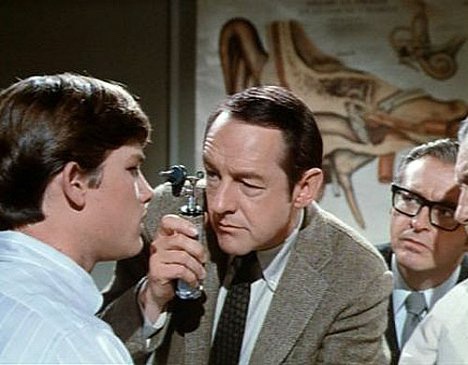
Medfield and the other colleges served as the catalyst for change. These small-time schools couldn’t compete academically or athletically until something crazy happened, usually an invention or accident.

In the 1960s and 1970s, life was good and Disney films spoke to that. This was family fare that ignored social issues, political events and war. Medfield could have been anywhere, which made it open to all.




 Ticket 2 Ride
Leave a comment