
I was hesitant to check out his two books, Paul McCartney, The Lyrics. By this point in life, I know most of his songs by heart, so I didn’t see the point of words I already knew. Investigating further, the books contained many personal stories about his music and life. Taken from five years of interviews with Paul Muldoon, McCartney talks about songwriting, his influences, and the origins of many of his songs. Okay, so I had to read them.
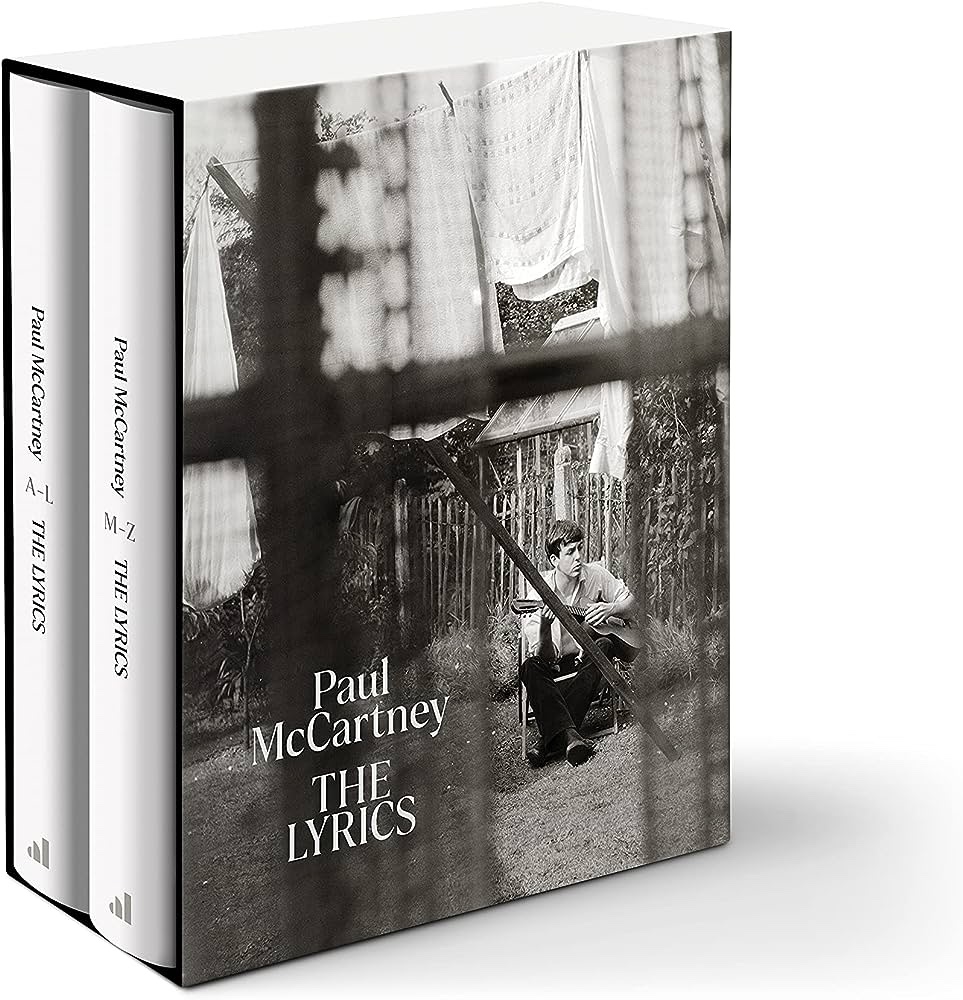
Not every song he’s penned in here, but all of his most recognized tunes. The lyrics are spread over two large books, arranged alphabetically, with copies of original lyric notes and art scribbles, along with photos and record jackets. There is much to appreciate, it’s McCartney his-story.

What were McCartney’s influences in songwriting? As one might suspect: His family and upbringing, his childhood memories and his observations in life. His father was a sometime musician and music was part of the McCartney household. Although his mother Mary, who died when young Paul was 14, did not play an instrument, but was a profound influence on his creativity. Her death left a huge emotional void in his life.

Of course, John Lennon was the other major influence. “A lot of what we had going for us was that we were both good at noticing the stuff that just pops up, and grabbing it. And the other thing is that John and I had each other. If he was sort of stuck for a line, I could finish it. If I was stuck for somewhere to go, he could make a suggestion. We could suggest the way out of the maze to each other, which was a very handy thing to have. We inspired each other.”
Liverpool, and the lives that McCartney read about, served as source material for some of his story songs. He was an observer and curious about people, creating songs around what he saw or what he imagined. His Beatle songs are full of these stories.
“The song itself was consciously written to evoke the subject of loneliness, with the hope that we could get listeners to empathise. Those opening lines – ‘Eleanor Rigby / Picks up the rice in the church where a wedding has been / Lives in a dream’. It’s a little strange to be picking up rice after a wedding. Does that mean she was a cleaner, someone not invited to the wedding, and only viewing the celebrations from afar? Why would she be doing that? I wanted to make it more poignant than her just cleaning up afterwards, so it became more about someone who was lonely. Someone not likely to have her own wedding, but only the dream of one.”
“Eleanor Rigby”
McCartney gives credit to the other Beatles and George Martin for the creative atmosphere as they helped each other in the studio. Even in later years, as the Beatles grew apart and friction crept in, McCartney writes that he tried to bring back the closeness from the early days.
“We were about to record it, and he said, ‘I think it would be good with an introduction.’ And I swear, right there and then, George Harrison went, ‘Well how about this?’ and he played the opening riff, which is such a hook; the song is nothing without it. We were working very fast and spontaneously coming up with ideas.
“All My Loving”
Another thing worth recalling is that George Martin was inspired to add a chord modulation in the solo of the song, a key change that he knew would be musically very satisfying; we shifted the chord progression to start with G minor instead of F-sharp minor – so, up a semitone.”
By 1968, the Beatles were running their own business empire and record label. The business end of it was not fun, but it provided inspiration for songs. “Carry That Weight” and “You Never Give Me Your Money” are two examples.
“That was coupled with the business problems at Apple Records, which really were horrible. The business meetings were just soul-destroying. We’d sit around in an office, and it was a place you just didn’t want to be, with people you didn’t want to be with. There’s a great picture that Linda took of Allen Klein, in which he’s got a hammer like Maxwell’s silver hammer. It’s very symbolic.”
“Carry That Weight”
McCartney didn’t want Allen Klein to manage the band and their business, but he was outvoted. McCartney hired Linda Eastman’s father to manage him separately. Klein had managed The Rolling Stones and ended up owning their early recording master tapes. McCartney wanted no part of Klein. That was a factor in McCartney’s decision to end the Beatles.
Becoming a solo artist was not easy as his work with the Beatles cast a large shadow on McCartney’s future work and expectations that he would grapple with forever.
“I started to write songs for Wings from 1971 onwards, when we got started, and I tried to keep them away from The Beatles’ style. There were avenues I could go down that I wouldn’t have gone down with The Beatles, like bringing in the influence of reggae, which Linda and I got into in Jamaica. I fancied doing something crazy, and Wings allowed me a little bit more freedom.”
“Arrow Through Me”
McCartney famously wrote songs for others like Peggy Lee, Mary Hopkins and Badfinger. “Come and Get It” was a huge hit for Badfinger, but the expectation was for the band to copy his demo, even when they had other ideas. McCartney was a hit maker and insisted on Badfinger following his direction.
“Afterwards, I said to Badfinger, ‘This is how you must do it.’ And they said, ‘Well, we’ll put our spin on it. I said, ‘No, I don’t want you to. I want you to do it faithfully, because this is the hit formula. You’ve got to do it this way.’ So they balked a little bit at that, but when you listen to their recording and my demo, they’re very similar.”
“Come and Get It”
One of my disappointments with the book was how much he skipped over. I would have enjoyed more about the recording of those songs and thematically how they shaped the albums. Beatle albums had a major cultural impact during the 1960s, and aside from a few songs like “Blackbird,” McCartney avoids the topic. Instead, he focuses on the relationships with Jane Asher, Linda and Nancy Shevell, and the romantic textures of his songbook.

McCartney approached songwriting as a hole to be filled, which is an interesting way to look at creating art. He admits having a structural template for songwriting, including a preference for writing the music first. Of course, he would deviate occasionally, but he had a writing style that proved quite successful. When he wrote with John Lennon, their style was to keep writing until they were done. On the book, he walks about writing with Lennon, but does not comment on writing with others like Elvis Costello, Eric Stewart, Stanley Clarke, Denny Laine or even Linda McCartney. He briefly mentions Stevie Wonder and Michael Jackson, but I didn’t really get much insight into their work processes.
Other songwriting comments:
“Once l’ve managed to isolate myself (in this case it was another little room while Linda was doing a cooking assignment elsewhere in the house), once I’m actually writing the song, I’m off on that trail. I really don’t know what the goal is, or even where I’m heading, but I do like to get there and find things out on the way.”
“I often think that when I’m writing a song, I’m following a trail of bread crumbs. Someone’s thrown out these bread crumbs and I see the first few, and ‘Somedays I look’ and see the next one. I’m following the song rather than writing it. I will think of the line that’s coming and think of how to get into it, like following stepping-stones.
“For me, writing a song is just following a trail and then diverging from it and beating a new path. I set down a map of sorts, some rough coordinates, and then go there and find stuff on the way, just picking up little objects that happen to be lyrics or melodies. It’s a time of discovery, and that’s what I love about it.
“Stephen Sondheim and I once spent a very pleasant couple of hours discussing songwriting methods. When he asked what my process was, I told him I started out by finding the chords. What chords work well next to each other, what progression suggests a new melody. He seemed a little surprised that what I did was all chord based. For him, it’s all about melody and counterpoint, how various melodies can work together and complement each other.”
McCartney lists the usual suspects as influential on him and the other Beatles. Roy Orbison, The Everly Brothers, Elvis and Buddy Holly and the Crickets. Each offered something The Beatles would incorporate, but McCartney was particularly drawn to Buddy Holly, who was a songwriter, a lead guitarist, singer and band leader. McCartney respected his talent and also his independence, writing his own songs and not relying on outside musicians.
“‘Please Please Me’ arrived as a very slow song when John brought it in. I heard it and straightaway said, ‘Orbisonesque.’ In fact, Orbison should have sung it. I don’t know if he ever did, but it has Roy written all over it. If you slow it down and do an impression of him, it fits exactly. But then our producer, George Martin, changed it. George liked the song when we brought it in, but he said, ‘Do you think we could do it faster?’”
“Please, Please Me”
One more thing. Reading McCartney’s lyrics is an opportunity to absorb how sometimes simple his words, but powerful in their imagery and poignancy. Known for his melody and sophisticated musical construction, the lyrics were of an older, wiser soul.

 Ticket 2 Ride
Leave a comment