
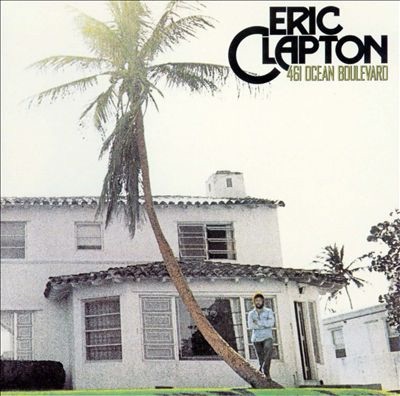
Eric Clapton has had many lives. He made this album as he emerged from a serious drug habit. Criterion Studios in Miami was a posh, relaxing location for Clapton to record in. While working on the album, Clapton stayed in the house located at 461 Ocean Boulevard, in the Miami metro area. The house belonged to a Hollywood producer who rented it to celebrities wanting a fashionable stay. Today, the house is probably more well-known than the album as it continued for years to serve as a Clapton shrine and stop-off for women wanting to meet the guitarist.
This was also the time period when Pattie Boyd (the inspiration for “Layla”) left George Harrison to be with Eric Clapton. There were numerous changes in Clapton’s life and perhaps several of his songs on this album were written to reflect those changes, and new beginnings.

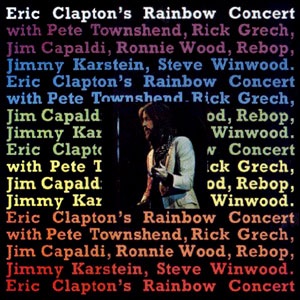
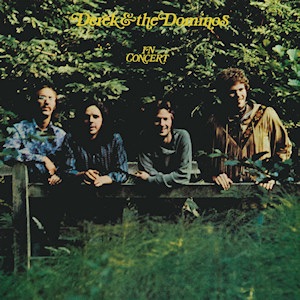
Released in 1974, 461 Ocean Boulevard was Clapton’s first studio album since his first solo album, Eric Clapton (1970) and Derek and the Dominoes: Layla and Other Assorted Love Songs (1970). Clapton had several live albums to his credit, Concert for Bangladesh, Derek and the Dominoes In Concert, and the Pete Townshend and friends organized Eric Clapton’s Rainbow Concert, which served to reintroduce Clapton to the world following his heroin addiction.
Clapton picked veteran producer Tom Dowd to oversee the recording sessions. Dowd, who had also worked with Clapton on Layla and Other Love Songs, also recorded at Criterion, would work with Clapton often during the decade.

Clapton gathered a core group of musicians to work on the album including Dominos bassist Carl Radle. These musicians would back Clapton for the 1970s. Dick Sims, Jamie Oldaker, George Terry, Yvonne Elliman and Albhy Galuten. Marci Levy would join later. Radle, Sims and Oldaker were from Tulsa and helped develop the “Tulsa sound” that was popular in the 1950s and 1960s. Leon Russell, who played music in the Tulsa area as a young musician noted: “I’m not sure what the Tulsa sound is, I suppose it started when we were with Jerry Lee Lewis, we would be playing a shuffle while Jerry Lee played straight eighth notes, if that is what they call the Tulsa sound, that’s not a bad thing”.
Sims’ organ is particularly strong on this album, almost ominous, as is Terry’s rhythm work on the guitar. The swampy Tulsa beat is apparent with Oldaker and Radle on drums and bass, respectively.
461 Ocean Boulevard is mostly a laid-back affair as Clapton dialed back much of the guitar fireworks he was known for. This is a quieter album, focused more on the softer country-rock flavor and cool, island grooves, than his British blues-rock. Clapton the chameleon would assume many styles in his long career. He would remain loyal to the traditional blues, a fan of Robert Johnson, Muddy Waters and B.B. King. His other favored style was the shuffle, folksy groove of “Lay Down Sally” and the music of J.J. Cale (“After Midnight”, “Cocaine”).
Side one
- “Motherless Children” Traditional (Arranged by Eric Clapton · Carl Radle) 4:55
- “Give Me Strength” Eric Clapton 2:51
- “Willie and the Hand Jive” Johnny Otis 3:31
- “Get Ready” Eric Clapton · Yvonne Elliman 3:50
- “I Shot the Sheriff” Bob Marley
Side two
- “I Can’t Hold Out” Willie Dixon (original album credit: “By Elmore James, Arranged by Eric Clapton”) 4:10
- “Please Be with Me” Charles Scott Boyer 3:25
- “Let It Grow” Eric Clapton 5:00
- “Steady Rollin’ Man” Robert Johnson (Arranged by Eric Clapton) 3:14
- “Mainline Florida” George Terry
Even though I view this album as an example of Clapton’s slow-hand phase, he doesn’t give up rocking out. The opening track, “Motherless Children” and the close track, “Mainline Florida”, are upbeat and soaring. While neither song is a Clapton classic, they give the album a harder feel and feature some great slide guitar.
“Give Me Strength” with the sweet dobro has a slow, spiritual vibe. “Willie and the Hand Jive” has a decidedly island feel, “slow-burning” as it was called. “Get Ready” continues that slow, energetic groove. Co-written by Yvonne Elliman, who shares vocals with Clapton.
The most famous song on the album is Bob Marley’s “I Shot the Sheriff”, a song Clapton had to be convinced to record. That, turned out to be a great decision as it was a big hit around the world and his first Number One Billboard single. There’s a little of the reggae in Clapton’s version, but he plays it faster and with more of a rock beat. One of Clapton’s strengths is his ability to synthesize different styles to reach a wider audience. The sequencing of side one is extraordinary and builds to a satisfying end.
Side two is no letdown from the hot, sweaty grooves conjured on the first side. “I Can’t Hold Out” is a mid-tempo blues, Sims and Terry keep the song driving along, while Clapton does his slowhand thing. “Please Be With Me” is a slow, gentle song; lovely singing and acoustic guitars. “Let it Grow” is one of Clapton’s best songs. Perhaps a plea to Boyd on the beginning of their relationship, a positive and poignant song, with layering of great guitar work and a wonderful fade-out. “Steady Rollin’ Man” is more electric blues, augmented by a shuffle beat, the song really just allows Clapton some soloing. “Mainline Florida” was written by Terry and is a more straight-ahead rocker. Clapton even uses a talk-box on the song.
Interesting fact. Galuten and recording engineer Karl Richardman became a production team and worked on future Clapton albums. The two also teamed with the Bee Gees to work on their albums during the Bee Gees 1970s period. Galuten, Richardson and Barry Gibb also produced albums for for Andy Gibb, Samantha Sang, Frankie Valli, Teri DeSario, Barbra Streisand, Dionne Warwick, Kenny Rogers, Dolly Parton and Diana Ross. [courtesy of Wikipedia]
A live performance from the 1990s, the song has more of a reggae feel to it in this version.

 Ticket 2 Ride
Leave a comment