

Peter Brown was a member of the Beatles inner circle. He worked for Beatles manager Brian Epstein and then was a director for the Beatles’ Apple Corp.
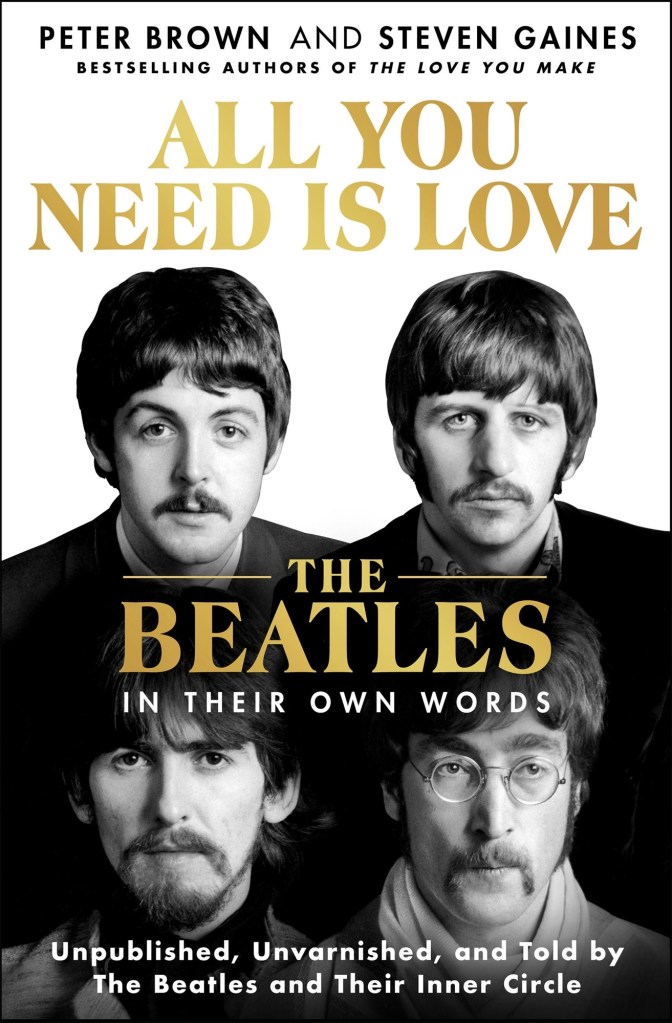
Brown is back with another eagerly awaited book about the Beatles from interviews conducted decades ago, All You Need is Love: The Beatles in Their Own Words (St. Martins Press, 2024). He and co-writer Steven Gaines authored The Love You Make, An Insider’s Story of the Beatles (McGraw-Hill, 1983) also from interviews of the Beatles, their wives and others in the Beatles’ orbit.

Brown’s main job in the Beatle years was to fix business problems, and the care and feeding of the Beatles. As Epstein’s assistant, he had a phone on his desk that only rang when one of the Beatles needed something.
Famously, Brown organized the informal weddings for John Lennon and Yoko Ono, and Paul McCartney and Linda Eastman. Brown is immortalized in the lyrics of “The Ballad of John and Yoko” (Peter Brown called to say, “You can make it okay, You can get married in Gibraltar, near Spain”)


When the Beatles split, Brown went to New York where he headed up Robert Stigwood’s operation, providing management services to The Moody Blues, The Bee Gees, Eric Clapton and others. His duties also included Stigwood’s film subsidiary that produced Saturday Night Fever, and the infamous Sgt. Pepper’s Lonely Hearts Club Band.
Brown moved on the form his own high-powered PR film with entertainers and corporations as clients.
And now, the book…
All You Need is Love consists of many priceless interviews with people who were involved in the Beatles evolution from a bar band into the most successful group of all time.
The list includes Music publisher Dick James, manager Brian Epstein, first Beatles manager Allan Williams, promoter Bob Wooler, NEMS employees Alistar Taylor, Geoffrey Ellis and Nat Weiss, Apple executives Neil Aspinall, Allan Klein, Derek Taylor, Ron Kass, and inventor Magic Alex. There are also interviews with Beatle wives, and May Pang (John Lennon’s girlfriend), the Beatles themselves, and John Eastman (Beatles attorney and McCartney management). The most interesting interviews, in my opinion, are with Yoko, Eastman, Dick James and Allen Klein.
One thing that is apparent is how over-matched the Beatles were in their business representation early on, signing ridiculous merchandising and publishing contracts that literally gave away billions of dollars. But who knew then what the Beatles would be worth, or deserved. Brian Epstein had their best interests at heart, but was out of his depth in seeing the long game and protecting the Beatles. He also took an incredible 25 percent cut of the publishing and recording contracts. His deals with the Beatles would prove problematic after his death in 1967.
Not everybody made a fortune off the Beatles, there are people that were key in the Beatles’ success that came away with a small slice of fame and great stories. Others like Epstein, Klein and James got a hearty slice of the Beatles’ pie. The most difficult parts of the book for me to read were the business and contract sections. It’s tragic how much money slipped through their hands because of bad deals or opportunists.
I am not a Beatles expert, but I’ve read extensively about them, and this book provided me some great insights I didn’t previously have. It was evident that the Fab Four enjoyed a great deal of carnal adventure in their touring days, and while they didn’t destroy hotels like other British bands, they certainly left many young ladies with stories to tell. What I hadn’t realized is how many dalliances the cute Beatle enjoyed in his bachelor days, even when he was involved with steady girlfriend Jane Asher.
The story about tour stops in Japan and The Philippines is priceless Beatles lore. No wonder the Beatles stopped touring. The Beatles barely escaped with their lives in Manila after offending Madame Marcos. A must read if you don’t already know the story.
Following Brian Epstein’s death, the Beatles found themselves vulnerable and splintering. Certainly their recording output was tremendous, but as they ventured into new projects and personal relationships, these were uneasy and challenging times. The Beatles created a company, Apple Corp. to handle their business and creative affairs, and the stories by Brown, Derek Taylor, Allister Taylor and others reveal the craziness and internal battles that took place. One of their Apple employees would write a book entitled, The Longest Cocktail Party.
The liquor chargers: “..maybe a couple of scotches, vodka, gin, a dozen Cokes. Maybe one week, two bottles of gin, a bottle of scotch. Neil would roughly order the same. I am not exaggerating when I say that Derek Taylor’s office order was thirty-six bottles of scotch, twenty-four bottles of vodka, twelve bottles of gin, a gross of Cokes. If you entertained Fleet Street every day, could they have been that drunk? I couldn’t believe these figures, and were not talking about the smoke. We’re talking about booze.” – Allister Taylor, the Apple bean counter
The Beatles were not good at business, that’s a reoccurring theme here, nor were they effective at maintaining close relationships with girlfriends/wives or employees. One Beatle wife referred to Beatle partners as luggage.
One complaint I have is that the book doesn’t really have a detectable linear flow, although the last third focuses on matters regarding the Beatles’ split, business entanglements and legal matters.
Brian Epstein’s sudden death exposed the Beatles vulnerability and nativity. Allen Klein would prove to be a sad chapter in the Beatles’ story. Klein, true to his reputation, portrayed himself as the master businessman and turned on the charm, promising things we couldn’t deliver. In his mind, every action was for his clients, yet he left a trail of wreckage and lawsuits, and saw himself as the victim. Klein comes across as a music mogul version of Donald Trump.
The Beatles took America by storm sixty years ago. There are only a handful of those mentioned in the book that are still alive. These are the folks who lived it. Thankfully, these interviews were done many years ago by Brown and Gaines. Sometimes their questions are pointed and dogged, because they wanted to get beyond the myth to the facts.
All You Need is Love is not just another book on the Beatles. It is the Beatles in their own words and the words of those closest to them. It is also the Beatles unvarnished and imperfect. John, Paul, George and Ringo were just young men from working class Liverpool, who became the brightest stars in the heavens, but who had to deal with mortal issues, and were in an uncharted territory of success.
The title of the book has some obvious irony. Love wasn’t the only thing needed, a smart lawyer and savvy business representation were also necessary.
A very good read.



 Ticket 2 Ride
Leave a comment