

Having recently viewed the latest Tom Cruise Mission:Impossible film, I had the chance to catch several episodes of the original TV series late one night. Actually, I have been watching a few episodes here and there, as I cut the cord on my cable and rely on streaming mostly free, online channels that provide old shows like Mission: Impossible.

I’m old enough to have watched the original series that began in 1968. Members of the IMF (Impossible Mission Force) were like secret agents, but that wasn’t the brand the show was after. Each show featured a mission (that was accepted) based around infiltrating an overseas government or organization to prevent some major threat to peace or democracy. Trickery, disguises and technology were used to accomplish the mission. The Mission: Impossible films use this same basic format, but ramp up the stunts and CGI to meet today’s required “thrill factor.”
The opening title sequence, with the heart-pumping editing and rocking musical theme, was one of the best and memorable in television history. I count Hawaii Five-O, The Streets of San Francisco, The Rockford Files, The Fugitive, Hill Street Blues, Magnum P.I., and Mannix as among the best dramatic series opening titles in TV history.
Lalo Schifrin’s theme became one of the most memorable in television history. The pounding, fast-paced music set the stage for intrigue and danger, which each episode. The theme music changed in later seasons, not for the better; the changed up theme lacked the punch and clarity of Schifrin’s original arrangement.
The series was developed by Bruce Geller for Desilu Productions, later purchased by Paramount Pictures. Geller also developed Mannix for Desilu. Lucille Ball had an eye for unique, contemporary dramatic series. She not only greenlit them, but supported them to find their legs and build an audience. Star Trek also came from Desilu.
As is common with episodic television, there was a rotation set of writers and directors for the series. Five directors helmed ten or more episodes, with veterans Reza Badiyi, Barry Crane, Paul Krazny and Lee H. Kazin directing the most episodes. [Badiyi also directed the opening title sequence of Hawaii Five-O and The Mary Tyler Moore Show.] The list of writers is long, but the most frequent writers were Allan Balter 24 episodes, William Read Woodfield 24 episodes, Laurence Heath 23 episodes, Paul Playdon 14 episodes, Ken Pettus 11 episodes and Harold Livingston 11 episodes.
Mission: Impossible was filmed on the Desilu and Paramount lots and in the Los Angeles area; one had to use their imagination to imagine Eastern Europe, Africa or Central America. Mostly, filmed on soundstages, the producers and directors used lighting, hip camera angles and creative set design to “add color” and dramatic effect to some pretty basic interiors.
The wardrobe department worked overtime refashioning the military uniforms into variations of nondescript authoritarian regimes. A legion of guest stars rolled-out their heavy accents to play heavies or damsels forced to be bad girls.
Some of the best character actors appeared numerous times including: John Vernon, Anthony Zerbe, John Paul Stevens, Albert Paulson, Milton Seltzer, Joseph Ruskin, David Sheiner, Sid Haug, Jack Donner, Fritz Weaver, William Windom, Antoinette Bower, Val Avery, Alfred Ryder, Mark Lenard, Warren Stevens, Percy Rodriguez, Pernell Roberts, John Colicos, Nehemiah Persoff, Lloyd Bochner, Diane Baker, Vincent Gardenia and Larry Linville.
CAST (1966-1973)
Daniel Briggs (1966-1967)…Steven Hill
James Phelps (1967-1973)…Peter Graves
Cinnamon Carter (1966-1969)…Barbara Bain
Rollin Hand (1966-1969)…Martin Landau
Barney Collier…Greg Morris
Willie Armitage …Peter Lupus
Paris (1969-1971)…Leonard Nimoy
Doug Robert (1970-1971)…Sam Elliot
Dana Lambert (1970-1971)…Lesley Ann Warren
Lisa Casey (1971-1973)…Lynda Day George
Mimi Davis (1972-1973)…Barbara Anderson
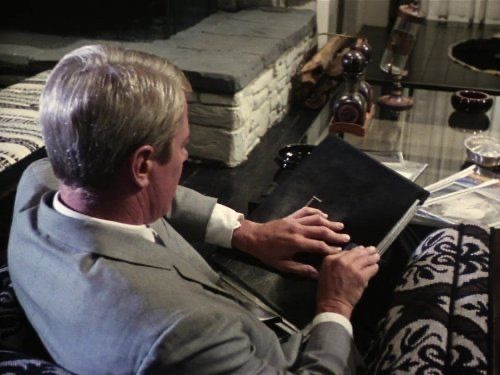
Steven Hill began as Dan Briggs, the IMF leader, but left after the first season. He would resurface later on Law & Order as the district attorney. Peter Graves took over for Hill and stayed through the final season. He even returned for the late 1980s series reboot, the only carryover actor from the original series. His Jim Phelps character seemed a better fit for the IMF lead. Both Briggs and Phelps had modern, swanky apartments, generally used for the meeting of the IMF to plan the project.
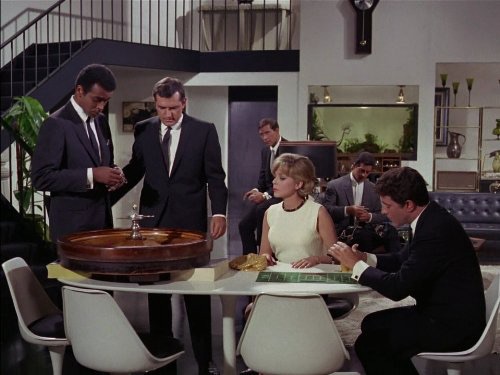
At the beginning of the early seasons, Briggs or Phelps would relax in their swanky apartments and open up a folder where they sorted photographs of both their team and their opponents, tossing them in two piles. This was the “Dossier Scene.” The opening credits usually took place during this event. Then Briggs or Phelps met with their teams and discussed key aspects of the mission and previewed special disguises or gadgets. For the times, these things were almost on the scale of secret agent films.
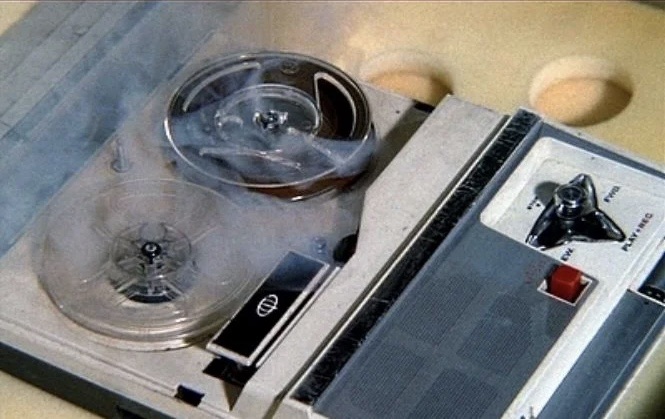
I failed to mention the very beginning of each show where Briggs or Phelps received their mission briefings; by way or another tape recorder or other recording device in a secret locale.
At the end of the mission brief, we learned the Secretary would disavow any knowledge of the team if they were caught or killed. Then the recording self-dissolved into smoke. That feature was unique and cool. Mission: Impossible had style.
After Graves replace Hill, the next cast change came with at the end of season three, as Martin Landau and wife Barbra Bain left the series. Landau portrayed Rollin Hand, a master of disguise, voices and sleight of hand (no pun intended); a showman, which he was. Bain portrayed Cinnamon Carter, a fashion model, who also assumed other identities and was as icy as her beauty. Their departure left a massive hole in the cast.
Greg Morris, was one of the few African-Americans who had a regular featured television role. His Barney Collier was a technical expert who mostly worked behind the scenes to rig and execute the trickery vital to each mission. Typically, Barney had little dialogue in the beginning, but was seen working his magic. Occasionally, Barney would step out-front when the IMF went to Africa or their some other locale where African-Americans were believable in the story. That’s a rather sad thing to say. In later seasons, Barney was a more central character. Morris was the only actor to play all seasons of the original television series.
Bodybuilder Peter Lupus played Willie Armitage, the quiet, strongman who assisted Barney and could be counted on to play whatever part the mission needed. Toward the end of the original series, Lupus was used infrequently, and Sam Elliott joined the show briefly. After Elliott departed, and the cast shrank to four, Lupus actually got more screen time.
After Landau left the series, Leonard Nimoy joined as the character Paris in season four. He portrayed a similar type of character as Landau had, but was less serious and appeared more relaxed than Landau’s character had been. Nimoy stayed for two seasons, and actually injected more warmth and humor than Landau had shown with Hand. This is not to infer that Nimoy was a better actor than Landau, but Nimoy’s character was more fun.
Bain’s departure created a void that took multiple actresses to fill, but never quite did. Lesley Ann Warren, Linda Day George, Lee Meriweather, Barbara Anderson, Sally Ann Howe – all fine actresses, but none had both the coolness and hard-edge that Bain established in the role.
Eventually, the IMF ran out of Eastern European, African and South American countries to fix. Later in the series, the IMF turned their attention mainly to organized crime at home.
Interestingly, in season one, there were two unique missions. Each season seemed to have a non-sanctioned mission (one of the IMF in trouble) or an unusual story. From IMDB: Rollin and Barney are sent to investigate the case of a scientist who believes her dead husband’s ghost is giving her orders on how to complete her important work. Ghosts and psychics, not exactly typical IMF territory, but a nice change of pace.
Pluto tv has an on-demand feature that streams episodes of Mission: Impossible. The episodes are often in random order, so I guess which season I’m watching. The cast changed so often it challenging to guess correctly.



 Ticket 2 Ride
Leave a comment