
He was told not to fight with him mother, she had a heart condition and might die. What a thing to tell a child. He made her laugh instead.
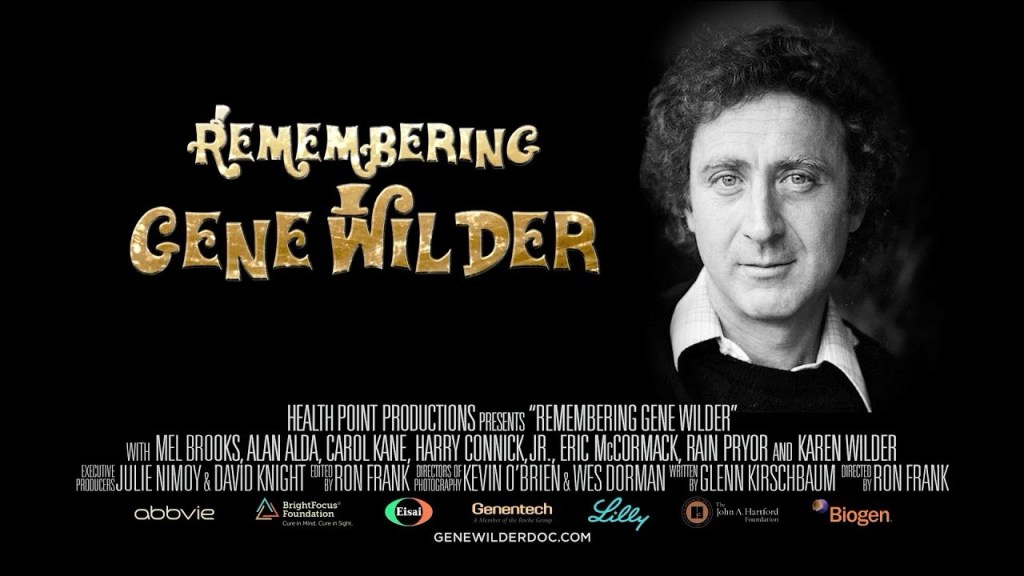
Remembering Gene Wilder (2023) is a touching and often sad documentary of the actor-writer-director. He passed away in 2016, from complications of Alzheimer’s.
The film includes a lot of narration from Wilder himself as he did interviews and narrated the audio of his memoirs. His own words are revealing and bittersweet. His longtime friend and collaborator, Mel Brooks, is also interviewed, with stories of their films together, and of their friendship.
“I love this film! It’s a warm and wonderful tribute to my dear friend, Gene,” said Brooks.
Wilder began his career on the New York stage, and had a supporting role in a play starring Anne Bancroft, who was the partner and eventual wife of Mel Brooks. As fate would have it, Brooks was casting roles for what would become The Producers, and he was told about Wilder.
A small, but notable role in Bonnie & Clyde, then co-starring with Zero Mostel in The Producers, alongside Donald Sutherland in Start the Revolution Without Me, and then, the classic film, Willy Wonka & the Chocolate Factory. In a few short years, Wilder not only featured film roles, but became a leading man. Although Willie Wonka became a classic over time, it was a box office failure. His next film would be a defining role: Blazing Saddles.
Brooks tells the story of how the actor originally cast in the role had to leave the film after production began. Brooks placed a frantic call to Wilder to immediately step in as the Waco Kid. Wilder was born to play that role. Although a comedic role, there were nuances to the character and the subject matter.
Although Wilder was married four times, only his last two marriages are included here: to actress Gilda Radner, who died from ovarian cancer; then to Karen Boyer Webb, who he was with until his death at age 83.
Radner and Wilder were very public in their relationship, both were already in the public eye. “My heart fluttered – I was hooked,” Radner said. “It felt like my life went from black and white to Technicolor.” The documentary doesn’t talk in detail, but Wilder would later say that the relationship was difficult at times and they separated on at least one occasion. They found their way back together and married in France and made a couple of films together, and tried to start a family. The pregnancy resulted in a life-threatening miscarriage. A few months later it was discovered she had cancer. She died in 1989.
Wilder met Webb when he was doing research for the film See No Evil, Hear No Evil, to be another pairing with Pryor. Webb was a speech pathologist, who helped him with his character, and then later with his heart. They would marry in 1991 and enjoy 25 years together.
The last few minutes of the film is incredibly sad as the disease progresses and takes away his life. Wilder battled the disease for six years, even forgetting the title of the film he developed, Young Frankenstein.
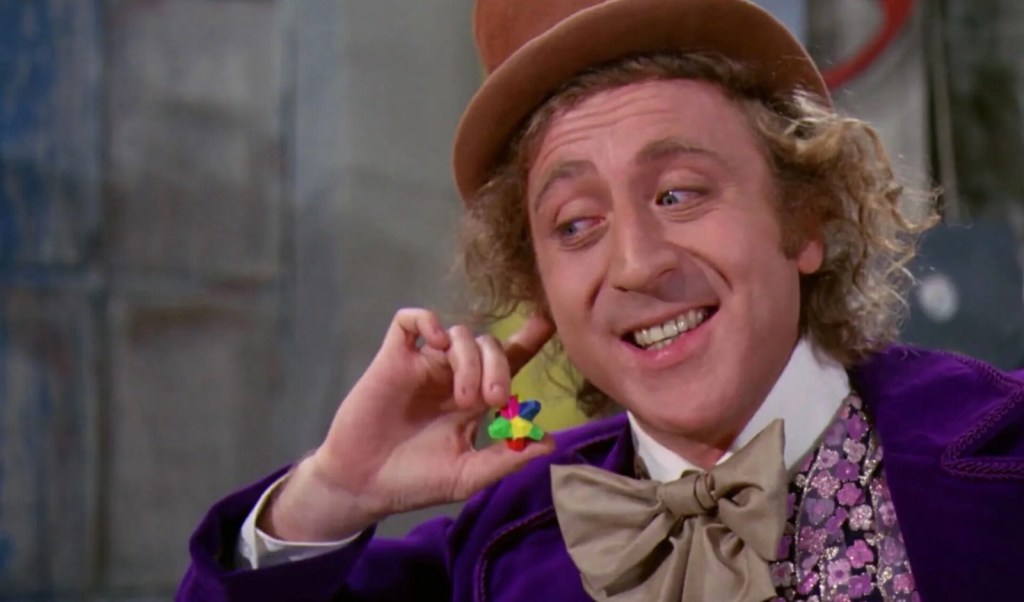
Despite the ending, there is plenty of joy in the documentary. Wilders portrayal of Willie Wonka brings warmth and wonderment to Roald Dahl’s character. When Wilder died, Forbes senior contributor Dani Di Placido wrote, “Willy Wonka & the Chocolate Factory succeeds due to Wilder’s pitch-perfect performance, which managed to capture the peculiar essence of the book.”
His films with Brooks allowed him to play the full range of character emotions without ever appearing to go too far over-the-top. His onscreen team with Richard Pryor certainly allowed Wilder and Pryor to bounce off of each other in riotous fashion in numerous comedies directed by Sidney Poitier.
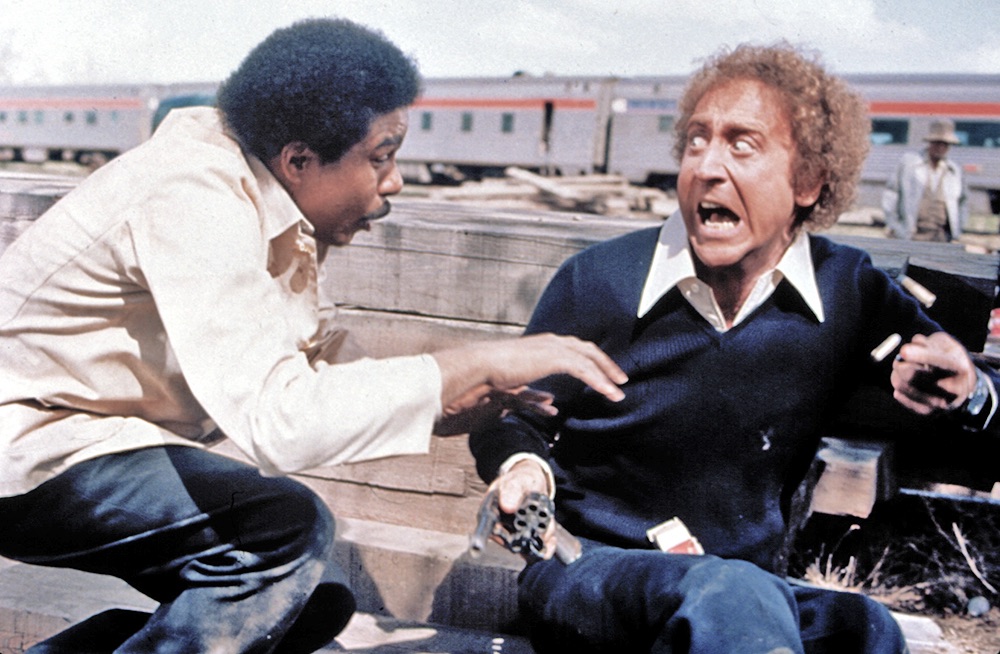
Wilder had a deceptively relaxed and engaging look, his blue eyes almost hypnotic. Beneath that gaze lived a man that was more complicated than what this film presents, perhaps that is for a different kind of film. Somewhere between the Waco Kid and Baron Von Frankenstein is the real Gene Wilder.
The film is directed by Ron Frank, as a loving tribute to Wilder. While Wilder endured his share of disappointment and loss, the focus is clearly on his talent to entertain, and the lives he touched. There’s sadness, but a lot of joy. Just like life.
4/5






 Ticket 2 Ride
Leave a comment