

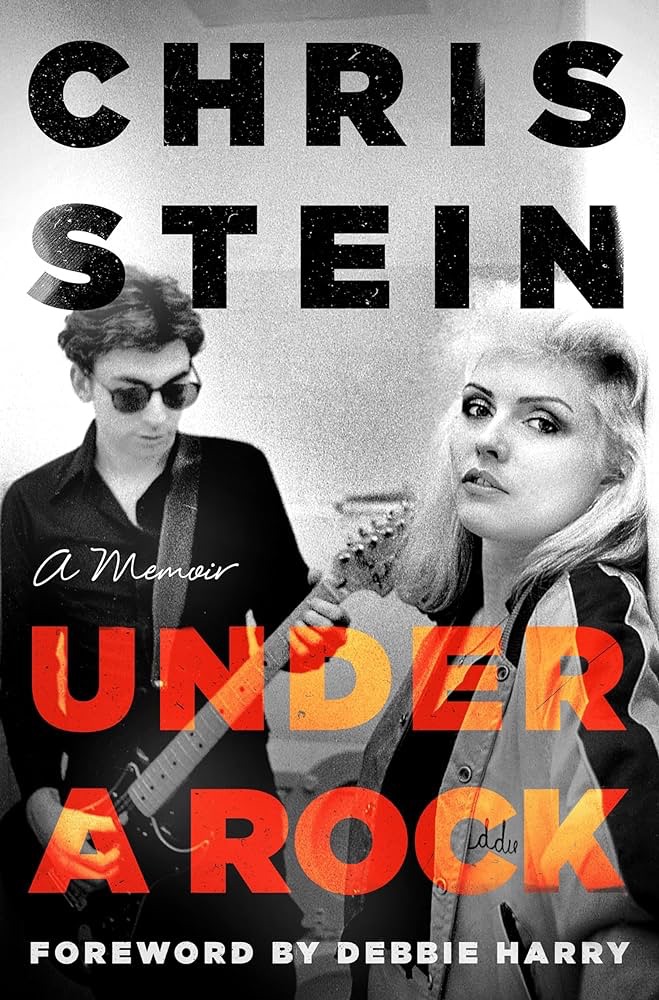
In case you don’t know who Chris Stein might be, he’s the co-founder and co-leader of the post-punk music group, Blondie. Most people think of Debbie Harry when Blondie is mentioned, overlooking the guitarist standing to the side of her, wrote or co-wrote most of their songs and charted the band’s musical direction. Stein and Harry were a couple and remain musical partners.

The first few chapters of Under a Rock (2024, St. Martin’s Press), could apply to many 1960s kids who found little meaning in school, traveled the country and gravitated toward other searching souls knee-deep in the art, music and drugs of the times. Chris Stein was one of them and that he would wind up in a rock band is no surprise.
In the early 1970s, there was a new, raw musical sound brewing, a vibe counter to the laidback groove that was happening in California and elsewhere. This energetic, very urban rock and roll, was embraced by such personalities as Tom Verlaine, Richard Hell, Patti Smith and The Ramones, who would all experience success in the next decade.
New York City in the 1970s is a character in this story. It’s no secret that NYC was a mess and teetering on bankruptcy. Stein writes of distressed neighborhoods, homelessness, drugs, crime, trash, and other conditions that made fertile ground for his story and many others. Times Square was known for prostitution, drugs, crime and poor sanitation. Stein seemed to feel very comfortable in the urban decay of the city, before it was taken over by big money and fancy people. Stein’s book focuses on the underbelly of Manhattan and the musicians and music industry people, drug users and dealers, artists, writers and many who were just hanging on.
In the urban decay, the music scene was flourishing in places like Max’s Kansas City and CBGB, two clubs that served as launching pads for many of these young, angry artists and embraced the punk subculture and other expressive styles. Rock and roll was always about youthful self-expression and that includes rejecting some social norms. Punk went further and rejected rock and roll norms, including the rock dinosaurs like the Eagles, Yes, Fleetwood Mac, Led Zeppelin and the other lavish and aging bands.
The first half of Stein’s book covers his life, mainly the young adult years living on his own, including the time before Blondie got their first recording contract. These years shaped not only his musical foundation, but his artistic vision, which was wider than just the music. It also formed the need for his drug use, a habit that would remain for many years and cost him dearly.
Surprisingly, the chapters devoted to the Blondie years seem less focused on the music and more on peripheral people, drugs and touring experiences. Stein writes very little about the people in the band and on songwriting. This guy is an artist, but chooses to not focus on creating it.
The Blondie success period came and went, Stein and Harry, still a couple, moved on. Stein got sick, they were broke and in tax trouble, but survived with Harry’s help. The drugs eroded their romantic relationship, but they stayed close, and eventually got the band back together.
Sadly, drugs played a big role in Stein’s life, even during his prolonged illness. Honestly, after a while, it was easy to just skim those pages. Unfortunately, the book’s tone varied little from beginning to end.
Things I wish Stein had spent more time talking about: what made his relationship with Harry so special; songwriting; his role in Blondie as co-leader; what he was searching for in his use of drugs; why he formed a friendship with William Burroughs; Blondie’s musical legacy; etc. So many missed opportunities.
One very interesting side note was that he spent time with Burroughs in Lawrence, Kansas, where I grew up. I’m also vaguely familiar with the Outhouse, located north and east of Lawrence, when it was a musical venue. “This place was epic in its outsider-fringe sensibilities, being an old storage garage, a cinder-block bunker in the middle of a cornfield,” Stein writes. “I’m not sure anyone even paid for electricity. There was a cable coming from a nearby telephone pole. Bill had the run of the place and was known as the Old Man to some of the kids who didn’t exactly know who he was. We went one afternoon to shoot guns in the cornfield near the place. Bill had done some of his shotgun paintings in and around the Outhouse.”
Final thought. Stein is a decent writer, and while I don’t want to be unkind, I do believe this book could have been better and more musically relevant. Knowing a fair amount about Blondie, and having read Harry’s memoir, I believe Stein sold himself and Blondie short here.
3/5




 Ticket 2 Ride
Leave a comment