

I loved the 1970s David Bowie. After the Berlin trilogy, his music seemed more challenging to appreciate, but I really enjoyed Let’s Dance. However, I felt his following albums were weaker and I hated Tin Machine, even though I owned a CD of their first album. By the 1990s, I had little interest in Bowie, to me his songs seemed to retreat into noise.
Bowie’s 2000s albums were getting good reviews, but I couldn’t manage a connection to them. After Bowie passed away, I started listening to the boxed sets that gathered live and alternate versions, and freshened up his music with remastering and remixes. I found that my ears had a new appreciation for some of his work that I deemed too challenging, although I’ve never change my mind about Tin Machine.
I found copies of his studio albums for the last 20 years of his life. I put each of them into the CD player and listened.
The albums:
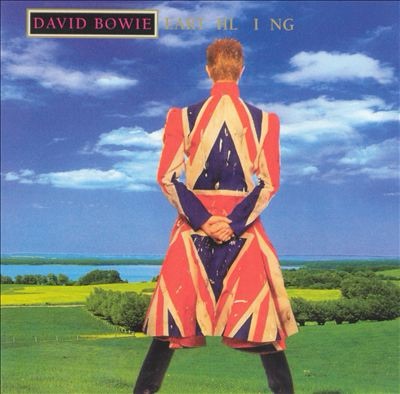
Earthling
Earthling (1997) This album passed me by. A fresh re-listen reveals a more layered and intricate approach to Bowie’s song-structure and soundscape. Yes, it’s challenging, but so has been a fair number of his efforts. Right off the bat, I like “Little Wonder” and “Looking for Satellites.”
Drum loops, funky electronic rhythms, synth programming and distorted guitars blast at you from the speakers. This could be the Berlin period on steroids. I can understand why it was a pass for me years ago. It requires patience and open-mindedness. “Seven Years in Tibet” is tricky, it’s both hypnotic and a visceral assault.
“Dead Man Walking” is catchy, funky, electronic. “I’m Afraid of Americans”, credited to Bowie/Eno, is pure industrial/techno.
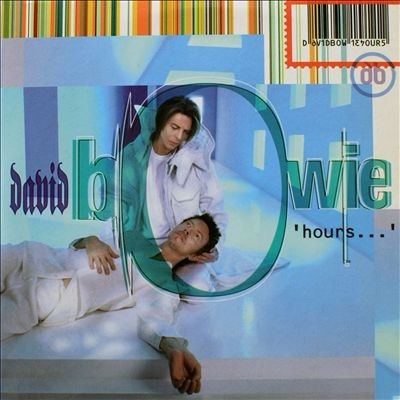
Hours
Hours (1999) “Thursday’s Child” leads off and it’s a somber, mid-tempo song. It’s quite nice, straight-ahead pop, as much of the album is. The pomp and experimentalism of the past is dialed down for this release. There is a lot of acoustic guitar strumming and synth strings, with some edgy fills thrown in, a bit like his early 1970s albums.
The reviews for Hours were mixed at best. No Bowie album is inconsequential, but this one is close, which is sad because the lyrics are personal and reflective.
“What’s Really Happening?” is interesting, a bit psychedelic, while “The Pretty Things Are Going to Hell” is more rocking. “Brilliant Adventure” could have been from Low, but the instrumental has more of an Asian sound instead of the low, Berlin grunge. “Dreamer”, the album closer is upbeat pop song, pleasant sounding, but Bowie-lite. The album is unfocused and not representative of his best work.
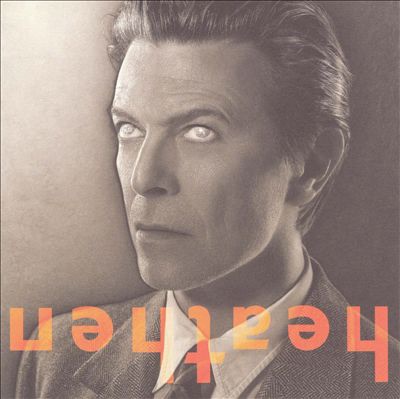
Heathen
Heathen (2002) Bowie reunites with producer Tony Visconti, and the results are what critics called a career resurgence for Bowie. The album includes three covers, including Neil Young’s “I’ve Been Waiting for You”.
“Slow Burn” is musically the best or one of the albums best songs. It’s a good balance of commercial and edgy. “I Would Be Your Slave” is quite good, the arrangement is velvety cool. I don’t know what that means, but it’s a Bowie-esque word combo. “Everyone Says ‘Hi’” is also one of the best tracks here, a jangly and upbeat song you want to hear repeatedly.
The album has a lot of quirky sounds and brings back the layering of instruments and soundscapes of earlier albums, probably why Bowie reached out to Visconti. Instead of futuristic, as Bowie often does, he sounds retro, returning to a successful approach. I almost said “formula” but this isn’t copying earlier albums as much as infusing a musical style that enhances these new songs and the covers. Overall, one of Bowie’s best later period albums.
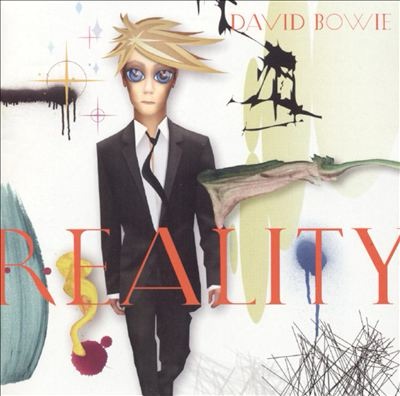
Reality
Reality (2004) A pleasing record, Bowie’s songs are quite mainstream, but not slick. Tony Visconti produces and Bowie uses his touring band of familiar names.
“New Killer Star” leads off and it’s refreshing, followed by Bowie’s rocking version of “Pablo Picasso”. “The Loneliest Guy” is a spacey ballad, very Robert Frippish. “Days” is a very melodic, bouncy ballad. “Dog Fall Bombs the Moon” has a nice melody, but a strange meaning. “Reality” rocks, while the last track, “Bring Me the Disco King” is a slow, meandering soliloquy on life in the 1970s.
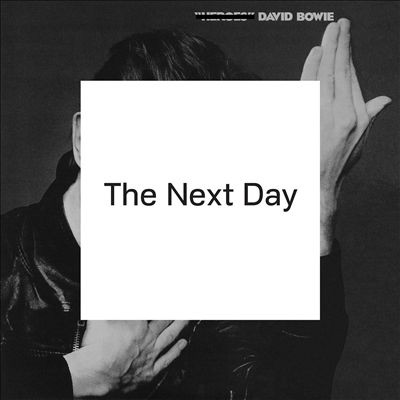
The Next Day
The Next Day (2013) After a ten year break, Bowie delivered The Next Day, not exactly groundbreaking, but very solid. With nothing to prove, Bowie showed that he hadn’t lost a step. Almost entirely written by Bowie, he recruited Visconti to co-produce and the usual suspects to back him in the studio.
“The Stars (Are Out Tonight)” is a killer, classic Bowie. “Love is Lost” is raw and pounding, tough and cutting. “Where Are We Now?” is a very reflective ballad about life; pretty, plaintive and hopeful. “Valentine’s Day” refers to a school shooting and speaks to the availability of guns. “I’d Rather Be High” is akin to his early 1970’s glam rock, with a repeating guitar line and trippy lyrics. “Dancing Out in Space” is not quite a rocker, but it sure does want to be. “(You Will) Set the World on Fire” takes a while to get going, but it does rock eventually. “You Feel So Lonely You Could Die” has some interesting vocal work, stacking his vocals and injecting his heart into this song.
The album overall is loud and noisy, but that noise is well-channeled into some tough statements. Bowie has always been as good as he wants to be. This album is not a classic, but has resilience and delivers more than it offers.

Blackstar
Blackstar (2016) The last studio album before Bowie died. Featuring longtime producer Tony Visconti, the album was recorded quietly and released days before Bowie’s passing. “Blackstar” was a successful and Grammy-winning song. Percussion-heavy, pounding bass and jazzy horns, it’s still fairly accessible, even by Bowie standards.
“Lazarus” is ghostly, hauntingly beautiful. “Dollar Days” is the most accessible and commercial song on the album. Reflective and moving, as is the final song, “I Can’t Give Everything Away”.
I would call this a decent coda on his career, a solid B. Better than some of his recent work, though lesser than his classic albums.

Toy
Toy (2021) Mostly songs from his mid to late 1960s recordings, re-recorded in 2000, and culled from the vault. “I Dig Everything” is a rocking song.
Lots of jangly guitars on his album. “You’ve Got a Habit of Leaving” is another rollicking, fun track. You can hear the bouncy 1960s vibe. “Shadow Man” is a nice ballad recorded during the Ziggy Stardust period. “Hole in the Ground” has a Neil Diamond vibe. “Can’t Help Thinking About Me” could have been a Who song. “Silly Boy Blue” has a big orchestral backing, and “Toy (Your Turn to Drive)” is pretty darn enjoyable.
The second disc of the Toy box set is composed of alternate mixes. The first track is “Liza Jane” was the first single by Bowie when he was with the King Bees in 1964. Written by Leslie Conn, it’s a rocker.
Observations
Bowie’s career had many branches and persona’s. Each phase of his long career had successes and rough patches, but Bowie’s rough patches were still more interesting than others’ successes. Bowie set the bar high, which proved challenging even for him.
Bowie pushed musical boundaries, and he continued until the end. It was his experimental work that seemed to influence more artists. Sound was like paint to Bowie, it could be mixed with other varieties of sound, manipulated, splashed on the soundscape in bizarre styles, and left ambiguous and open to debate.
As much as he enjoyed seeing beyond the genre horizon, he embraced drawing upon his musical past to inject it into his current work. He didn’t copy, he reimagined.
Even with “Fame” he enjoyed working under the radar. Often he required secrecy in recording his projects, and later in his career he suddenly pushed them out. In his personal life he strived for privacy, his death was a surprise, his battle with cancer was private.
Listening to these albums again was fun. The Bowie estate has released a number of boxed sets, covering different periods, with remixes, alternate versions, concerts, and working tracks to offer up a deep view of his stages of creativity.
My opinion of this late stage of Bowie music has undergone Ch-ch-ch-ch-changes.



 Ticket 2 Ride
Leave a comment