
True crime is a huge business, people are fascinated by whodunnits, whydunnits, and just really bad people who get caught.

The Texas Killing Fields stretches over 25 acres of land between Houston and Galveston, mainly along I-45. This area was marshy, remote and rarely traveled – perfect for killing and body disposal. Thirty-three bodies (more, depending on how you count), some never identified, have been discovered in this area. Only a few of the murders have been solved.
A book and docuseries are available, in addition to other sources to tell this true crime story, or rather stories, that began in 1971. So many young women, a handful of killers, at least 11 law enforcement jurisdictions, and many broken lives.
Kathryn Casey
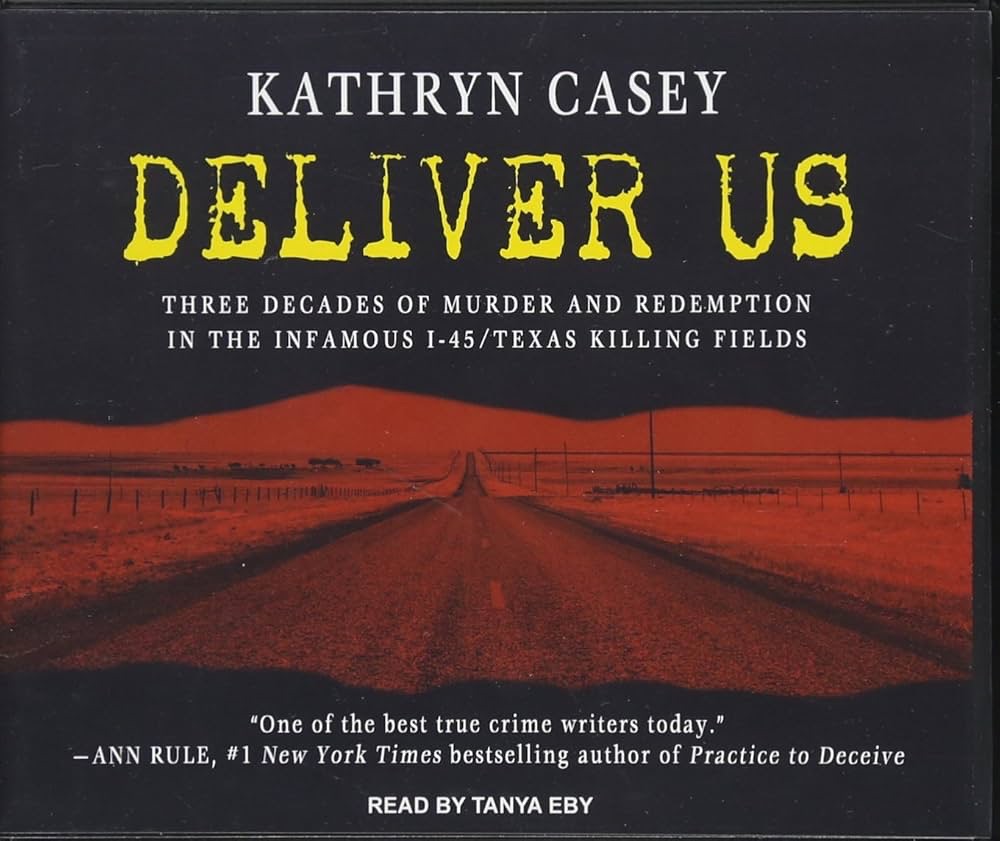
Casey’s Deliver Us: Three Decades of Murder and Redemption in the Infamous I-45/Texas Killing Fields (Harper, 2015) is spellbinding. I’m not a huge fan of reading true crime, I gravitate more to fiction, with more mystery than horror. The disappearances, murders and aftermath are horrific in and of themselves – it’s not easy reading, but Casey makes it readable without minimizing the facts. She writes about most, but not all of the missing girls and women, but admits that some cases are not included. Casey covers a tremendous amount of ground, so many victims and case specifics, I had a difficult time keeping these cases straight in my mind. One has a difficult time processing the amount of evil and pain associated with these cases.
The thing that resonates the most with me is how central the families of the victims are presented in these stories, their efforts to find their children, to keep the stories in the news and before the public, how much they helped other families dealing with loss, and the long journey to justice or putting their lives back together. There is not a lot of justice in these stories.

On Netflix is Crime Scene: The Texas Killing Fields (2022) is a highly rated three-part docuseries that focuses primarily on four murders. Casey is one of the interviewees, providing much of the context and investigative detail. When I started watching this series, I decided that I needed to read Casey’s book to gain a deeper history of the three decades of the area known as the Texas Killing Field.
Jessica Dimmock directs the docuseries, which profiles the four murders from the ‘80s and ‘90s timeframe. Dimmock does look back at the 11 disappearance cases took place in the 1970s. In addition, the docuseries updates some cases since Casey’s book was as published, bringing needed closure for some families.
“I think one of the things that struck me in so many of these cases, going back to the ‘70s and then up to the ‘90s, is that the families knew something was wrong and were told by the police in a lot of the cases that they were wrong,” Dimmock told FoxNews in an interview.
According to articles posted after this series first streamed in November 2022, social media blew up with outrage over the blunders, non-interest and lack of foresight by law enforcement in the investigation and handling of these missing women. Dismissing initial reports by parents and witnesses, lack of follow-up, lack of coordination with regional law enforcement departments and poor handling of evidence are among law enforcement stumbles. Sadly, in one case, a confession was coerced from an incident man, who would die in prison for crimes he did not commit. Now, that’s not to paint all law enforcement officials with the same brush, Casey’s book highlights the years-long efforts by several officials whose dedication and tenacity resulted in solved cases and convictions. Justice was slow, these were complicated cases, with perpetrators dodging detection or being convicted of lesser charges.
Many cases were unsolved and cold for years. Only in later years was DNA and other scientific procedures key in identifying victims as well as leading to prosecution of suspects. Sadly, evidence from the 1970s and 1980s cases was often missing and not always available for current testing. Witnesses die, the memory of those faded, making prosecution years later more difficult.
One of the cases profiled in the Netflix series was the disappearance of Laura Miller. Police dismissed her disappearance as a runaway, at first, despite protests of the parents. Laura was on medication for seizures, and she didn’t have her meds. Laura was not the first girl from the area to disappear. Laura’s parents didn’t know that waitress Heide Fye had also gone missing. Police had also dismissed that case, even though Heide had a young child at home. Heide’s decomposing body was found in Calder Road Field six months later. Five months after that, Laura disappeared. Police refused to consider the two cases related and instructed Tim Miller, Laura’s father, to stay away from Heide’s family. Then a third body was found not far from the Heide. Then a fourth body turned up also in the area.

One cannot read Deliver Us or watch the Netflix series without feeling sadness and anger. Was it ever safe to hitchhike or travel roads alone at night? Could you walk along a road by yourself and safely reach your destination? Not if you were a child or a woman. Predators were out looking for potential victims. In the 1970s, the decade of freedom, sunshine and pet rocks, also gave us the phrase serial killer, and exposed a sick, dangerous underbelly to America. The phrase “serial killer” was not yet a part of our vernacular.
To be fair, law enforcement was unprepared for this new phenomenon, and families of victims struggled in their pain with minimal support and understanding. There are many tragedies in the Killing Fields stories, especially the victimization of victims and their families by a society that did not know or understand how deeply lives were broken and the degree of their suffering.
Casey writes that while in the area, she noticed a young girl by herself, same age as as many of the Killing Fields victims, and watched her walk to a convenience store and use the pay phone. Only then did Casey realize it was the same phone used by two different victims immediately before they disappeared. Seized by fear, Casey then saw the girl get into a car, but this time it was not a strange man, but a woman that appeared familiar to the girl.

In an instant, lives can be forever changed, futures snuffed out, and just how vulnerable we are, especially those who are in the crosshairs of predators.
I certainly do recommend both the book and series, for their quality and storytelling, and also for the resilience of those left behind to fight for justice and carry on.




 Ticket 2 Ride
Leave a comment