
I’ve been waiting for this one. I admire Connie Chung, she’s a fighter, and has quite a story to tell. Connie, A Memoir (2024, Hachette Book Group) is a straightforward and brutally honest look at her life. Although she dishes on her work relationships, and husband Maury Povich, the book is like her approach to news: facts and little sensationalism. The facts are interesting enough.

Chung’s family fled China during the Second World War, her Chinese family forced to assimilate into a foreign culture in America, at a time racism was still very overt, and Chung grew up a Chinese young woman in a male dominated culture – so there is a lot to be gleaned from her (and her family’s) journey. Imagine the differences between her parents’ traditional upbringing and arranged marriage, and the burgeoning changes of America’s postwar culture that began to cater to youth, beauty and a very White, Christian, upwardly mobile family unit.
This is also a story of the television news business and of the how women and people of color broke through the systematic racism and sexism in the good old boy journalism profession.
“Maybe someone can figure out if being the only Asian reporter was a help or a hindrance,” Chung writes. “I still don’t know. There was no doubt that the racism I experienced was as reprehensible as the sexism.”
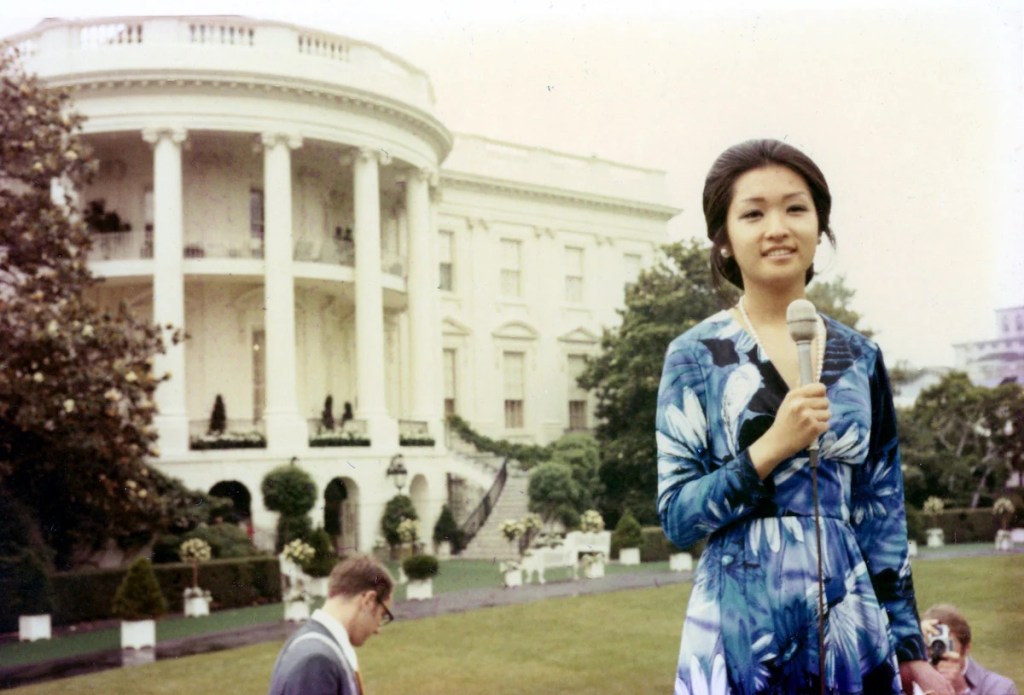
As Chung writes, many men had either of two thought about her: fuck her or fuck her over. Many men came onto her, as one would expect, and usually her blunt comments would back them off. Awkwardly, some were blatant in their moves, like Senator George McGovern who suddenly tried to kiss her, while she covered his presidential campaign.
“Those who called me ‘dragon lady’ or said to me, ‘You slant the news’ or called my reporting ‘yellow journalism’ thought they were so clever.”
Chung was the only American-born member of her immediate family. There was a constant push-pull of her traditional Chinese culture with the American culture she was trying to succeed in, as a young, Asian woman. Her stories reflect the limits others tried to put on her, particularly by men in her profession.

“My approach to these derogatory remarks was the only way I could handle them at the time,” Chung writes. “It was tiresome and insulting, but I lived with it. If I’d obsessed about the issue, I could not have done my job.”
Chung arrived after Nancy Dickerson, Barbara Walters, Helen Thomas, and not many others. Men ruled the news. Even when women joined the team, men still dictated who spoke first and last, asked the questions, got the best assignments and got top-billing. Her stories about the news business and the differences between how men and women were treated are engrossing and jaw-dropping at times. For a historic presidential trip to China, Chung, as the only Chinese-speaking member of the network new division, was not selected to go.
“Yet it was common for viewers to scrutinize a woman’s appearance on the air, while men were allowed to be bald, fat, and ugly!”

The comments were not just by men, women could be harsher critics of each other. Chung arrived when networks began using consultants and focus groups to guide programming and personnel decisions. Hard news was softened in favor of “happy talk,” particularly at affiliates.
“For me, every day was a test. My being a woman was a bigger challenge than my race.…Everywhere I looked, there were men. Since I wanted to fit in, I became one of them. In my mind, I could walk like them, talk like them, and be as tough as they. Why should I perceive myself differently?”
Chung cursed and drank, and fired off comments to shock her co-workers. And she stood up for herself.
Other female journalists would be supportive, but there weren’t yet many, and they had their own battles. As more women joined the team, things didn’t always get better.
Over time, Leslie Stahl, Jane Pauley, Diane Sawyer, Sylvia Chase, Judy Woodruff, Lynn Sherr, Andrea Mitchell and others were hired, to compete for opportunities, often against each other. Chung writes that when men vied against each other for stories or jobs, it was viewed as a competition, when women were up against each other, it was referred to as a cat fight.
“We were doled out only a small sliver of the male-dominated pie. We had to share that small piece, creating unnecessary competition and infighting for the same morsel. It fostered a climate in which women were apt to fail to support one another.”
There was both support and knife-wielding at the same time. Chung had both a close and cautious relationship with Barbara Walters. At ABC, Chung competed with both Walters and Diane Sawyer for stories, and was often told that stories or interviews belonged to Walters.
The choicest stories are reserved for Dan Rather, who she “shared” the Evening News with at CBS. You’ll have to read those for yourself, but it’s no wonder that experiment did not work.
Chung’s career, put into perspective, is quite remarkable. Regardless of the battles won and lost, she had this to say: “With the benefit of years behind me, I can safely say I moved the needle a bit for women.”
Indeed she did, and perhaps even more so for Asian women. Journalist Connie Wang discovered a very interesting story, which applied to herself.
“She (Wang) had uncovered a generation of Connies—untold numbers of Asian females whose parents had named their baby daughters Connie, after me— a sisterhood of Connies I’d had no idea existed. I gasped at the thought. A living legacy.”

Chung realized what it meant for the Connies, but more what is said about the dream of their parents. “‘What it means is your parents want you to work hard and be brave and take chances.’ That’s when I lost it and could not stop crying.”
Connie is worth the read.




 Ticket 2 Ride
Leave a comment