

Searching for something to read, this book caught my eye. Joni Mitchell is always a grand book subject, whether it is her life, music, art, or some combination, each writer provides a different glimpse of her mystique.
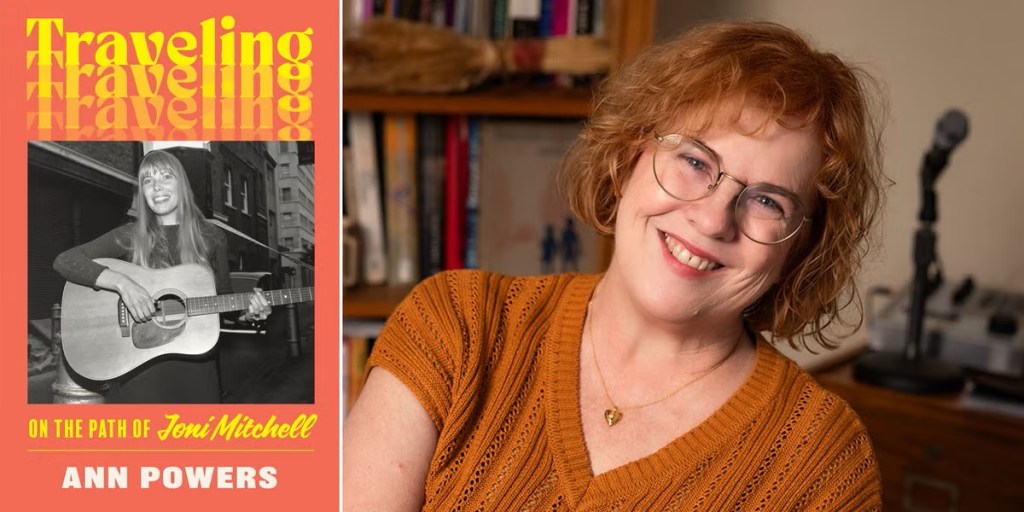
Ann Powers makes it very clear, Traveling: On the Path of Joni Mitchell (2024, HarperCollins) is not your typical biography, especially of a very atypical artist. Traveling is a look into Mitchell’s journey, the influences, the men, the music, and societal influences along the way.
“But I wanted to think of the life of Joni as an icon, as a cultural influencer – and as one who was influenced by a culture,” Powers told The Globe and Mail. “Not that all those things couldn’t happen in a conventional biographical form, but I found that interweaving cultural criticism with some memoir allowed for a fuller picture.”
Traveling includes many side journeys, which are used to provide deeper context to the musical and cultural influences in which Mitchell navigates. Admittedly, I skimmed some of these, for whatever reasons, for me, these journey turnabouts, as culturally significant as they might be, distracted me from the narrative.
Powers is also clear that she did not interview Mitchell; she did intend to reach out, but later changed her mind. “The power of her allure can be a little overwhelming to writers I think. It’s important to make space for an artist’s own account of their work and their lives.” Powers did interview some of the main players in Mitchell’s life, and dug back into the archives for some of her material.
Mitchell’s love life is a big chunk of her story and how these men contributed to, or influenced, her life and her art. On one hand, the parade of lovers gets a bit soggy, but each played a role in her musical journey. It’s not clear why she bounced from relationship to relationship. One might ask, why is that important to know? Her music reverberated her life, and her loves are all over her songs. Mitchell’s life and her music are indelibly linked.
One thing is clear, Joni Mitchell made it cool for girls to write songs and play the guitar. However, it was predominantly a man’s world, in love and in business. Mitchell befriended many men, and some were influential in her career, but very quickly, she took the helm and produced her own albums. There was great strength in her music and the creativity of her sound. Success and influence gain you power in the music business. For as long as your music sells.
“Male rockers incorporated tales of madness into their lexicon of questing heroes, from Elton John’s ‘Madman Across the Water’ to Pink Floyd’s ‘Brain Damage,’ Powers writes. “Women rarely explored the subject in the same way, and the exceptions were marketed as pop novelties.”
Powers has a lengthy resume as a music writer and critic, she digs deep into Mitchell’s songs, including how she incorporated different genres, and new, contemporary technologies. Joni Mitchell working with Thomas Dolby? Strange musical bedfellows indeed.
Powers’ writing style has a quirkiness that blends well with the subject matter. She has a great command of off-beat descriptiveness that is fresh and quite interesting, yet doesn’t call attention to itself as trying to impress the reader. Powers is just a good writer.
“Women bleed,” Powers writes. “Men forge through. But in fact, art of this caliber is always made through both the cut and the suture.”
For me, one of the book’s strengths is the journey from Mitchell’s folk-based confessionals to a jazz-fusion period, then the experimental years of sound loops, synth programming and then back to her simplified sound. Mitchell, much like fellow Canadian Neil Young, chose to divert from commercial success into more challenging, but less popular, musical genres and experimentation. Both would return to more conventional approaches as new generations of listeners discovered their legacies and musical expressionism.
I found this remark by Powers quite revealing, and it fits with her injections of 1970s feminism:
“Mitchell’s music demands the integration of sadness into a free woman’s range of emotions, in defiance of go-getterism. It reminds women that liberation is very difficult to fully achieve, both within society and internally. But Don’t interrupt the sorrow!”
If you want a different take of Joni Mitchell, this a good read, and Powers’ style is refreshing and makes the journey an intriguing one
4/5


 Ticket 2 Ride
Leave a comment