
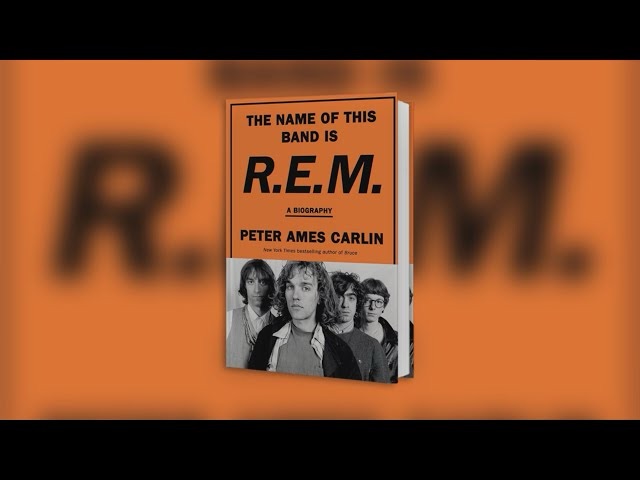
R.E.M. was one of the most successful bands, an indie-rock band before there was such a thing. A new book by music biographer Peter Ames Carlin captures the essence of the band, its uniqueness and why it connected with people.

Carlin has written books about Bruce Springsteen, Brian Wilson and The Beach Boys, and the story of Warner Bros. Records. This book is well-researched and offers great detail and insight into the band’s evolution and music. While there are extensive interviews with those who knew and worked with the band, there are no interviews with members of the band, who declined interviews, but were helpful in other ways.
In the early 1980s, the emerging rock sounds were primarily British synth-pop, and the stripped-down, pop-punk rock. R.E.M. was in the latter group, the edgy, folk flavored, jangly guitar rock, reminiscent of mid-1960s rock. R.E.M’s sound was as distinctive as The Police, U2, the Pretenders or XTC. When you heard R.EM., you instantly knew who it was.
Carlin lays out the band’s slow, but incremental success, less focused on self-promotion or bending to the whims of their record company or MTV. Early on, when they signed their recording deal with I.R.S. Records, they took less upfront money in order to maintain creative control over their work.

After five albums with I.R.S. Records, R.E.M. was a free agent, signing a huge contract with Warner Bros. Records. The band went from modest album sales at the beginning of the 80s to millions of albums with each new release into the 1990s. Carlin does a great job of tracing the band’s evolution from formation in 1980, to arguably one of the top rock bands by the end of the decade. Signing with Warner Bros. was validation for their hard work and increasing success, but it also raised the stakes, and expectations going forward.
R.E.M. benefited from the creative freedom they sought, and their labels’ support, and not repeating themselves, by experimenting with different instruments, textures and sounds. U2 was another band that underwent a similar evolution in the 1980s and grew their audience with each album.
R.E.M., like U2, managed to avoid serious drug and alcohol issues, and was free from in internal discord. R.E.M. intentionally set up their ownership, publishing and earnings to be shared equally.
Carlin describes the growth and professionalization of the business end of the band, from traveling with their equipment in a van, and mixing with fans following concerts, to luxury travel, detailed food and beverage requirements, and highly organized security operations. Those things are pretty standard now, but not so much then. For a band that really just wanted to write and play music, the complications that come with success are difficult to avoid.
In the mid 1990s, success began to plateau and life threw challenges at them. Despite big tours and album sales, cracks within the band began to occur. The cohesiveness and synergy now spun in other directions. The album Monster was exactly that; huge sales and reception, followed by their first tour in a few years, but 1995 would be a year of peaks and valleys. On tour in Switzerland, drummer Bill Berry suffered bleeding in his brain that nearly killed him. The band would never be the same again.
R.E.M. and their manager parted ways, the result of a messy, internal situation. Their recording contract with Warner Bros. was ending, which started a long negotiations process that would see the band stay, after Warner dug deep in their pockets.
Then Berry left; his desire to continue the grind was gone. R.E.M. would soldier on as a trio, with help from trusted sidemen. Eventually, the band broke up, vowing to never reform, and thus far, they haven’t.
R.E.M. was always a contradiction to me. An idealistic, media averse, art-folk-rock band, who were uncomfortable being rockstars, but who learned to enjoy the money, artistic freedom, and perks that came with success. Carlin’s book underscores the difficulties R.E.M. eventually had as a result of being hugely successful. Despite the solid band relationships and careful business planning, the band succumbed to inevitable stresses of lengthy partnerships.
I enjoyed the book, it took me inside the band’s dynamics and internal management, an area I had limited knowledge. Would the casual fan enjoy the book? If they selectively read the book, perhaps. It’s pretty deep, even for consummate followers.



 Ticket 2 Ride
Leave a comment