

There’s only one Shemp. That name is forever linked to The Three Stooges. Baby Boomers know the Stooges, but these guys don’t just live in a piece of amber like a prehistoric Fred Flintstone. The Three Stooges’ short films and feature films are available for viewing, and digital likenesses adorn a variety of products via their website. Fifty years after the death of the last Stooge, they still live on.
Shemp was born Schemuel Horwitz in 1895 and his name eventually became Sam, or Shem as his Lithuanian mother pronounced it, then Shemp. Horowitz became Howard.
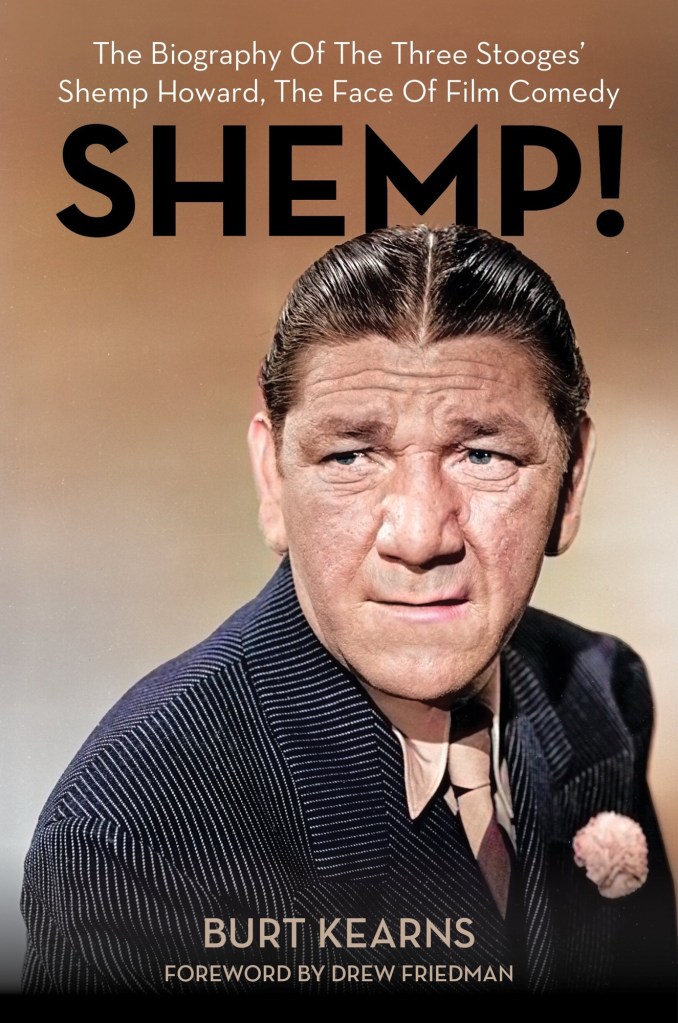
Shemp! The Biography of The Three Stooges’ Shemp Howard, The Face of Film Comedy, by Burt Kearns, is a 2024 book devoted to Shemp and is a great history of The Three Stooges.
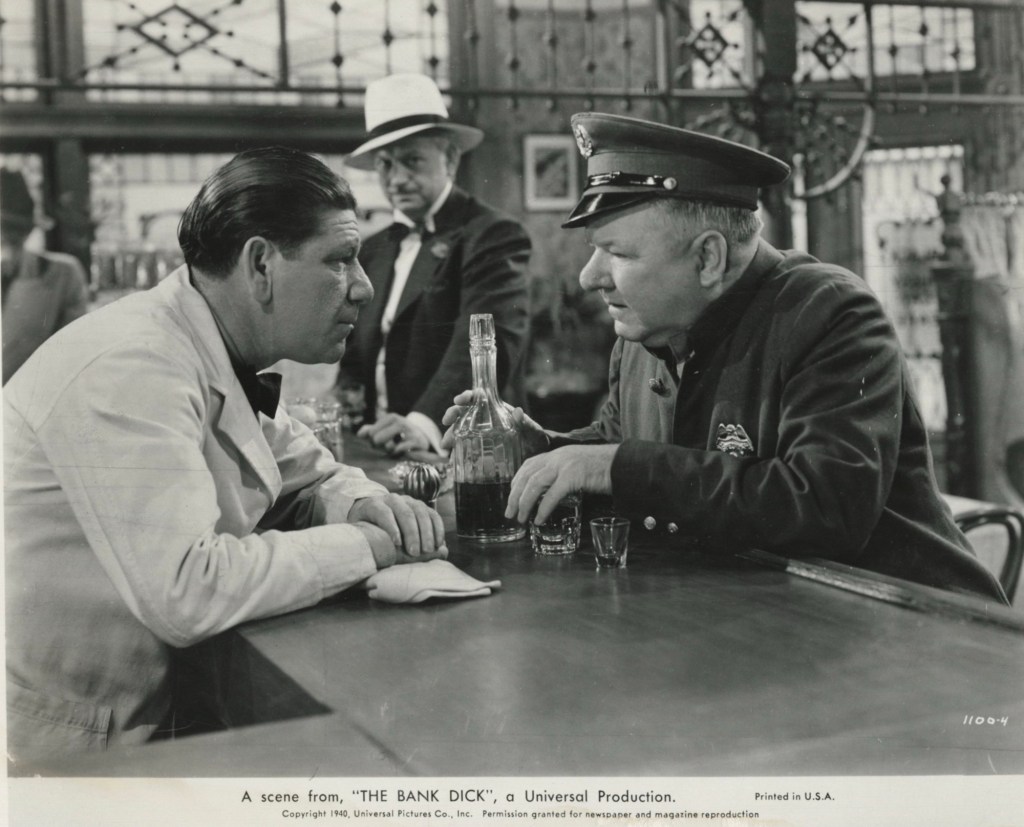
“The Face of Comedy” is an odd subtitle, Shemp is known as much for his worn, unhandsome mug as he is for his show business antics. One year he was selected as “The Ugliest Man in Hollywood”, according to Kearns was something Shemp embraced. As a working actor, hired for supporting roles, this was publicity. His ruddy, well-traveled features actually allowed him to play a lot of characters and types, he was just going to be the handsome leading man.
Shemp was born the third of five sons; he was older than Moe and Jerome (Curly). Not everyone knows that these guys were brothers, or that Shemp preceded and succeeded Curly in the Stooges. It was Moe, Shemp and Larry Fine in the original group, who worked with Ted Healy in vaudeville starting in 1922. Healy was the star, and he dealt the slaps and other physical comedy to the others. Shemp left in 1932 for a film career, to be replaced by Curly. It was Moe, Larry and Curly that broke away from Healy and became the Three Stooges, and performed in well over 100 short films.
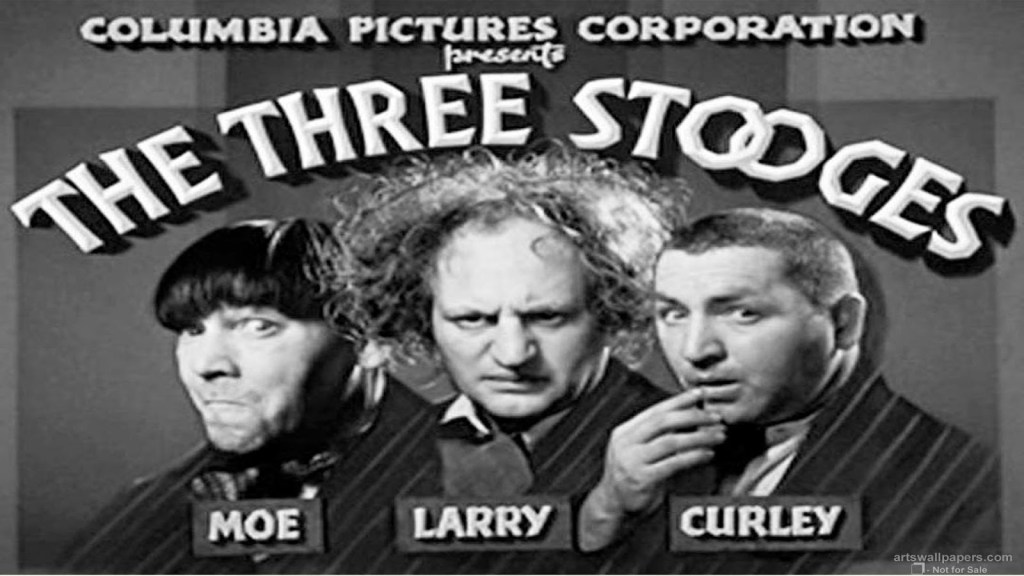
Curly befell a series of debilitating strokes that sidelined him in 1945. Shemp agreed to fill in for Curly “temporarily”, but Curly’s health only worsened. Shemp carried on as the third Stooge until his sudden death in 1955.

What’s interesting is how getting to the facts of the Stooges’ lives is rather complicated. There are lots of film and show records, but the human facts are somewhat conflicting. Moe and Larry each wrote their memoirs at the end of their lives. According to other experts and biographers, many dates, events and remembrances are just different enough to make you wonder what the truth is.
For example, the deaths of Curly and Shemp. According to Kearns, complete autopsies were not done, although causes of death were noted. Strokes and brain bleeding were noted with Curly, but Shemp had a massive heart attack. Larry Fine also died after suffering strokes. The Stooges were all about blows to the face and head, in the hundreds of films, vaudeville shows and appearances, how many thousands of blows to the head did these guys suffer?
Moe’s role, in addition to booking the tours and functioning as manager, he delivered most of the blows, taking much fewer in return. Kearns often quotes Moe as proudly saying, “I took Ted Healy’s role.” Moe wasn’t dumb, he stepped in to be the boss. And the contract the others signed with him gave Moe the rights to The Three Stooges’ name.
Another aspect of Moe is brought out by Kearns was how Moe kept the boys working, continuously. When they weren’t on the Columbia movie lot, they were traipsing all over North America. It sounded physically exhausting, and by the 1950s, these were technically senior citizens, performing acts like 30 years before in vaudeville. It’s sad how Curly’s body broke down; he was overweight, had a bad heart, high blood pressure, hypertension, suffered a number of suspected mini strokes, and couldn’t perform the demanding Stooge routines, although he tried. His health rapidly declined in his last years.
According to the book, Shemp’s family refused to believe he was brought down by a heart attack; they were sure it was from the constant blows to the head that weakened blood vessels and caused a cerebral hemorrhage.
Shemp had a steady film career and had actually accepted a contract with Columbia Pictures, the home of The Three Stooges, as Curly’s film career drastically declined. Shemp was not a young man when he agreed to the temporary arrangement, but did Moe and Columbia executives arrange Shemp’s return? Did Moe set up his own brother? Kearns’ book raises the question, and frankly, Moe is painted as a manipulative and sometimes cruel man to his brothers. Just a few hours after Curly’s funeral, Moe and company were back before the cameras.
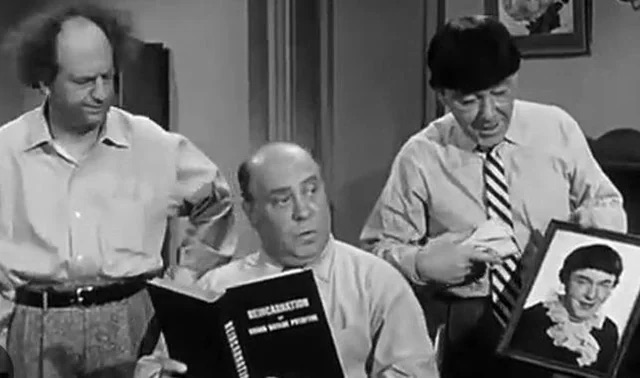
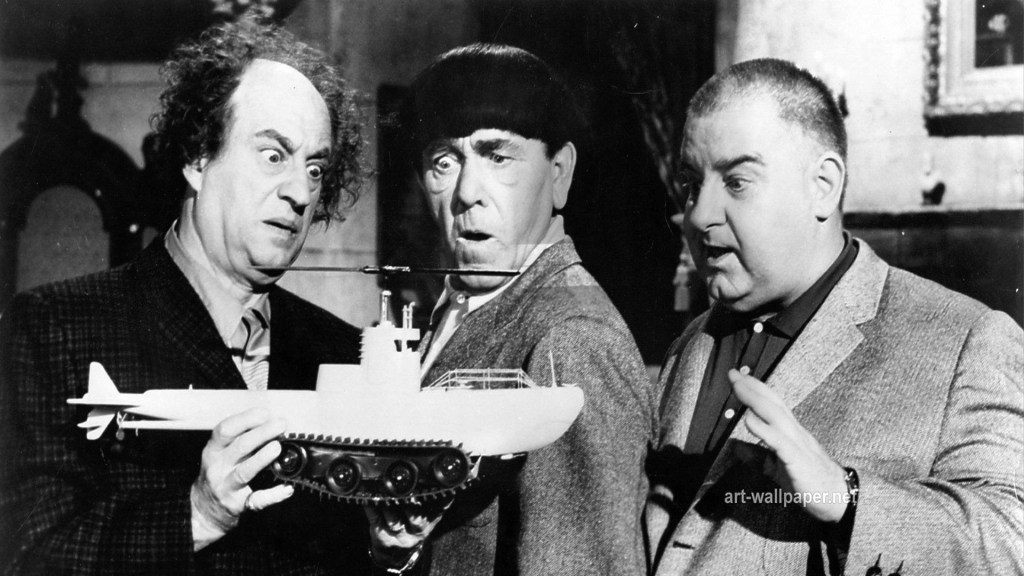
After Shemp passed, Moe recruited Joe Besser as the third Stooge. Besser was a comic and played had played clubs and theaters across the country, then joined Columbia Pictures making short films and working his way into features. He joined the Stooges from 1956-1958, and moved into more visible roles on television. Next up was “Curly” Joe DeRita, also a burlesque comic, and for a while, also made short films for Columbia. DeRita joined in 1958 and stayed a member of the group until it folded in 1970, after Fine’s stroke left him partially paralyzed.
Moe and Columbia had a few more short films to make immediately following Shemp’s passing, so they dressed up actor Joe Palma to look like Shemp from behind and in quick transition shots. Longtime Stooge director Jules White also combined footage from old Stooge films to complete the needed “Shemp” films, rather than recast or fess up to the “fake Shemp,” a term coined by director Sam Raimi, about a practice that predated Shemp, but gained notoriety with the Stooges.
Shemp might be the least popular of the Howard brother Stooges, maybe the least popular of all Stooges. Unfairly demeaned because of his ruddy complexion and baggy eyes, what he might have lacked in good looks, he made up with hard-work, good humor and family loyalty. Shemp was married to the same woman and didn’t have a reputation for carousing on the road or being arrested on morals charges. Going to the fights or placing the occasional wager seemed the extent of his vices. Shemp appeared in nearly 200 roles listed on IMDb.com, the majority of those non-Stooge roles. Being a Stooge got him into films initially, but I don’t believe returning to the group helped his later career. Why would any producer cast him? Shemp doesn’t get the respect he deserves, Kearn’s book clearly establishes that point.
—
I wrote a blog about the Stooges, discussing their validity in today’s world. Do the Stooges Still Matter





 Ticket 2 Ride
Leave a comment