
I wanted to include The Chairman in my recent list of political films, but was unable to find a copy in time. I’ve now seen the film.
The Chairman (1969) was based on a novel by Jay Richard Kennedy, adapted by Ben Maddow. Directed by J. Lee Thompson, who helmed The Guns of Naverone, Cape Fear, Mackenna’s Gold, before his career turned downward and he made Planet of the Apes sequels, and a number of Charles Bronson films of decreasing quality. Gregory Peck made three films with Thompson.

Gregory Peck is scientist John Hathaway, who is enlisted by U.S. military intelligence to use his work as a Nobel Prize scientist to get into Red China to steal a new food formula. Sounds easy, peasy.
The Chairman was a high-concept idea, certainly battling Communism was a worthy premise during the Cold War, but usually it was the Soviet Union, not China, that populated our espionage films. Stealing a scientific process, designed to feed their masses, is much different than weapons of mass destruction, invading a democratic country or some devious plot to destroy Western Civilization. American objectives in Asia have always been a bit murky, made even more so by enlisting the help of the Soviet Union in the caper. Despite the weaknesses in the script, this film had the makings of a smart, contemporary political thriller.
Twentieth Century-Fox financed this film from Arthur P. Jacobs, who also produced the original Planet of the Apes. The production cost of The Chairman was upwards of five million dollars, not counting marketing and distribution costs, and on first release, the film barely made back its negative cost, but was not considered a success.
The Chairman refers to Communist Chairman Mao who is portrayed in the film as meeting with Hathaway, playing a little ping pong, and ultimately approving the American’s visit, and ensuring his safe departure. Wow, we know that Greg Peck had star power, but Mao was a pushover.
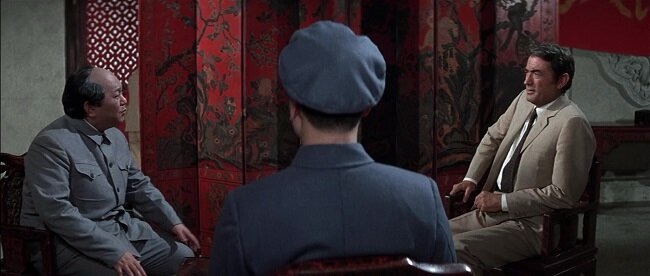
The Chairman doesn’t quite know what it wants to be: part James Bond, part Albert Schweitzer, part propaganda lesson. Hathaway is some kind of botanical expert, but he’s also a former colleague of the Chinese scientist who invented the formula. That makes Hathaway the perfect espionage agent.
The important formula is for an enzyme that applied to plants, can grow food anywhere, regardless of the climate or altitude. Apparently, in the late 1960s, China was facing food shortages for its growing population, and made the communist country it a global threat.
This is a strange case of cooperation between the Soviet Union and America, each who have an interest in keeping China from monopolizing food production. Soviet intelligence is helping the American military to get a sample of the enzyme, and whatever else might be needed. Hathaway’s scientific knowledge could help China to mass produce the enzyme, so his value to the Chinese makes his detainment a real possibility. Thankfully, Hathaway has that “get out of the country safe” note in his suit pocket.
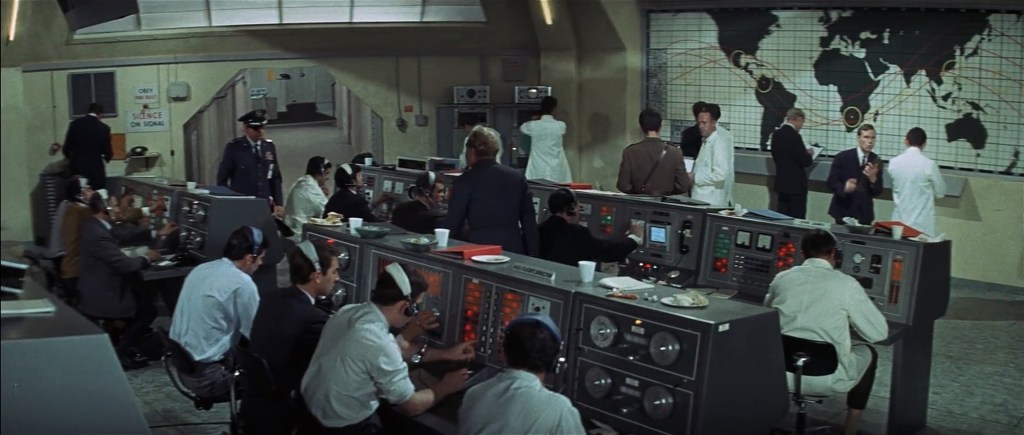
To make this a real spy film, the military has implanted a small microphone, the size of a button, behind Hathaway‘s ear. A satellite overhead will receive audio from Hathaway, in addition to his position and medical information. He isn’t told that the microphone is also encased in an explosive shell in the event that Hathaway is captured and tortured. Activated would kill Hathaway and anyone close to him. Later, when Hathaway visits Mao, U.S. officials discuss the opportunity to assassinate Mao, but decided against it.
In Hong Kong, where Hathaway first meets the Chinese representatives, Hathaway is offered drink, gambling and any woman in the restaurant/gambling establishment. He declines, but is knocked unconscious so his things can be searched. The foreign version of the film contains brief nudity, something excised from the American release. American audiences needed protection from communism and female nudity.

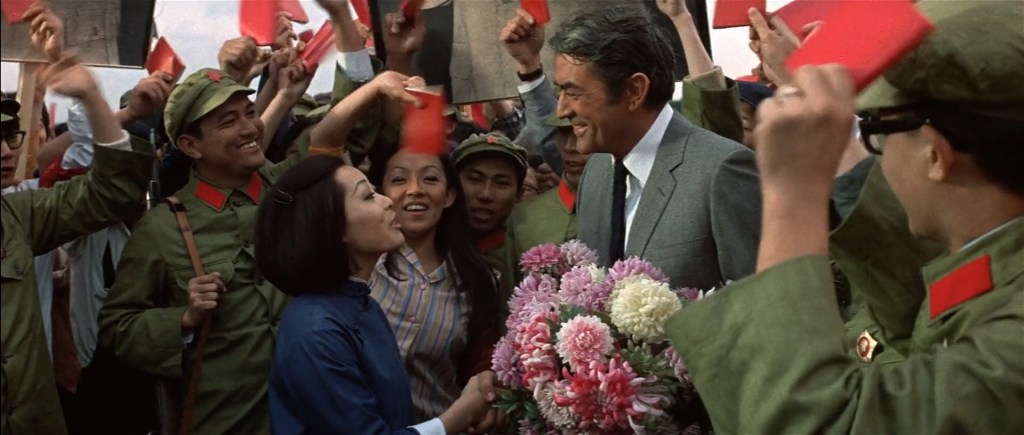
Arriving in China, Hathaway is met by cheering crowds and shown examples of a modern society with enthusiastic daily teachings by Chairman Mao to the workers.
To summarize the last half of the film, Hathaway tries to steal the formula but his effort fails. His Chinese hosts suspect he’s get a radio transmitter and just miss capturing him before a firefight that leaves his Chinese contact dead, and Hathaway escaping towards the Chinese-Soviet border. The Chinese military close in after Hathaway is injured in a vehicle wreck. As he tries to get under an electrified border fence, Soviet troops arrive, just the cavalry in Westerns, at the last moment, to get him safely across into Russia. The Soviets did come through, and some of you were doubting their word.
Because Hathaway was about to be captured by the Chinese, his American military handlers were about to set off the explosive in his head. The movie should have ended there, but it continued with some talky, anticlimactic scenes that only slowed the film to a halt. Too much talk.
Instead of a heavyweight international thriller, this looks more like an episode of Mission Impossible, with a bit more violence and a dash of nudity thrown in.
The Chairman is an interesting film from another time.





 Ticket 2 Ride
Leave a comment