
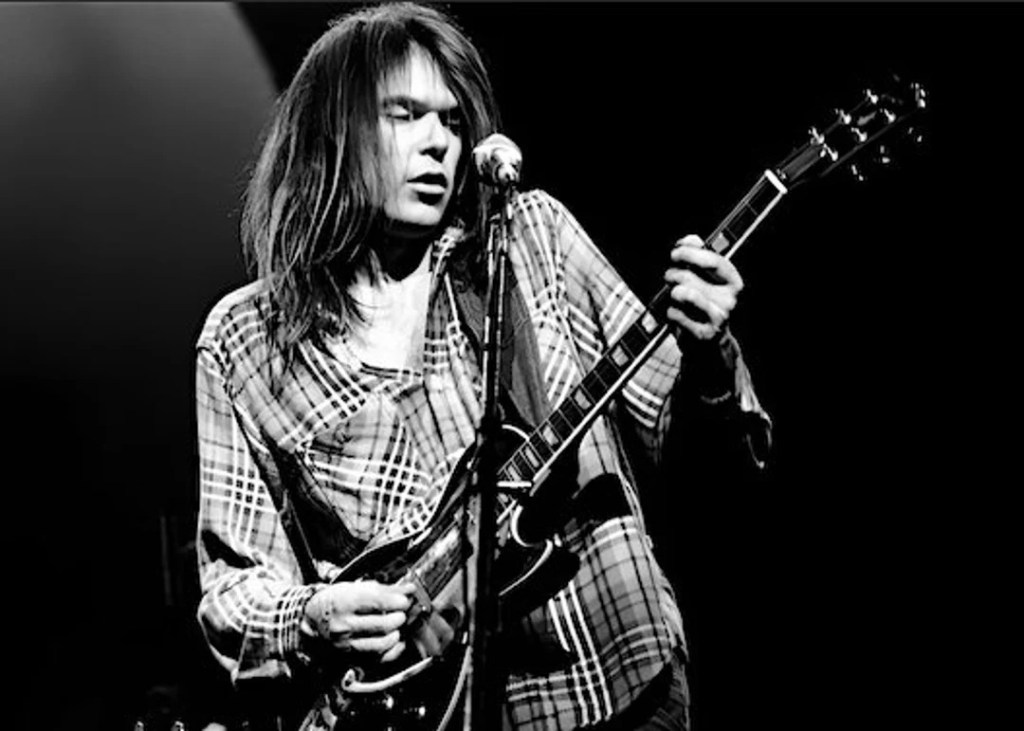
I wanted two lists, because Neil Young has such a wide musical soundscape of songs in his long career. On this list are the heavier, electric Neil Young songs, sometimes grungy and distorted, other times just uptempo. Of course, there are a few songs that don’t fit cleanly on either list, that’s the challenge we must contend with in a modern world.
I revisited all of Young’s studio albums, almost all of his live albums, and a few compilations: almost 60 albums. This was not a simple task. I looked at live and alternate versions and some demos. I didn’t always pick the most familiar version of a song, finding something more interesting or intimate in a different version.
Young often used Crazy Horse to back him on albums and on tour, but he played with many configurations of musicians. His sound changed as well as he moved from rock to country to synth to rockabilly to grunge to jazz, and many stops in between. His rockers could blistering fast, or slow and bluesy, clean or dirty, four minutes or nearly 20, overdubbed or live.
Here are my favorites, in no particular order. I’m not sure how many there are, but let’s go…
“L. A.” – Time Fades Away (1973). Written about the city, performed live, but no studio version exists (that I’m aware).
“Fountainbleu” – The Stills/Young Band (1977). A song long from play lists and set lists. This is a blistering rocker. A remnant of a failed reunion with Stills.
“This Note’s For You” – This Note’s For You (1988). Famous for being banned by MTV, but a grand message about sponsorship and rock and roll. Young was in his funky blues period, complete with horns. Great song.
“Got it Made” – American Dream (1988). Co-written with Stills, it’s an uptempo rocker, smooth and polished. The best song on the album.
“Cortez the Killer” – Zuma. (1975). Young is drawn to slow, grueling, bluesy songs. From early on, he was lifting the veil on historical imagery and exposing the truth of our sins.
“The Loner” – Neil Young. From his debut solo album. While it might have been a career misstep, the songs and arrangements are quite interesting and unique for his catalogue. His audience was expecting what he delivered in his next album. “The Loner” was really a fine song, but seemed to get lost as he moved through the late 1960s in search of his voice. The entire album is worth a listen.
“Like a Hurricane” – American Stars ‘N’ Bars An album of disjointed styles. This song is a classic, one of his best.
“Southern Man” – After the Gold Rush (1970). An angry song, certainly with references to slavery and segregation. Young said the anger also came from a rough patch with his first wife.
“Alabama” – Harvest (1972). Dismissed as a copy of “Southern Man” and the subject of “Sweet Home Alabama”, there’s a lack of love for this song. Despite that, I like the grit and toughness of this song.
“Powderfinger”- Rust Never Sleeps (1979). One of his best songs, period. It’s a story song, and a good one. He locks into a rolling, mid tempo groove that propels this song forward. A classic.
“Rockin’ in the Free World” – Freedom (1989). This song is blistering hot. The guitar work is just incredible.
“Ohio” – released as a single, 1970. A response to the National Guard shooting of students at Kent State University. It’s still a powerful statement.
“Words” – Harvest (1972). A powerful way to end the album, this song soars, and it doesn’t depend on loud, distorted guitars to do it. The song and long fade-out is smartly arranged.
“Mansion on the Hill” – Ragged Glory (1990). The song rocks, nothing too complicated about that. The lyrics recall days of Billie’s past.
“Down By the River” – Everybody Knows This Is Nowhere (1970). Neil airs it out. Not a false note anywhere in this elongated rocker. It’s rough, but very clean and tight.
“Everybody Knows This Is Nowhere” – Everybody Knows This Is Nowhere (1970). Very basic rocker, the sound Young was searching for, he found with Crazy Horse as a backing band. Very melodic song.
“Don’t Cry No Tears” – Zuma (1975). A mid tempo rocker, clean guitar sound. Nice sound, very melodic. Totally overlooked song.
“Weight of the World” – Landing on Water (1986). Young’s attempt at a very contemporary, commercial sound with big 80s drum sound, lots of echo and use of synclavier, a new digital sampling computer. Underneath all the synthetic sounds is a very nice song.
“Big Time” – Broken Arrow (1996). It’s grungy, but not sludgy. Upbeat, a nice groove and the guitar work has a freshness to it.
“What Did You Do to My Life” – Neil Young (1968). A rocking, acoustic and electric song. Beautifully produced, just like the rest of the album. Love the guitar work.
“When You Dance I Can Really Love” – After the Gold Rush (1970). An out and out rocker that has clean piano balancing the fast-moving electric guitars. Nice harmonies on the choruses.
“On the Beach” – On the Beach (1974). This is a slow, bluesy song, almost a dirge. The album, long underrated, has a bit of a renewed appreciation.
“Lookin’ For a Love” – Zuma (1975). A rolling, rocker, it just carries you along. A country rocker? Maybe. It’s upbeat and you can move to it.
“Crime in the City” – Freedom (1989). The realities of life on the street, it looks like a losing battle. A great concert song, just airing it out, letting it rock. It does.
“No More” – Freedom (1989). The damage and senselessness of addiction. He’s seen it first hand. The song is harsh, like the reality.
“Change Your Mind” – Sleeps With Angels (1994). Mid tempo rocker, nice chord progressions and chorus vocals.
“Psychedelic Pill” – Psychedelic Pill (2012). This album, spilling over onto 2-CDs is rather bloated. With numerous long tracks, the title song is just over three minutes. I like the guitar work on this track, the sonic texture and the tempo.
“Computer Cowboy” – Trans (1983). I never embraced this album, it just sounded to different. The pulsating, electronic synths were too jarring, but Neil was onto something. As is his nature, the next album he was onto something else. Trans is worth revisiting.
“Mr. Soul” – Buffalo Springfield Again (1967). There have been many versions recorded of this song, but I’ll stick to the original released by Buffalo Springfield.
“Country Girl” – Déjà Vu (1970). Young recorded the song for the CSN&Y album, mainly working on it separately from the others. Built from three song sections, Young would later say that it was overblown. He overdubbed a lot of sound onto the track. Not a great song, but ambitious and easy to enjoy.





 Ticket 2 Ride
Leave a comment