
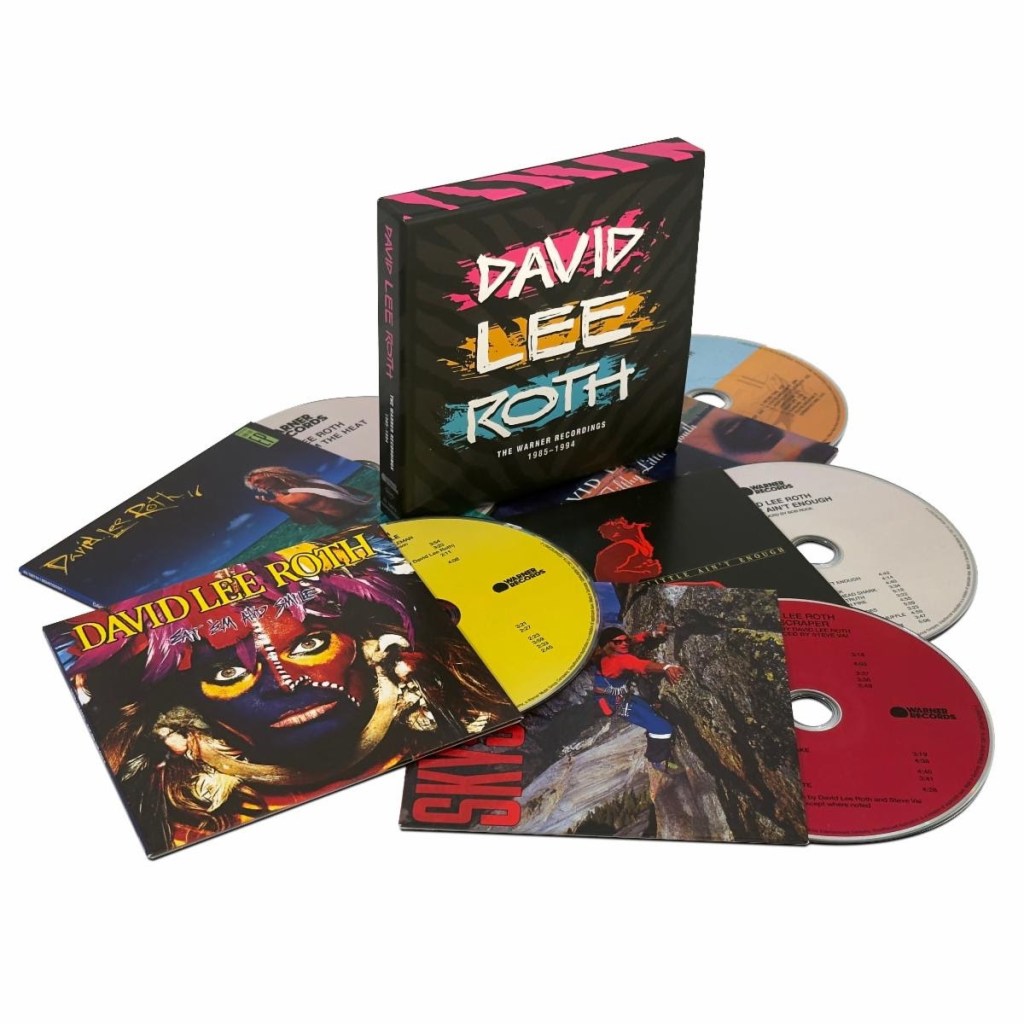
Remember when David Lee Roth was a serious rockstar? It’s been awhile. “Diamond Dave” was the first member of Van Halen to venture out on his own, and did while still a member of the band. VH’s sound was so unique in the hard rock genre, and Roth’s voice so tied to it that wondered if Roth could achieve a sound that was his, and separate from VH.
Roth was signed with Warner Bros. who was VH’s record label. His first release, also produced by VH’s producer, Ted Templeman.
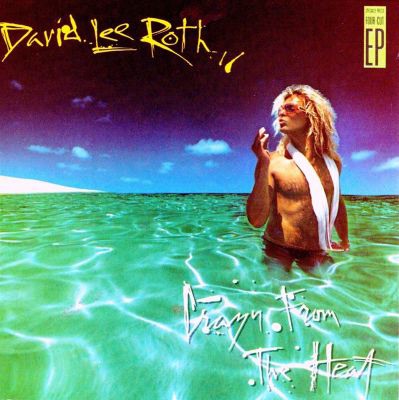
Crazy From the Heat (1985) was actually an “extended play” not a full album full of songs. This introduction to Diamond Dave as a solo artist was a strange introduction, all covers, with lush production, a “welcome to the party” announcement. This could have been a David Johansen – Buster Poindexter album, it’s campy enough. This is Vegas lounge rock at its finest. I believe most people saw it as a disappointment, certainly nothing like VH. Maybe that was the point.
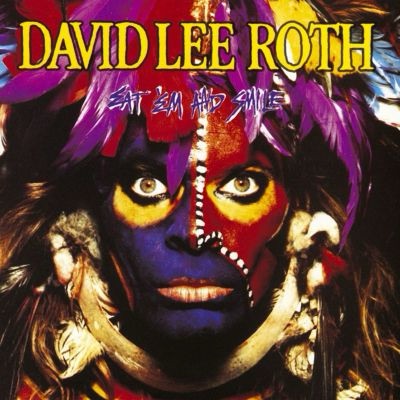
Eat ‘Em and Smile (1986) Again produced by Ted Templeman. When this album came out, I bought it. I believe it’s still his best solo album. A fair number of VH fans seem to prefer this album to other VH albums that followed Roth’s departure. That is certainly a conversation starter.
Roth hired guitarist Steve Vai, bassist Billy Sheehan, and drummer Gregg Bissonette, who complement him well. Six of the ten songs are credited to Roth/Vai.
“Yankee Rose” is a call and response song between Roth’s vocal and Vai’s guitar. A muscular song, with “Shyboy” in a similar vein of shred and bombast.
“Goin’ Crazy” was a very accessible single. It’s packed with grit, but very melodic. “Ladies Night in Buffalo?” is a driving beat with Roth coaxing it along with his low vocals. Another song in the VH mold, not a copy, but in the style.
“Elephant Gun” is Vai shredding and Roth doing his speed singing. It works. “Bump and Grind” sounds like a nasty VH song. “That’s Life” is a cover, much in the spirit of Crazy From the Heat.

Skyscraper (1988) Produced by Roth and Steve Vai. “Just Like Paradise” was the single that got radio play. It’s a passable tune, easy to sing along to. “Damn Fine” has some nice Vai acoustic guitar work, it’s an enjoyable song. “Stand Up” starts promising, some interesting synth and guitar work, but fails to develop into anything more. The comments are the same for “Hina.”
The playing is top shelf, the production is fine, the problem is the songwriting – it’s bland. That lies at the feet of Roth and Vai who wrote most of it. Critics will tell you this album is strong on songcraft, less wild and outrageous than Eat ‘Em and Smile. I’d like to agree, but can’t. The songs are more structured, but the quality and spark aren’t there.
Roth tries to do his VH act and it falls short. His screams, alternating with his knack for speaking the lyrics, exposes how weak the writing is. Vai is a great guitarist, but this “band” never gels on these songs, what we get is sadly very generic.

A Little Ain’t Enough (1991) Produced by Bob Rock (Metallica, Motley Crue), this was an effort to boost Roth’s fading career with Warner Bros. The title is accurate, there wasn’t enough of what was decent, and too much that didn’t have any spark or sizzle. Roth fans are divided on this one, is it close to his finest solo work or a stinker? It’s both.
“Tell the Truth” is one of Roth’s best songs. Musically, it’s not groundbreaking, but it’s worth repeated listenings. “Baby’s On Fire” sizzles. “Sensible Shoes” is slow and bluesy. Bob Rock is great at taking hard rock and shaping it into listenable tunes without gutting the muscle.

Your Filthy Little Mouth (1994) Produced by Nile Rodgers (Chic, Diana Ross), it’s an interesting pairing. I expected to hear the chunka-chunka-chunka of Rodgers’ guitar, his trademark riffing, but it’s not here. Rodgers is credited as producer, but not player on the album, and he’s not listed as a songwriter either. Most of the songwriting is by Roth and guitarist Terry Kilgore. “A Little Luck” has a different sound, horns, and it stands above the other songs that fail to distinguish themselves. The playing is adequate, but the songwriting is disappointing. “Cheatin’ Heart Cafe” has Travis Tritt helping out, but it’s useless. The title track is okay, “Nightlife” and “Sunburn” are bluesy, in different ways, and lift the second half album. Producer Rodgers does mix in a little R&B and reggae as well. Too bad he didn’t bring some songs with him.
Final thoughts…
Diamond Dave had a great opportunity to establish a successful solo career, but several things didn’t happen. Roth isn’t the best vocalist so not every kind of music works for him. He was most successful with a strong producer who understands his strengths. Templeman and Rock were good choices.
The other thing that failed Roth was consistent songwriting. His albums had a lot of filler and they sounded very much the same. When Roth changed it up, incorporating different genres or sounds, his music seemed fresher and his voice more embraceable without so many VH vocal tricks.
Music was changing in the late 1980s and Roth mostly stuck with what he knew best. Unfortunately, that sounded tired and lacked originality.
I had looked forward to hearing these albums again after so many years. There were high points, along with a lot of mediocre and forgettable tracks. I wanted to like this set, but my ears just weren’t having it.





 Ticket 2 Ride
Leave a comment