
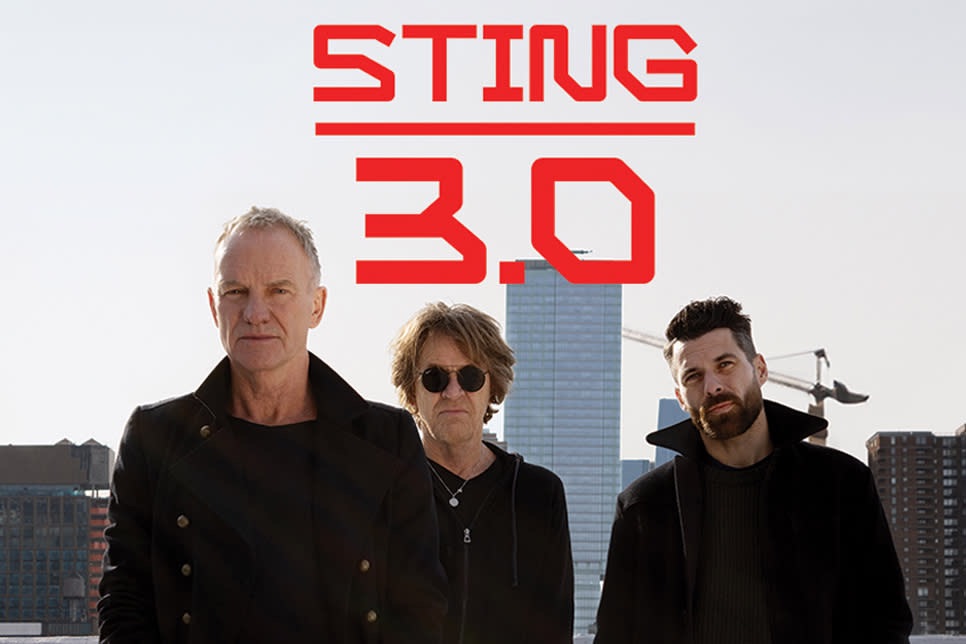
Sting is having a tremendous solo career after leaving The Police about 40 years ago. Recorded on his current year-plus concert tour, Sting 3.0 comes in several length formats. This review will cover the nine song standard disc, but I’ll mention the Japanese version that has eight additional songs.
Over his lengthy career, Sting has several live albums in his catalogue, including Bring On the Night (1986), his first, and a vinyl set still in my own collection.
Sting brought his magnificent bass playing to this trio. Dominic Miller, Sting’s longtime guitar player is able to play more than one guitar part at the same time. Chris Maas is on drums and percussion.
Sting has sold a lot of albums and earned about every award possible. When he left The Police, Sting broadened his musical pallet to embrace a jazzy vibe to both his new music, and Police favorites. His songbook is quite deep, so he has many choices when it comes to a set list. I have always found his music to be brooding and like a slow drink of a powerful cocktail.
Early on, Sting was painted as an angry, sneering punk, similar to Billy Idol. Sting challenged the music world with many flavors to his music and personality. Like the generation of songwriters who emerged before him like Dylan, Springsteen, Mitchell, Young, etc., he’s much more than the initial impression, evolving into a painter of moods and sophisticated musical textures. As he aged, Sting’s audience seemed to expand, even as he stepped far outside the pop/rock genre of his early work. Allmusic’s Stephen Erlewine wrote, “he entertained his esoteric interests — he collaborated on a classical album, he rearranged his old tunes for an orchestra, he reunited the Police, he wrote a musical — before he returned to pop/rock with 2016’s 57th & 9th.” When Sting toured, fans showed up.
If you are a fan of Sting’s previous work, you will enjoy this album. Even though it’s a three-piece band, he’s done it before, and sticks to arrangements that deliver the songs as fans know them. That doesn’t mean he’s copying the records, his band brings a freshness and loose vibe to these songs. What I wonder though is why more of his set list isn’t represented. Why not two discs?
“Message in a Bottle” – This is a sterling version of The Police hit. Sting’s voice is slightly lower in register than when he first sang these words. Dominic Miller’s guitar playing is spectacular, not better, but different than Andy Summers on the original.
“Englishman in New York” – Very pretty version, although the drum interlude was not needed. Overall, enjoyed the song.
“Fields of Gold” – A nice version of, but the continuous percussion sound became a bit annoying. Not a favorite of mine, but they do a fine job.
“Seven” – Again, that damn percussion, thankfully it changes during the song. Parts of this song are great.
“All This Time” – I really like this performance.
“Driven to Tears” – Time to get fast again, very stylized. A bit jazzy. Nice guitar solo. Different enough from The Police version.
“Synchronicity II” – Personally, there are other Police songs to feature than this one. Just my opinion. As a trio, I give them high marks for bringing it to life.
“Every Breath You Take” – This song works better as a trio. Faithful to the original. Great performance.
“Roxanne” / “Be Still My Beating Heart” / “Roxanne” – This version of “Roxanne” is really good, and it was obviously written to play as a trio. The shift in style to perform “Be Still My Beating Heart” the song as a slow reggae compliments the first part of the song. Sting returns to “Roxanne” to quietly end the song and the album.
“Fragile” – Bonus digital track, not on album.
—
The Japanese CD release also contains these songs. Why it wasn’t released as an option in America…no idea.
“I Wrote Your Name Upon My Heart”
“It’s Probably Me”
“Never Coming Home”
“Tea In The Sahara”
“Fortress Around Your Heart”
There were other songs played in concert, but not on any version of CD.


 Ticket 2 Ride
Leave a comment