
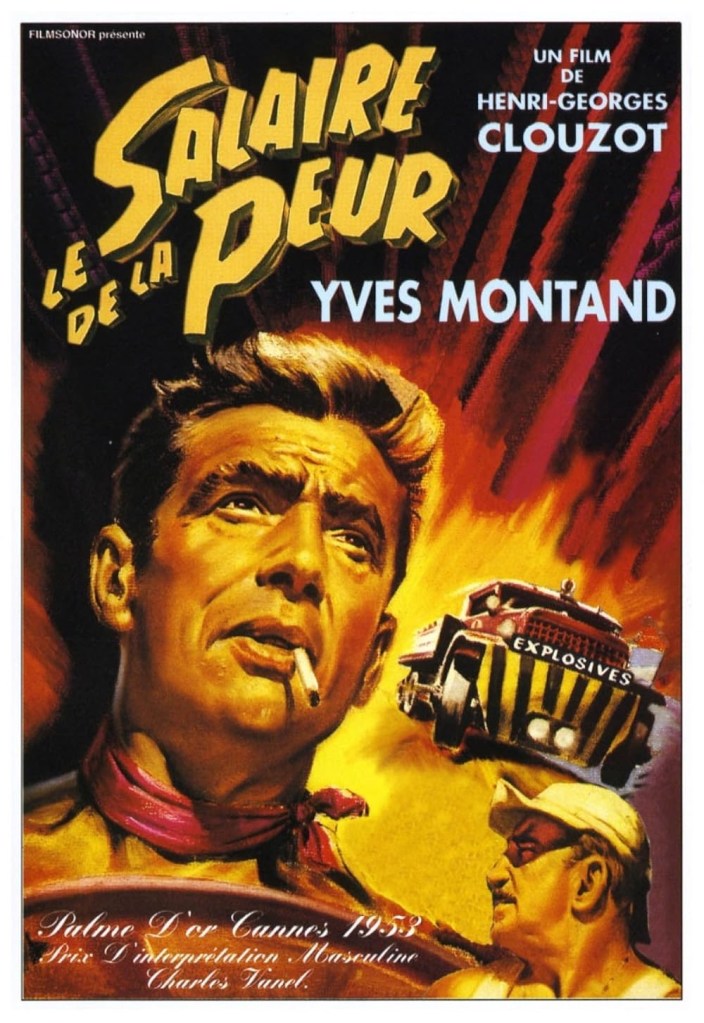
The Wages of Fear (1953) had been successful and revered, regarded by many as a classic. Directed by Henri-Georges Clouzot, from a novel by Georges Arnaud, simply, it is a tale of four desperate men who agree to drive two trucks carrying nitroglycerin through a mountainous desert to an oilfield where an explosion and fire necessitates using the nitro to extinguish the fire to cap the well.
Starring Yves Montand as Mario, Charles Vanel as Jo, Folco Lulli as Luigi and Peter van Eyck as Bimba, the four fight the jungle, the weather, obstacles and crumbling roads and bridges, to haul the precious and dangerous cargo. Perhaps the greatest threat are each other, tempers, prejudices, greed, and competitiveness make for an even more hazardous journey to the remote oil field camp.
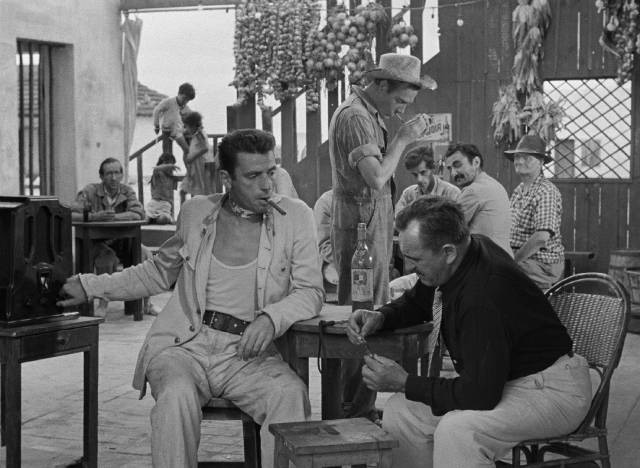
The oil company is the primary source of employment and pretty much controls the lives of the workers and is the de facto law. Hauling the nitro is considered too dangerous for the company employees so the job is handed to these four drifters who have no other opportunities and the pay is attractive.

Very little of the film is spent setting up the story, most of what we learn about these four strangers we find out along the way from the challenges ahead and what each reveals of himself. Clouzot is masterful at setting up the dangers and hazards on the road. He builds the tension as fights develop, trucks break down, and the desert and terrain wear them down to a breaking point.
Through the years, The Wages of Fear developed a cult following, especially in America, and with a young group of filmmakers.
After the film success of The Exorcist and The French Connection, William Freidkin decided to direct a remake of the French film, The Wages of Fear. Awards, box office and critics approval gave Freidkin unlimited freedom in making his next film. Freidkin, Coppola, Speilberg and Bogdanovich were the Golden Boys and Hollywood was only too happy to green light some personal and risky films.

Paramount agreed to Freidkin’s project and they would regret it. Over schedule and over budget, Sorcerer created many problems for the studio during and after principle production. Suffice it to say that the finished film pleased no one at the time. Reviews were mixed, it lost money and everyone distanced themselves from the finished film.
Sorcerer (1977) substitutes a Central American jungle for the desert. The plot is generally the same as Wages of Fear, but Walon Green’s script is structured like Freidkin’s previous films, a lot of background that slowly builds to where the four strangers are selected to drive the trucks with the dynamite, containing unstable nitroglycerin, to the oil drilling site. The first 45 minutes or so traces how these four characters came to be in Central America. Wages of Fear is a longer film and cover the background in less screen time. If you aren’t familiar with the story, you won’t have clue where the story is headed. Freidkin demands that the audience pay attention and allow the story to come together, even though it’s often not communicated through dialogue but rather a series of actions across various locales (Jerusalem, Paris, New Jersey, Central America).
Roy Scheider plays Jackie Scanlon, who is on the run from a botched church robbery. Unfortunately, a mobster’s brother, a priest at the church was shot in the robbery. Even though the other accomplices died in a car wreck, the mobster wants revenge. Scanlon becomes Juan Domíngue, who faces a very tough future in the Central American village. We meet two other members of the foursome, Amidou plays Kassem who is a Palestinian freedom fighter who bombs a building and is on the run. Bruno Cremer is Manzon, a French investor who is caught up in some illegal financial activity and is on the run. Francisco Valera is Nilo, the final member of the group who is a bit mysterious and becomes a substitute after he kills the man originally selected.
Scheider had played opposite Gene Hackman in Freidkin’s The French Connection, and was enjoy a surging career after headlining The Seven Ups, a featured role in Marathon Man, and his starring role in Jaws and its sequel. Scanlon/Domingue was not a sympathetic or particularly glamorous role. It is written that Freidkin and Green shaped the character to resemble Fred C. Dobbs, Humphrey Bogart’s character in The Treasure of the Sierra Madre.
The jungle scenes are brutal and the rain is constant. The scenes that ratchet up the suspense are the two scenes of the heavy trucks going across the rickety and dilapidated bridge. The other notable scene is where the truck with Domingue and Nilo are stopped by guerrillas who want the truck and will kill them for it. Nilo is seriously wounded in the ensuing gunfight, but Domingue tries in vain to get him to the oil field camp.

Freidkin builds in a lot of political subtext with the Jerusalem bombing at the film’s beginning, and the social unrest in Central America where most of the film is set. It’s a hard, suffocating life. The village is really a slum where there seems little, if any hope. The workers are being suppressed by both the oil company, and the military government’s strong-arm soldiers.
Freidkin selected the German electric rock band Tangerine Dream to provide the pulsing and jagged soundtrack music, and it’s very effective in supporting the tension and tedium that builds in the film.
The film was so costly ($22M in 1978 dollars) that Paramount brought in Universal to share the load. After the initial screenings, the studio execs knew this film was in trouble. Through the years, Sorcerer languished as a bit of a cult classic, rather than a film many people knew about or saw. Today, Sorcerer has been rediscovered and boasts a pretty respectable rating on Rottentomatoes.com. I have to admit, the film was better than I thought, but far from a classic. There’s nothing really uplifting about this film or its ending, and it deserved the box office response it received at the time. The film’s title is very misleading and convoluted. Sorcerer, is one of the truck’s name, and according to a Friedkin quote, sorcerer is an evil wizard named fate. Even if that’s true, it’s still a lousy title for the film he directed.

In 2024, Wages of Fear was again remade, this time by director Julien Leclercq for Netflix. Instead of a jungle, the story material reverts back to a desert setting. Franck Gastambide, Alban Lenoir, and Ana Girardot star in this French production. While trying to stay true to the original source material, the film was stylized for a modern audience. The politics are more personal, as is the brutality and violence, some sex was added to the mix, and very contemporary film techniques used, including a story structure that uses jump-cutting, and modern camera movement technology and CGI effects.
It’s a stretch to imagine hauling a dangerous substance would be much of a problem today, 500 miles across the desert seems very doable. Modern communications, satellite GPS, state of the art vehicle technology and weaponry almost put this film in the realm of a typical Hollywood action flick. The original film had none of this gadgetry or high-concept evil corporate villains. I guess it takes more to entertain an audience of 14 year olds. Any semblance of the original story and this film is purely incidental.
This version of The Wages of Fear lacks originality, offering up instead, well-placed explosions and surprise ambushes. At least Sorcerer tried to put the audience inside the truck and feel the hopelessness of those four men. This version should make you want to see the original film. Instead, it’s forgotten as soon as the credits roll.
—
Final thoughts
It’s hard for me to not like the 1953 film version the most. It’s taunt, genuine, gritty and powerful. They do not make films like this anymore. They could, but don’t. Audiences have changed, and filmmakers employ more technology, gadgetry and stylization visuals in pushing the boundaries. Sorcerer and the 2024 remake each offer a different telling of the basic storytelling. The visuals are quite different for both, and the character backstories are approached differently too. The original is the one to see, but the other two have their moments.




 Ticket 2 Ride
Leave a comment