
This album has been long forgotten in my collection. Something about it, I don’t know what, stopped me from playing it much. It might have been the song “Black Water”, a very popular song from the album, which I’ve never really liked. Even though that song was a huge hit, the album didn’t offer any of those monster guitar chunky, powerchord songs, “Eyes of Silver” notwithstanding. Instead, the Doobies rocked out on this album.
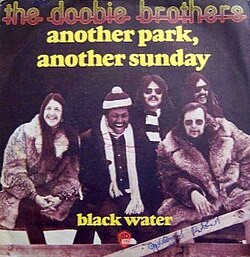

As the middle 1970s approached, the music world would begin to separate rock into subgenres. Bands like the Doobie Brothers played the type of music that was challenging to classify – they were both hard rock and pop rock. This album in particular skews their category. Why does it matter? To the listener, it doesn’t. Within the music industry that determines everything from production to marketing to concert promotion to radio airplay to musical charts – they determine the musical artist’s survivability and future. Bands that skirt the genres and dabble in more than one style have a harder time connecting with their audience. The Doobies would be caught in this riptide several times, but they have survived and doing well in the new musical order.
The lineup on this album:
Tom Johnston: lead and background vocals, acoustic and electric guitars, main songwriter. Patrick Simmons: Tom Johnston: lead and background vocals, acoustic and electric guitars, main songwriter. Tiran Porter: bass and background vocals. John Hartman: drums, percussion. Michael Hossack: drums.

Future Doobies drummer Keith Knudsen provided backing vocals, and future guitarist Jeff “Skunk” Baxter played pedal steel guitar. Billy Payne of Little Feat provided piano, organ and clavinet. Percussion and vibes were played by Milt Holland and Eddie Guzman. Arlo Guthrie contributed auto harp on “Tell Me What You Want.” The Memphis Horns can heard on several songs, providing an R&B feel. Novi Novog plays viola on “Black Water” and “Spirit.”
The album was produced by frequent Doobies producer Ted Templeman, and engineered by Donn Landee and Lee Herschberg. This is a first rate production team. Templeman has worked on over 60 platinum albums.
I read something recently that linked the Doobie Brothers with Creedence Clearwater Revival, both known for rhythmic played guitars, powerful, but very melodic. Those are hummable songs, three to four minute songs with a Southern vibe, although the Doobies were a Northern California biker band in the beginning. It’s less the straight musical genre, and more the accessible feel of the music and the relaxed vibe. CCR had a swampy, country-rock feel; the Doobies were guitars, strong rhythm section and occasionally a violin or acoustic guitars. On What Were Once Vices Are Now Habits, that’s what you hear.
So, specifically, what did I find when I listened again?
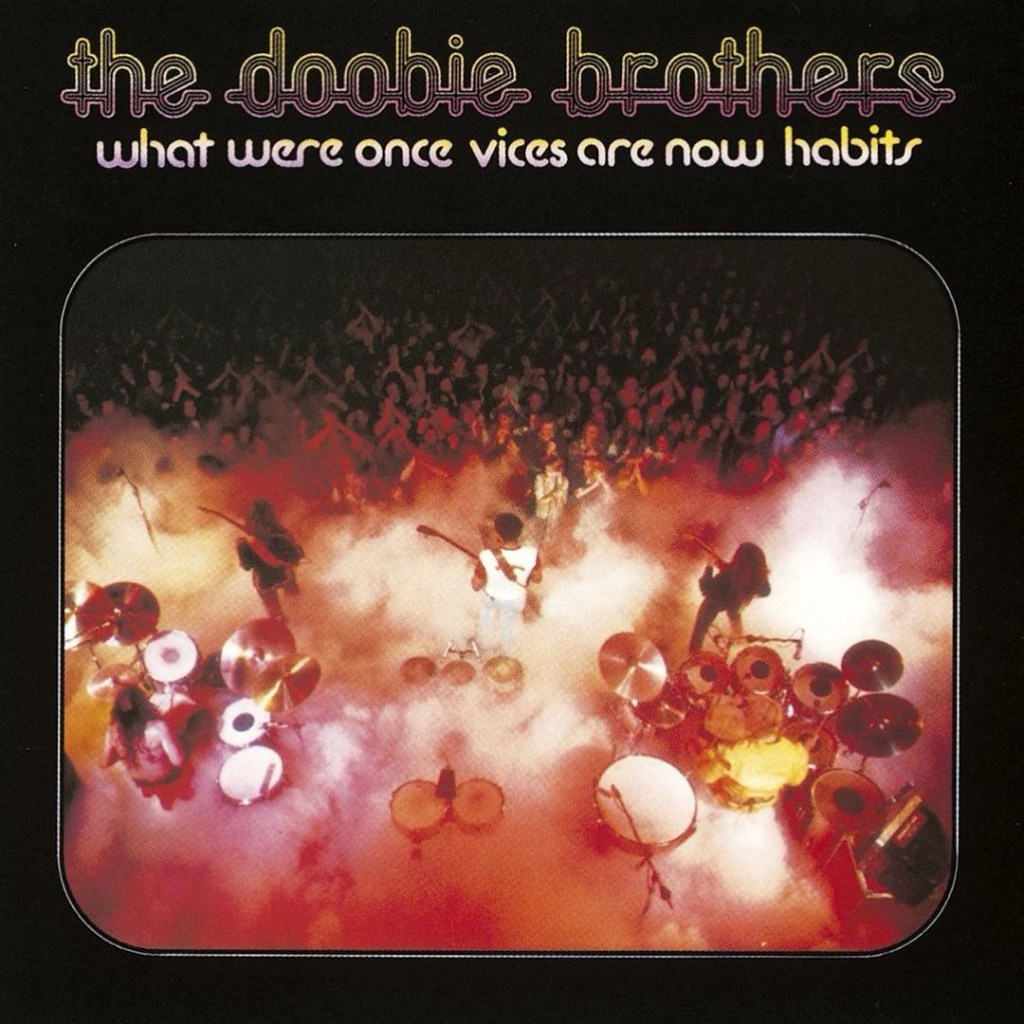
Side one
“Song to See You Through” Tom Johnston 4:06 An uptempo R&B flavored rocker. The horns are a nice touch.
“Spirit” Johnston 3:15 A foot-stomping rocker with prominent acoustic guitar and viola. This could be Allman Brothers or Eagles. A big slice of countrified rock.
“Pursuit on 53rd St.” Johnston 2:33 An all-out rocker, perfect in a bar to get the dance floor filled. Gritty guitars. A lot of song in a short amount of time.
“Black Water” Patrick Simmons 4:15 The first big appearance by Pat Simmons, the surprise hit off the album. Acoustic guitars and viola punctuate this song. Not a favorite of mine, but I respect the song’s great popularity.
“Eyes of Silver” Johnston 2:57 Chug-a-chug guitar riffing. While it’s a prototype Doobies guitar song, not one of Johnston’s premier songs. The horns are great. Still fun to hear.
“Road Angel” John Hartman, Michael Hossack, Johnston, Tiran Porter 4:59 For a deep track, this is a pretty good rocker. I’m guessing that it started out as a jam since most of the band is credited as writers. The only song where the Doobies really open it up. The beat is heavy and the guitars nasty. I’m reminded of The James Gang on this song.
Side one is a pretty solid set of songs. A laidback swampy song is the most famous song on the side. Simmons had only one songwriting contribution, but it was a big one. Johnston dominated the side with his signature guitar chords.
Side two
“You Just Can’t Stop It” Simmons 3:28 A rocker infused with The Memphis Horns. Simmons’ guitar work is awesome.
“Tell Me What You Want (And I’ll Give You What You Need)” Simmons 3:53 A very underrated song. Smooth and soulful. The Doobies we’re much more than power chords. The guitar picking here is skillful.
“Down in the Track” Johnston 4:15 Another nasty guitar song from Johnston.
“Another Park, Another Sunday” Johnston 4:27 Always my favorite track on the album. Smooth and polished. Even the electric guitars sound tame. Peaked at number 32.
“Daughters of the Sea” Simmons 4:29 This enchanting song is underrated. It’s a rocker with a lot of rhythm guitar and percussion, with the aching guitar in the distance. The vibraphone is a nice touch.
“Flying Cloud” Porter 2:00 One interesting song per album comes from Porter, an underrated bass player. He contributes fine background vocals mostly. This is a quiet, haunting instrumental, unlike what the Doobies usually release. A great piece of musicianship.
Side two really belongs to Simmons, although Johnston contributed a solid single. The guitar work is absolutely amazing throughout the album, it really shines when you play it on a good sound system.
Final thoughts
There have been three distinct versions of the Doobies Brothers. The first iteration was the lineup that produced this album. Guitar-driven, soulful and very melodic. By the time this album came along, these guys were tight musically, the playing interwoven, and the background vocals finely blended.
This might be their best album of the first version of the band. Drummer Hossack would leave the band after this album, replaced by Keith Knudsen. Hossack would return later. Obviously, some of the credit for the warm, welcoming sound goes to producer Templeman and engineers Landee and Herschberg who shaped the music without losing the edge or muscle.
In summary, I found this album to be much more than I remembered. The songs, the playing, the sound – all superb.



 Ticket 2 Ride
Leave a comment