
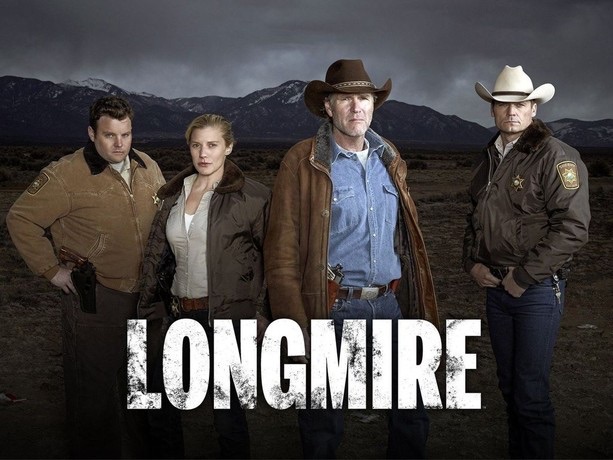
Walt Longmire is the sheriff of Arapaho County, Wyoming. A character in a series of modern Western mysteries by Craig Johnson. Warner Bros. bought the series rights and teamed with A+E to put a series, Longmire, on cable in 2012. After three seasons, A+E canceled the series, reportedly because the show’s audience was old and not the desired advertising demographic. Netflix picked up the series and another three seasons were made before the streaming service decided to shut it down. From various reports, Netflix felt the show had been sufficiently mined of story ideas; however, Netflix supposedly approached Warner Bros. about buying the series, but Warner declined. Sounds like Netflix had ideas about the Longmire character or his universe. In the years since the series ended, there has been buzz about Warner Bros. rebooting the character. Just rumors.

The wife and I watch a lot of dramatic series, finding most of them on streaming services. We’ve watched many crime and mystery series, including Dark Winds on Netflix. In the back of my mind, I wondered if Longmire would appeal to her, there are similarities between those two series.
I read the Longmire book series as soon as Johnson publishes a new book each year. The one thing I haven’t done is revisit the TV series – until now.
As I’ve said before, the differences between the books and the TV series are striking. The Walt character in the book is funny, apt to get himself into difficult situations and not the stoic, wall of granite that we see in the TV character. That’s okay with me, I’ve come to realize that each work best in their respective medium. The world of Walt in print is a more surreal mix of the spiritual forces of the Wyoming cultures. At times it’s challenging to know what is really and what is imagined, spiritual or folklore. That’s one of the pleasures that works better on the page. To a limited degree, the power of the spirit is used in the TV series.
Beginning with season one, the strength of the series starts with the writing. The characters are revealed slowly as the emphasis is on the story. As a police procedural, the episodes follow the clues, yet twists and turns abound to get the truth. Character traits are learned as the episodes unfold, their backstories slowly appearing, and the impact of those play out over time, but there’s no rush to fully explain each character. Walt is a big mystery, and his resistance to talk about his wife’s death, as he’s built a wall between himself and the world, is peppered with brief flashback images, that hint at something unsavory that happened related to her death. Some event that left him scarred and haunted by it.
The casting of the series is oddly perfect. Robert Taylor, who has a thick Aussie accent, transforms himself into the low speaking, Walt Longmire who ignores technology as simple as cellphones. With his low-setting hat, penetrating eyes, leather and denim apparel, and cut to the bone directness, Walt might seem to be the prototype Western lawman – he fits many of the traits of the genre, including rock solid loyalty, a tireless quest for justice and rarely deviating from what’s right. He’s not without his faults, he is slow to adapt to technology, doesn’t always present himself in the best light, is not a great communicator,and has that damn wall up between himself and the world.
Henry Standing Bear (Lou Diamond Phillips) is Walt’s best friend since grade school. Each would walk through fire for each other. Both are involved in the mystery of the murder of the meth head who killed Walt’s wife in Denver. Henry is arrested for the murder. Walt’s daughter Cady (Cassidy Freeman) becomes Henry’s lawyer, and Walt takes over running the Red Pony bar while Henry is in jail. Their friendship is absolute.
The other foundational relationship is between Walt and Cady. At times it’s complicated, like when she started secretly dating Branch, one of Walt’s deputies, who happened to be running against Walt in the upcoming sheriff’s race. The death of Walt’s wife, Martha, further complicated Walt and Cady’s relationship in a number of ways. Perhaps Walt’s greatest challenge is how he interacts with those closest to him, and that would include his other deputy, Vic. There is definitely a sexual tension between them that does not erupt, even though it’s noticed by other people. Vic (Katee Sackhoff) has her own challenges, the predominant one is needing to prove herself daily.
The series is populated by interesting characters in their own right. Casting is such an essential element in an ensemble show, which this is. It’s not the amount of screen time, it’s making the most of it. Graham Greene, who just passed away last week, is the unsavory Malachi, a former rez police chief who Walt put behind bars, but resurfaces as the head of security for Jacob Whitehorse’s casino. Whitehorse is played by veteran actor A Martinez, who brings complexity to the opportunist Whitehorse. Gerald McRaney is Barlow Connelly, wealthy developer and Branch’s father, who dislikes Walt and fronts some questionable deals. Peter Weller (RoboCop) is Lucien Connelly, retired sheriff and Barlow’s brother. Lucien is alternately a help and a hindrance to Walt, but he’s an entertaining character; more so in the Longmire books. Weller is also an occasional series director. You may notice Zahn Tokiya-ku McClarnon, who plays Mathias, the police chief on the rez. He now plays Maj. Joe Leaphorn on Dark Winds.
The key an adaptation or an original script is the words on the page. As an unorthodox police procedural, following a case each episode is accompanied by side stories that run through the season or the series, proving character exposition, and providing unifying story arcs. The producers and writers have taken the barest of Walt Longmire essentials from the book series and reconstructed the Longmire universe for an ongoing dramatic series. When I first started reading the Longmire books, after I was several seasons into the television series, I had a difficult time because they were so different. I stopped reading the books until the series was over. It was like dating two people at once, it never worked for me.
The television series embraces the Native American customs and spirituality in a different way than the books. The books are freer to blur the line between mysticism and reality, whereas the television series can allow some doubt, but must be clearer where that line is. That being said, the stories are believable and as far as I’ve read, represent Cheyenne culture and tradition genuinely and with respect.
As I’ve watched the television series again, I’m seeing it for the first time since it originally aired, and we’re watching episodes in batches, which certainly helps in following the stories and carrying forward character information.
I am amazed at how well this series is written and acted. The stories involve many current issues, and conflicts between cultures and economic interests. There’s nothing melodramatic or sensational here, no cartoon violence or unrealistic characters, that’s probably in part why the demographics skewed older, like me.
The writer, producers and crew that define the characters, write the plots and create the visual storytelling include: Hunt Baldwin, John Coveny, Craig Johnson, Tony Tost, Michael M. Robin, Greer Shephard, Patrick McKee, Brad Davis, Chris Donahue, cinematographers Cameron Duncan, J. Michael Muro and Todd A. Dos Reis, and main editor Adam Bluming. Plus composer David Shepard whose gritty musical score, and those who scout locations, dress the sets and characters, and support what you see and what you don’t.
Final thoughts…
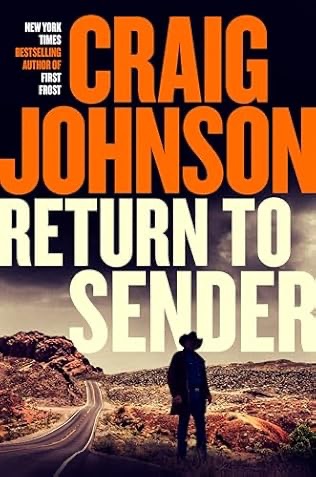
There’s a new Longmire Mystery I’m anxiously waiting to read. We should be finished watching season six soon. Perfect timing. From one Longmire universe to another.





 Ticket 2 Ride
Leave a comment