

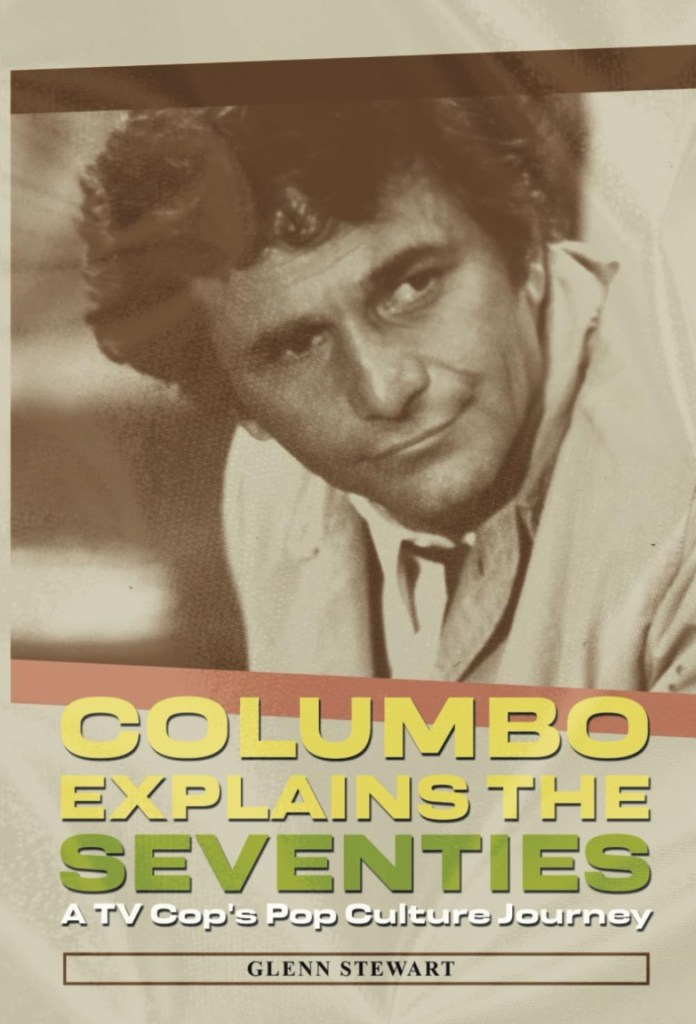
It’s Tuesday again! Time for another book to discuss. If you enjoy the Columbo TV series, you’ll enjoy the subject matter of this book.
Columbo Explains the Seventies: A TV Cop’s Pop Culture Journey (2025, Bonaventure Press).
LAPD Lt. Columbo was a force to be reckoned with; once he got hold of a case, he stayed with in until it was cracked open. Columbo fan Glenn Stewart does a deep dive into other ways the show reflected the world of the 1970s. This is not a trivia book, although there are little known facts revealed about the character and show. Casual fans will see many things from episodes in a new context, that of the times. Salty, old fans like myself, identified the referenced items immediately, and appreciated that others noticed them too.
“I began to find plenty of examples where Columbo was reflecting and sharing the values of the 70s’ world around it,” Stewart said in an interview with the columbophile blog. “The classic episodes are a form of history. What could those original episodes explain to us about class conflict, power struggles, feminism, race relations, sex, technology, media, psychology, politics, and violence? How is this particular TV cop a product of his particular time?”
In several categories, I might take a different view than Stewart. For example, the topic of feminism, he’s correct that the LAPD is shown as not having women in street or investigative positions, but that might be entirely accurate. However, there are numerous female villains that match wits with Columbo, and in other instances are heads of corporations or positions of power. As far as race relations, there are only two non-white villains, and few persons of color shown as LAPD personnel. I believe the show underrepresents the actual percent in the LAPD, but maybe not by much.
Stewart correctly pays homage to the use of technology in the series. Keep in mind, this is 50 years ago, computers were huge and primitive by today’s standards, video tape was in use and played a part in several episodes, film projection was old school including changing reels and the manual editing of images into a film. One episode is about a cutting edge detective agency with more gadgets than LAPD has, another episode is about a home with surveillance cameras, another episode is about electronic eavesdropping, another concerns programming computers for war simulation, and so forth. Technology not aids the villains, but backfires and helps Columbo solve his cases.
There is a very interesting chapter on Patrick McGoohan, the most frequently Columbo villain and occasional (5 episodes) director.
One book reviewer wrote about Stewart’s book: “…essays are entertaining, and while copiously sourced in the back of the book, they’re always energetic and enthusiastically written with affection and assurance.” I generally agree that it’s well researched and entertaining, but I would use a few less adjectives. Stewart has dived into the 45 classic episodes to find examples for each category of 1970s culture. I don’t always agree with his arguments, but I respect his conclusions.
By the way, Stewart doesn’t like the final 24 episodes that aired on ABC starting in 1988, and the final one airing in 2003, after sitting on the shelf for two years. I agree with Stewart, these 24 episodes lack many quality the classic Columbos had.
I never thought of Columbo as a historical record of the decade. There are other shows of the period that could surpass Columbo in solid examples in certain areas, but overall, I cannot argue with Stewart’s overall list, the show checks the boxes.




 Ticket 2 Ride
Leave a comment