
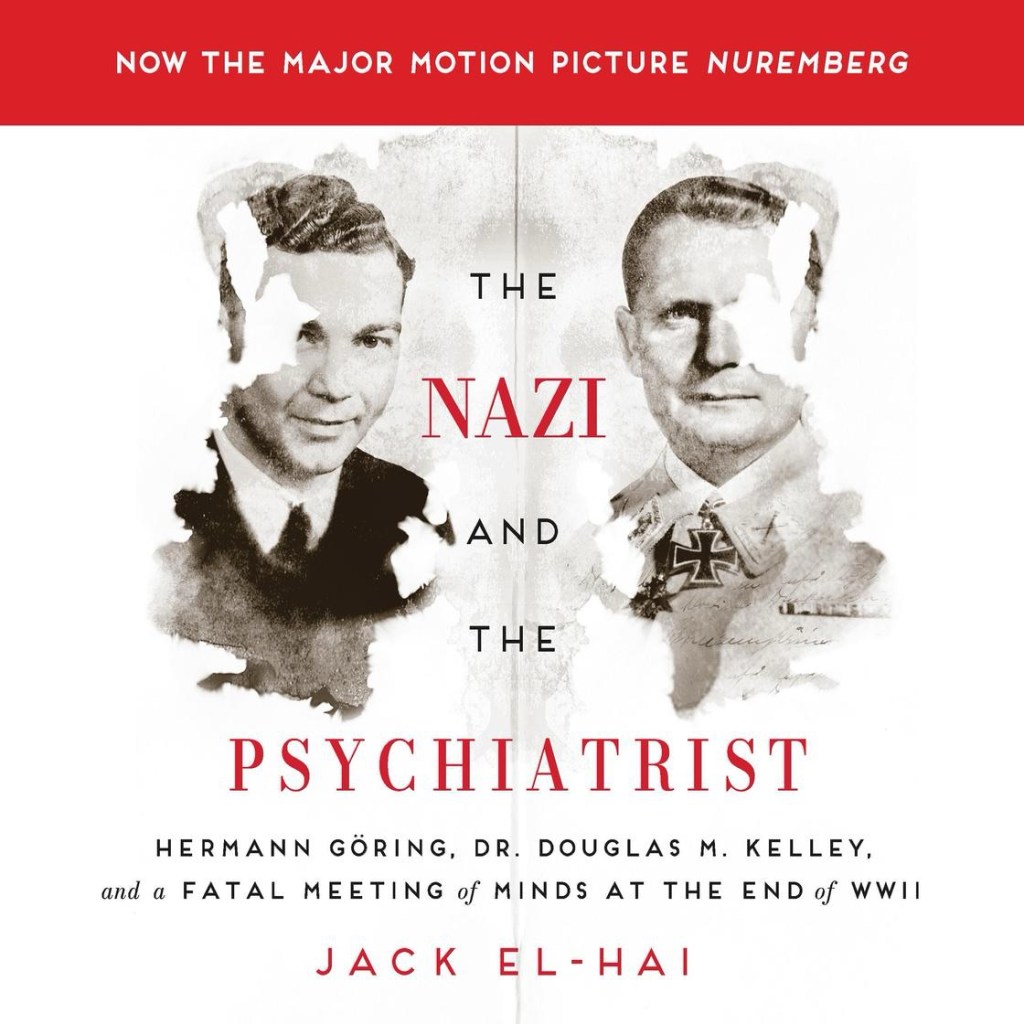
The Nazi and the Psychiatrist: Hermann Göring, Dr. Douglas M. Kelley, and a Fatal Meeting of Minds at the End of WWII (2013, PublicAffairs)
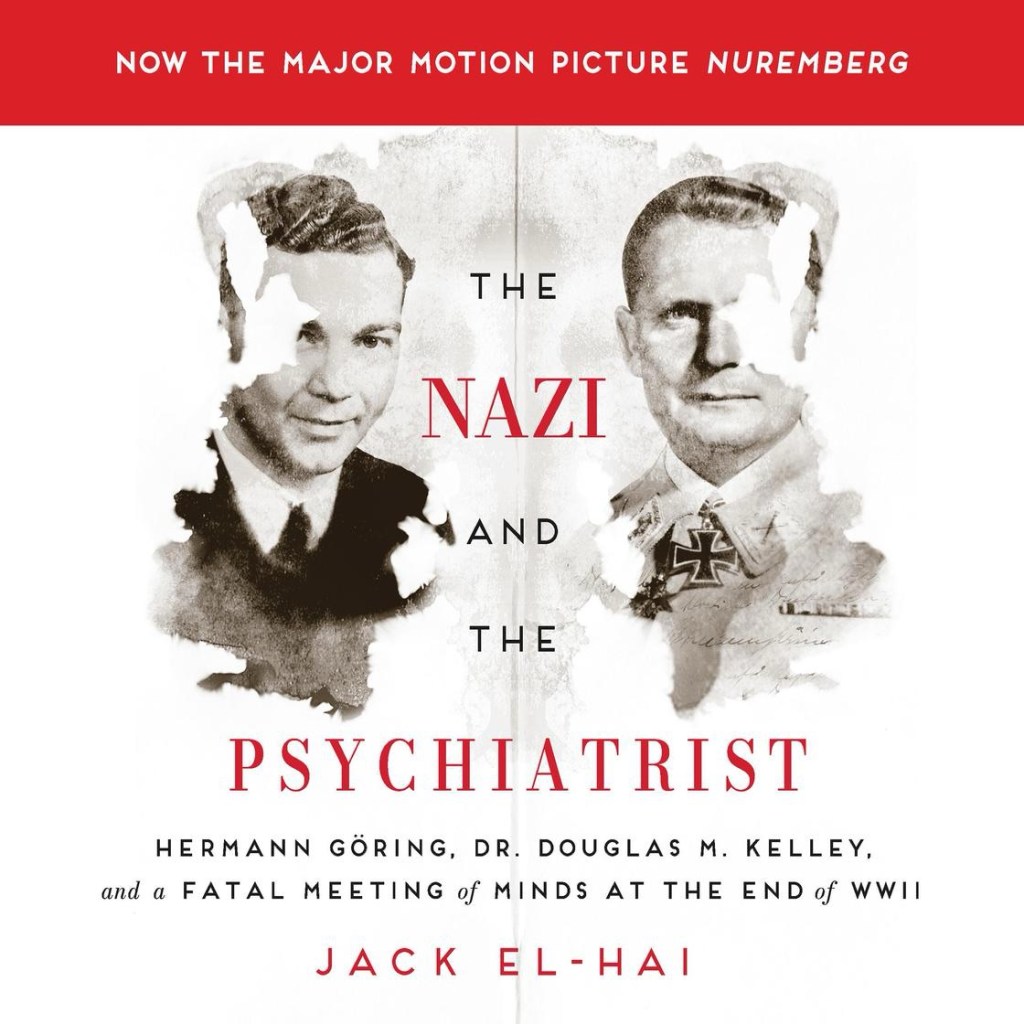
The 2025 film Nuremberg, is based on the book by Jack El-Hai on the time Maj. Douglas M. Kelley spent evaluating Hermann Göring and 21 other Nazis who faced trial for their actions during the Second World War. The Nazi and the Psychiatrist is about more than just the Kelley and Göring relationship, but that is the heart of the book and played a major role in the remainder of Kelley’s shortened life.
Kelley prospered in the Army, he rose to the rank of major and had many responsibilities, “he supervised all research for the development of new methods to treat combat exhaustion, took charge of the treatment of all psychiatric army cases in Europe, organized the army’s psychological clinics, and won appointment as European theater consultant in clinical psychology in March 1945.”
According to El-Hai, Kelley official role was “to guard the health of men facing trial for war crimes.” But there was more. Kelley wrote that he sought to “study them as a researcher in a laboratory.” Early on, Kelley knew that he had to write a book on his study of these men. What was at the root of their evil? Was Nazism an illness that could infect people anywhere, even growing to epidemic proportions around the world? Was there a Nazi mind? Kelley was not ordered to investigate Nazism, this would be his personal quest.
Dr. Kelley followed the Nazis to the Nuremberg jail. His new orders were to evaluate the mental fitness of the top twenty-two men to face justice in the trial to come.
The Nuremberg Trials were unprecedented in history, and it was important to evaluate these 22 men with whatever psychological tools available to determine their mental fitness, but also truthfulness in their fitness. One of the accused, Rudolph Hess, had been diagnosed with amnesia during his captivity in England. Was it true, or had he been faking it. These were wily and manipulative men, powerful members of the German Reich. Hess would later admit that he faked the amnesia.
“Then I didn’t fool you by pretending amnesia?” Hess asked. “I was afraid you had caught on. You spent so much time with me.”
The Hermann Göring portrayed in the book went through various phases and displayed different personality traits during the lead-up to the trial. He entered prison as a drug addict (paracodeine), but was weened of his drug intake. He was obese with heart problems, but managed to lose so much weight that his uniform no longer fit. He certainly remained a narcissist, unfeeling about his fellow prisoners, nor the millions who died by the Nazi hand. He felt superior to others and rejected the jurisdiction of the court. He modulated his personality to those he was forced to deal with, not cracking under the months of confinement, or showing all of his cards. According to Kelley, Göring was about Göring; becoming a Nazi was a means to an end, and he played that role well, but he was in it for himself.
El-Hai wrote, “Göring’s efforts to be a model prisoner and present himself in the most flattering light were working. Their time together showed Kelley the charm, persuasiveness, and ‘excellent intelligence bordering on the highest level’ of Göring. The Nazi was funny, charismatic, well mannered, and cultured. These admirable qualities did not blind the psychiatrist to Göring’s inherent wickedness, however. Kelley was intrigued by Göring’s ‘ability to carry out policy no matter how brutal.’”
Göring admitted that he had rival Erich Roehm murdered during the bloody party purge of 1934, the Night of the Long Knives. Göring typically denied culpability from the violent acts. “‘But how could you bring yourself to order your old friend killed?’ Kelley blurted out. Göring sat silent and fixed his eyes on the American. The look expressed bewilderment, impatience, and pity. ‘Then he shrugged his great shoulders, turned up his palms and said slowly, in simple, one-syllable words: ‘But he was in my way…’” That was Göring.
“I am ready,” Göring told Kelley. “But I am determined to go down in German history as a great man. If I cannot convince the court, I shall at least convince the German people that all I did was done for the Greater German Reich. In fifty or sixty years there will be statues of Hermann Göring all over Germany. Little statues, maybe, but one in every German home.”
“Göring hasn’t changed a bit,” Kelley told journalists months later. “He is still the same swaggering, vain, conceited braggart he always was. He has made up his mind he’s going to be killed anyway, so he’s very anxious to be considered the number one Nazi, a curious kind of compensation.”
The screening of the death camp films blew a hole in Göring’s plan for the trial. Göring could not escape the evidence presented in court, which established that Göring knew about the atrocities and details of the “final solution”, it had occurred with his assent and assistance. Göring had planned his defense, he intended to do battle with the prosecution, he was convinced the power of his personality and his reasoning would prevail, but the evidence was overwhelming and riveting.
Kelley visited the prisoners in their cells that night, after the film was shown in court. El-Hai writes the prisoners were weeping and in denial, casting responsibility for those actions on others.
The court would rule on these 22 men. Some were found not guilty, others were sentenced to prison, a few were executed and two died by suicide. Trials for other Nazis, collaborators and sympathizers would continue by various courts over the next years.
Kelley’s story did not end with the Nuremberg Tribunal.
The other psychiatrist that joined Kelley in evaluating the Nazis, Gustav Gilbert, did not agree with some of Kelley’s opinions about the Nazi prisoners or conclusions he reached about some of the psychological tests conducted on them. Kelley was very insistent about use of the Rorschach test, but Gilbert was not. Gilbert’s repeat of the Rorschach test with Göring arrived at a different interpretation than Kelley’s. Gilbert also wrote a book, which was more popular than Kelley’s. El-Hai believes that is because Gilbert told the public what they wanted to hear, “that the Nazis were a psychiatrically disordered group.”
Kelley did not believe that that a Nazi “germ,” a deviant personality common to the defendants existed. According to El-Hai, Kelley “found in their personalities traits that he called neuroses, not uncommon psychiatric flaws that could certainly trouble the Nazis and increase their ruthlessness, but did not put them outside the boundaries of the normal.” In essence, Kelley believed that “countless men like Göring, unburdened by conscience and driven by narcissism, spent their days ‘behind big desks deciding big affairs as businessmen, politicians, and racketeers.’” Not a very popular conclusion. But he went further. Kelley pointed to various American politicians who “exploited racial myths ‘in the same fashion as did Hitler and his cohorts. They use racism as a method of obtaining personal power, political aggrandizement, or individual wealth. We are allowing racism to be used here for those ends. I am convinced that the continued use of these myths in this country will lead us to join the Nazi criminals in the sewer of civilization.’” Powerful stuff.
In describing the Nazis’ rise to power was, “partly because of their nation’s cultural training. But they ‘are not unique people, …who would not hesitate to climb over the backs of half the people in their country to subjugate the other half,’ Kelley wrote.”
Kelley believed his Nazi Rorschach results had historical value. These were after all,, according to Kelley, “the [greatest] group of criminals the human race has ever known.” El-Hai follows with what Kelley had concluded. “They offered possible answers to the questions of why German citizens followed these men on a disastrous and destructive course and what motivated unusual but still normal people who knew exactly what they were doing as they ruthlessly ran a regime that persecuted and killed millions.”
Kelley saw connections between the growth of Nazi ideology and the presence of longstanding tendencies and prejudices in German culture, and concluded that “the Nazis did not have to invent notions of the Führer principle…They simply tapped into what was already present in the national atmosphere.”
Kelley after the war.
Returning home, Kelley had an uneven time adjusting to life and jumpstarting his career. He found his footing and became a teacher, attended patients, consulted, lectured, worked on his book and busied himself as a husband and father. On the surface, life appeared happy and successful. Surprisingly, he found little interest in his book, yet he completed it.
Kelley’s mental decline had its origin is his upbringing. El-Hai describes Kelley’s mother “teaching him to never to feel satisfied with what he had, always to crave to know, obtain, climb, and deserve more. The roots of June’s mental tumult are unknown, but she lived in darkness, anger, and fear.”
Kelley’s own children feared that he would “destroying the family or himself and seeking help from a fellow psychiatrist, in Kelley’s mind, would have tainted his authority.” Dukie, Kelley’s wife, thought he too proud to see another psychiatrist.” El-Hai says that “Kelley’s frustration and anger remained bottled up” as he went about his busier and busier life. Until he could no longer cope.
In the end, El-Hai writes of Kelley’s action. “The cyanide was deliberate evocation of Göring’s defiant suicide and the Reichsmarschall’s pose of a hero backed into a corner. When Kelley fetched the cyanide, he signaled the arrival of his final stand against a fate worse than death that lay ahead. Death provided the quickest and noblest escape for the overwhelmed psychiatrist from an ignominious future—a descent into incompetence in the face of his insecurities, responsibilities, and pressures.”
The more Kelley sought to tell his story of how the Nazis came to power and cast their spell over the German population, the less Americans were interested in his views. He saw how persuasive the Nazis had been in America and other countries before the war, and noted the seeds of authoritarianism and hate being used in postwar politics, just wrapped in a different ribbon and bow.
El-Hai concludes with Kelley failed message. “The Nazis, he warned, were you and me-given the slightest twist of fate. In broadly optimistic postwar America, he sounded slightly paranoid.”
The parallels between Kelley’s story and today are striking. Kelley was destroyed by his own immersion in the Nazi ideology and drive to put his conclusions before the world. He also saw how the theatrics of nationalism and selling victimization by foreign interests are powerful in any culture. The parallel between Göring and Kelley in death is almost unbelievable. The truth in this story is blinding and stranger than fiction. Jack El-Hai’s book is worth the read, allow time for processing each chapter.



 Ticket 2 Ride
Leave a comment