
Hitler’s submarine fleet inflicted devastating losses on Allied shipping, especially in the early years of the Second World War. The U-boat capability and their hunting techniques surprised even Hitler, and submariners became celebrities in Germany.
Wolfpack, Inside Hitler’s U-Boat War, by Roger Moorhouse (2025, Basic Books) is a penetrating and scholarly look at the U-boat program and their impact on the war.
Author Roger Moorhouse writes that novelists and filmmakers exaggerated the cruelty and horrific acts inflicted on civilians and shipwrecked sailors, and wanted to present a more accurate history of the U-boats during the Second World War. That’s a tall task because U-boat sinking of merchant, civilian and naval ships accounted for thousands of deaths.
Originally, there were “prize rules” that set in place what type of ships could be attacked and under what circumstances, to avoid harm to civilians. Early in the war, German submariners were known to render aid, provide food and even assist the shipwreck survivors get to where they could be rescued. Moorhouse writes that the German Command was sensitive to criticism over attacks on civilian ships, even those by accident. That protocol quickly changed as U-boat captains were often unable to tell civilian from enemy vessels, and it became problematic to warn and transport civilians without endangering U-boat personnel. After sinking a few ships with civilian casualties, the gloves were off.
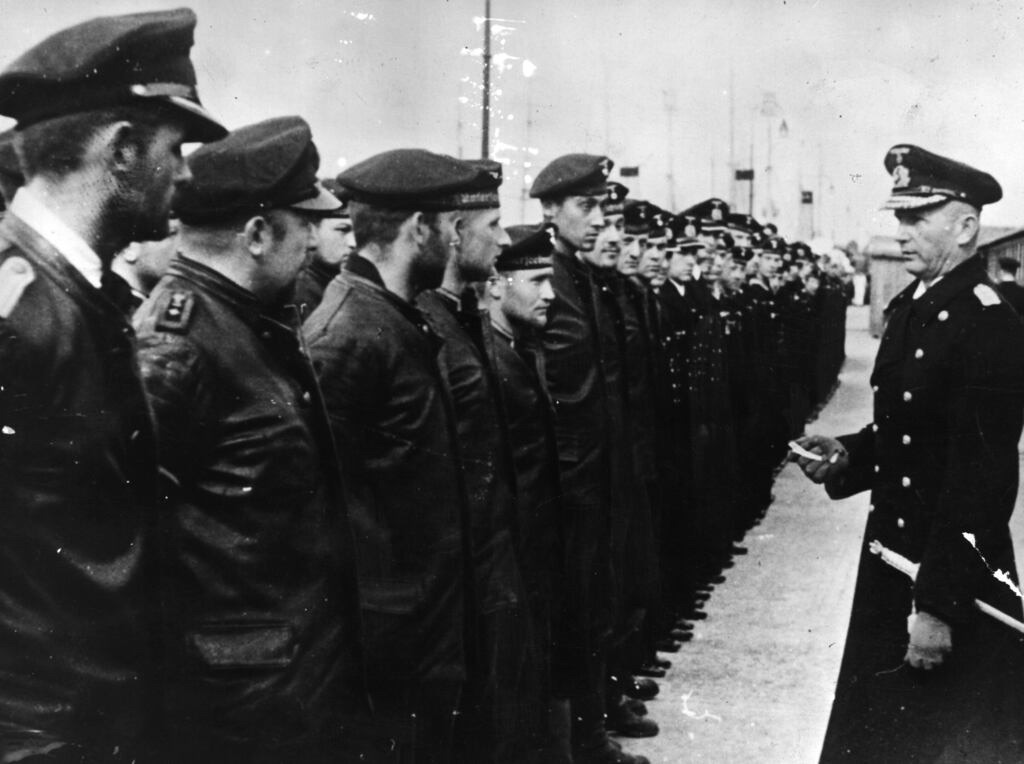
Was there honor among U-boat captains to not engage in the cruelty known to be inflicted on civilians in the German land campaigns? Depends on the captain and situation. Early on, selection to a U-boat crew was an honor; rigorous selection and training was done, and captains were experienced naval officers carefully selected as strong leaders. Moorhouse writes that not every captain went along with the Nazi propaganda efforts, emphasizing professionalism and naval honor at least as strongly as Nazi party rhetoric. American and British films often depicted U-boat officers as robotic killers or merciless Nazis; perfect villains, but less representative of the efficient, patriotic, naval professionals who cared for their crews, and were more interested in sinking ships than machine-gunning helpless people in the water. At least in the early stage of the war, the naval officer corps sent into action mainly well-trained captains, but as Moorhouse reveals, that would change and not for the better.
The term “wolfpack” or Rudelaktik was a strategy from World War I. According to Moorhouse, the concept “had been much discussed in theoretical terms in the interwar years and had been an established part of the training regimen following Karl Dönitz‘s restoration of the U-boat program.” Surprisingly, Moorhouse does not talk much about attack strategies in the book.
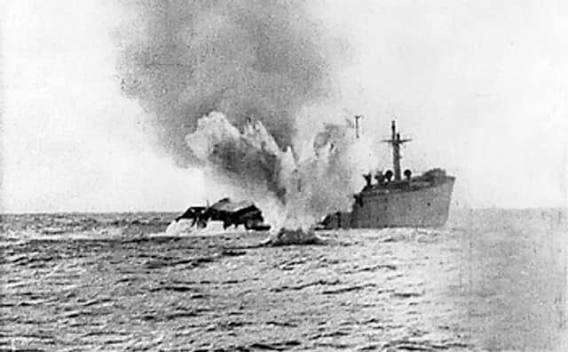
The British had captured an Enigma machine from a German sub and for most of the remainder of the war could read German communications. That was a significant factor in how the war changed in the North Atlantic, but it was not the only one. America entering the war was the other huge event, that obviously brought many more naval ships, and allowed the Allies to provide more abundant air support for shipping. While naval vessels and mines were growing more effective against U-boats, it was from the air that ratcheted-up U-boat casualties.
In the book, there’s a lot about U-boat engagements with convoys, but very little about naval battles other than depth charges being dropped. If you are looking for the stuff action-thriller war films are made, you won’t find that here. Moorhouse takes a more analytical approach to telling the U-boat story.
Life aboard a submarine during WWII, on either side, was not a pleasant experience, and much worse than you see in the movies. Missions could be weeks or months in length, outlasting food and water. First aid and medical care was sparse. Oxygen was fouled by diesel and oil fumes, rotten food, poor sanitation, condensation, mold and unclean bodies. Crews could be submerged for long periods of time, and any chance for daylight was quite limited, especially in cold, stormy climates. Work was continuous, only broken up by a quick meal and sleeping. The danger of leaks shorting-out equipment, and water on the batteries causing toxic gases, was ever-present. Fresh water was rationed, food spoiled and turned rancid, restocking food and supplies was limited by supply line problems. Sleep was never restful, the work was continuous and dirty, everyone lived in fear, and death could be quick or long and painful.
The Germans were constantly looking for an edge, and found a few. One was equipping subs with a sound absorbing tiles that provided a stealthy presence to sonar detection. It worked well-enough, but its implementation was slow and at the later part of the war. “Allied superiority—both numerical and technological—-was by this stage so complete that few of the submarines were able to score any meaningful successes,” Moorhouse wrote.
Even with the growth in the U-boat fleet, Allied shipping was still taking a beating, but even the head of the German Navy felt the Battle of the North Atlantic, the main battleship ground of the sea war, was lost. That didn’t mean the war was done, but even rudimentary metric told naval personnel that it was not sustainable. U-boat losses were mounting, and even though the number of German subs was growing, inexperienced and overwhelmed crews were no longer a match for the influx of American ships, greater air resources, and improved defense technology and strategy. Germany was still improving their U-boat designs, radar technology, and was able to partially read British codes. Even with these enhancements, the tide had turned, so much so that Moorhouse writes, U-boats were being assigned to other regions outside the North Atlantic where Allied defenses were less threat. The German supply line improved so that U-boats could spent more time “in theater” rather than traveling to get supplies.
What always puzzled me was how U-boats could identify Allied shipping so easily, the type of ship and its tonnage, often its name. One way was by using the Merchant Fleets of the World 1940 book showing pictures siloulettes, class of ship and tonnage. Ship radio traffic and intelligence information were other means.
Here are a few stats from Moorhouse’s book:
- July-Dec. 1941, Axis submarines sank 169 ships totaling more than 720,000 tons, a monthly average of 120,000 tons. U-boats sank nearly 3,500 Allied ships for a total of almost 15 million tons of shipping.
- In 1940, Germany 50 U-boats. In 1942 alone, 238 U-boats built. In 140 in February 1943, 140 U-boats were in service. The monthly average of shipping sunk by U-boats in 1942—110 vessels—was more than twice the monthly averages posted for 1940 and 1941.
- Of the 859 combat U-boats that entered service during the war, more than half-465 of them—-failed to sink anything at all. 30 percent of the Allied ships that were lost were sunk by 2 percent of the U-boat commanders.
- Of the 373 combat U-boats that were commissioned in 1943 and after, only 61 of them—16 percent-succeeded in sinking anything at all. Per U-boat at sea, Allied ships sunk peaked at over five in October 1940, then from the summer of 1941 never exceeded two, and languished below one from September 1942 to the end of the war.
- 782 had been sunk during the course of the war. 212 U-boats had been scuttled at the end of the war.
- Of the 41,000 men of the U-boat arm who went to war, only around 11,000 are thought to have survived: a death rate of nearly 75 percent, which was unmatched in any other branch of service in any army in any theater of World War II. Of the 859 combat U-boats that actually set off on war patrols, 429 yielded no survivors and no bodies.
Roger Moorhouse is a visiting professor at the College of Europe in Warsaw. The author of several books on World War II history, including Poland 1939 (winner of the Polish Foreign Ministry History Prize), Berlin at War (shortlisted for the Hessell-Tiltman Prize), and The Devils’ Alliance, he lives in the United Kingdom.



 Ticket 2 Ride
Leave a comment