
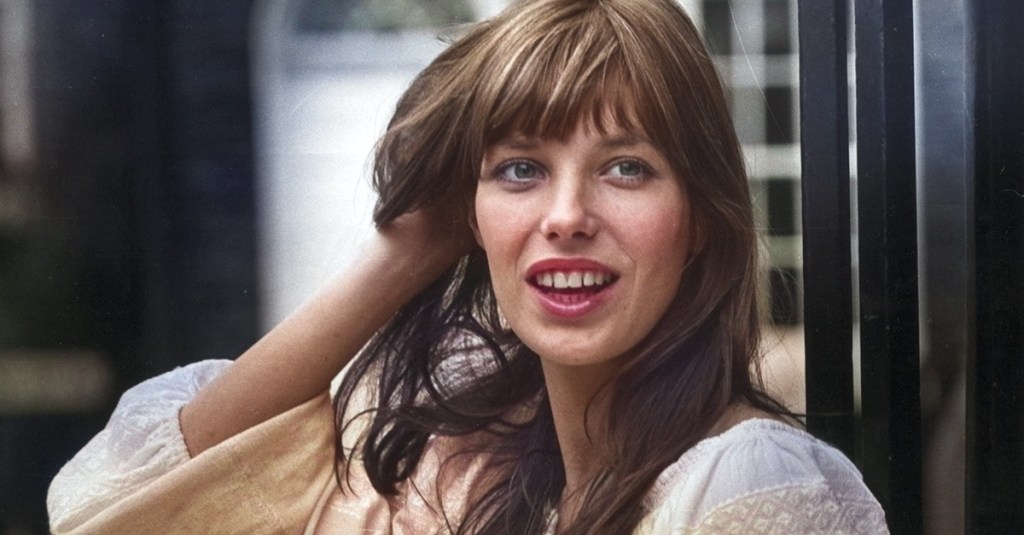
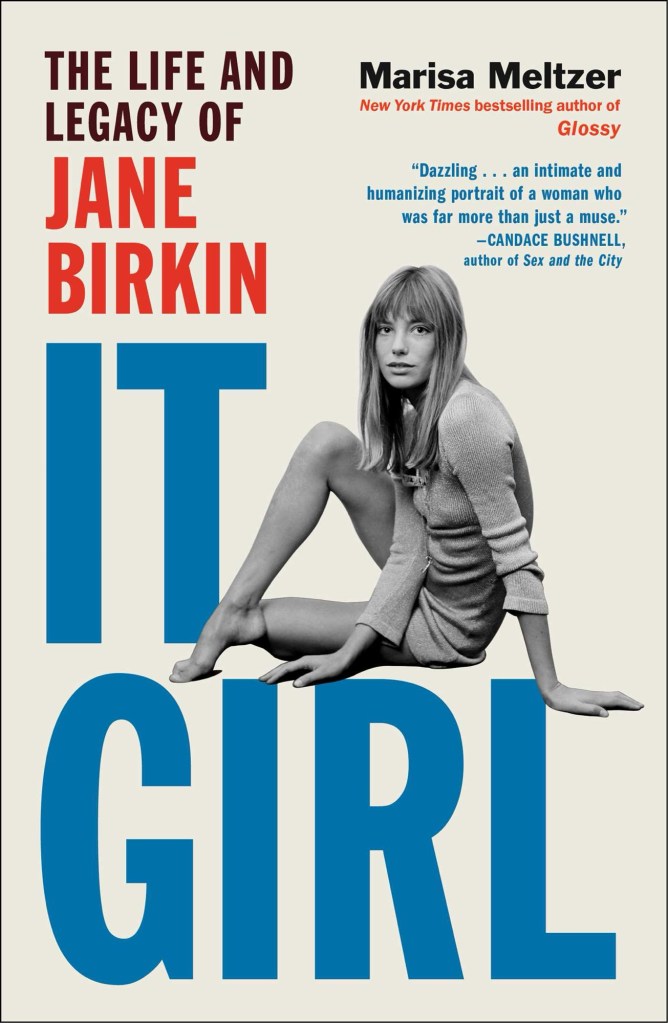
In the forward, author Marisa Meltzer asks, who is Jane Birkin? I knew a little about her, but I plead ignorance on the whole “It Girl” thing of the 1960s. I know nothing of handbags, but I’ve seen a couple of her films.
This was before social media, although it was around during her later years. People became famous differently then. Birkin said she fame was never her intention: creative expression was her aim. That creativity took many forms and got her square in the public eye.
It Girl: The Life and Legacy of Jane Birkin (2025, Atria Books) by journalist Marisa Meltzer.
Jane Birkin died in 2023, and although she was British by birth, she was revered in France, her longtime home. Her funeral was attended by film stars, fashion icons and even the First Lady of France. Hundreds gathered outside the church to recognize the Englishwoman they claimed as her own. More on her legacy below.
In the mid 1960s and through the 1970s, Birkin was the rage, particularly in Paris, but elsewhere as well as fashion mags and tabloids featured her in photo shoots and later stories of her unconventional, but intriguing personal life. Yet, she was conflicted about her beauty. “You said you’re the first sex symbol with ‘big teeth, bad legs, and no bust.?… You reckon that’s a fair account?” In England she had been bullied about her looks.
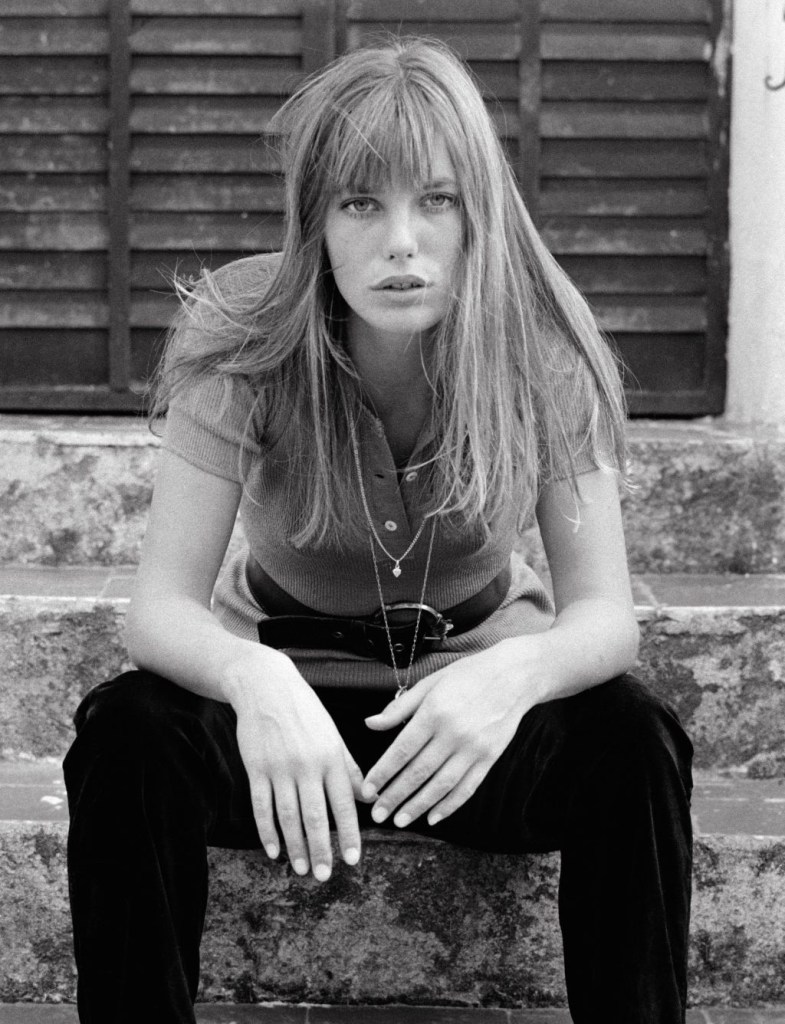
Who was this young woman who appeared in magazines around the world, record albums, appear in numerous films and be known as the face of a changing culture. She would move to France and live there most of her life. France embraced her, it was a clean canvas awaiting her arrival.
Birkin’s first acting role, as an extra, was in Richard Lester’s The Knack… and How to Get It (1965) and a small, but noticeable role in Blow–Up (1966). At the time, numerous fashion models were being considered for film roles. Birkin didn’t really have a plan, but in 1968, the world was nearly upside down with political, cultural and social changes. Jane Birkin stepped right into the eye of this hurricane. Birkin was not alone in the sudden popularity of stylish and comely young women. Twiggy, Jean Shrimpton, Catherine Denuve, Brigette Bardot and Marianne Faithfull were others.
Birkin was first linked with film composer John Barry, which resulted in a child, but quickly became an unhappy pairing. Not long after, Birkin hooked up with French film actor and raconteur Serge Gainsbourg, her Svengali for the next dozen years, then director Jacques Doillon. Gainsbourg wrote a song for Brigette Bardot called “Je t’aime… moi non plus” that was performed with Birkin instead and it became an international hit, and started Birkin’s singing career that would last her entire life.
Meltzer has access to Birkin’s diaries and uses other research to explore Birkin’s life, much of it revolving about three older men and three daughters. Although seen as a strong, independent woman, these men would greatly shape Birkin’s life. While the 1960s brought sexual freedom and feminism, French culture was not as progressive with respect to traditional men-women relationships. Meltzer does a skillful job of laying out the contradictions in Birkin’s complicated romantic relationships. These men were quite domineering, and had it been for their cheating and abusive behavior, she might not have jumped to other relationships, that’s the conclusion I take away. Meltzer writes of her decision to leave Gainsbourg, “Gainsbourg considered her his creation. She had been a willing participant in this dynamic for years, but now she wanted to break free. Shed once laughed off her partner’s antics; now she no longer felt amused by him at all.”
Her marriage to Barry was short, but long enough to produce daughter Kate. Birkin left Barry for Gainsbourg and moved to Paris. After 12 years and daughter Charlotte, Birkin left him for Doillon, who she would not marry, but would have daughter Lou. After Doillon would be yet another older man for Birkin.
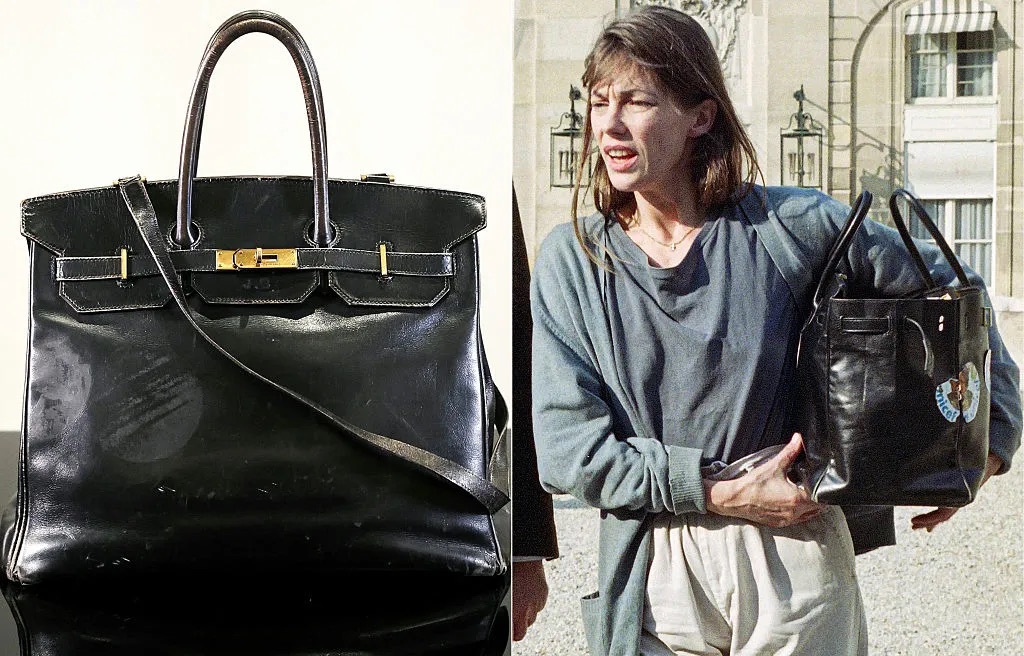
Hermès.
Birkin was a heavy smoker and her skin showed exposure to the sun; she continued to appear on stage and in films until she no longer could. She was not a slave to altering her appearance to prolong her modeling career. She wasn’t one to change her wardrobe from her bohemian attire, which was part of her “It Girl” look that became so popular.
I’m only familiar with two Birkin films, both adaptations of Agatha Christie books. She appeared in many films, mainly French, and even wrote, directed and starred in Boxes. She was an activist throughout her life, campaigning against capital punishment, she made humanitarian trips to Tibet, Rwanda, and Burma (now Myanmar) and worked with Amnesty International concerning the AIDS crisis and immigrant welfare.
Birkin donated the very first bag Hermès designed for her. It was auctioned with the money going to AIDS programs. That bag was sold in 2025 for $10.1M. Owning a Birkin bag is a status symbol, the richest women own them. The story of how Birkin sat next to Jean-Louis Dumas, then the chief executive of Hermès, on an airplane is retold in the book. Had this event taken place today, Birkin would have negotiated a sizable royalty instead of the mere $40K she received annually, which she donated to charity. Later, Birkin learned that Hermès had trademarked the bag’s name, cementing her legacy, but depriving her of any rights over her name associated with the product.
Birkin was known for more than pricey handbags. A maker of a collagen and biotin conditioner referred to using on “Birkin bangs.” Gwyneth Paltrow’s company Goop’s Colorblur balms are “a little Jane Birkin, a little New England summer ease.” There is a full body sculpting procedure referred to as the “Birkin Body” is a high-end, comprehensive body-sculpting procedure developed by Dr. Ryan Neinstein designed a “Mommy Makeover” with a price tag approaching $75K.
Meltzer almost describes Birkin as a tragic figure. “She got her first taste of fame around the same time she got her first taste of dating. She spent the rest of her life chasing that same cocktail of feelings, and throughout Birkin’s life-from her twenties into her sixties—she continued to be overly idealistic in relationships, sought out the kinds of operatic emotions that inspire one to write dramatic poetry, and again and again chose to align herself with a specific kind of romantic partner.” I believe that Birkin would not accept being referred to in any way as tragic, she lived life fully, and chose her path.
Birkin’s eldest daughter Kate died in 2013 and it shifted the emotional center for rest of her life. It was roughly the same time as Birkin was diagnosed with the return of her leukemia. While the event of her death was suspicious, it appears that she left on her own time. Birkin can be remembered for certainly making the most of her time, and was of her time.
This is not the usual read for me, but I found a lot to enjoy.




 Ticket 2 Ride
Leave a comment