
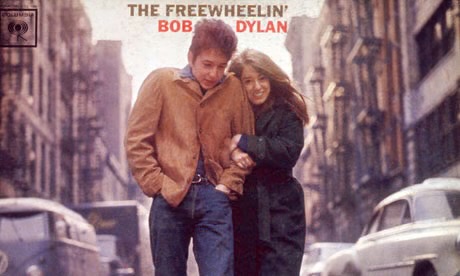
The girl from the album cover. The first muse Bob Dylan would have. Their time together spanned several years, but in the end, they parted ways as their lives drifted apart and Dylan started his affair with Joan Baez.
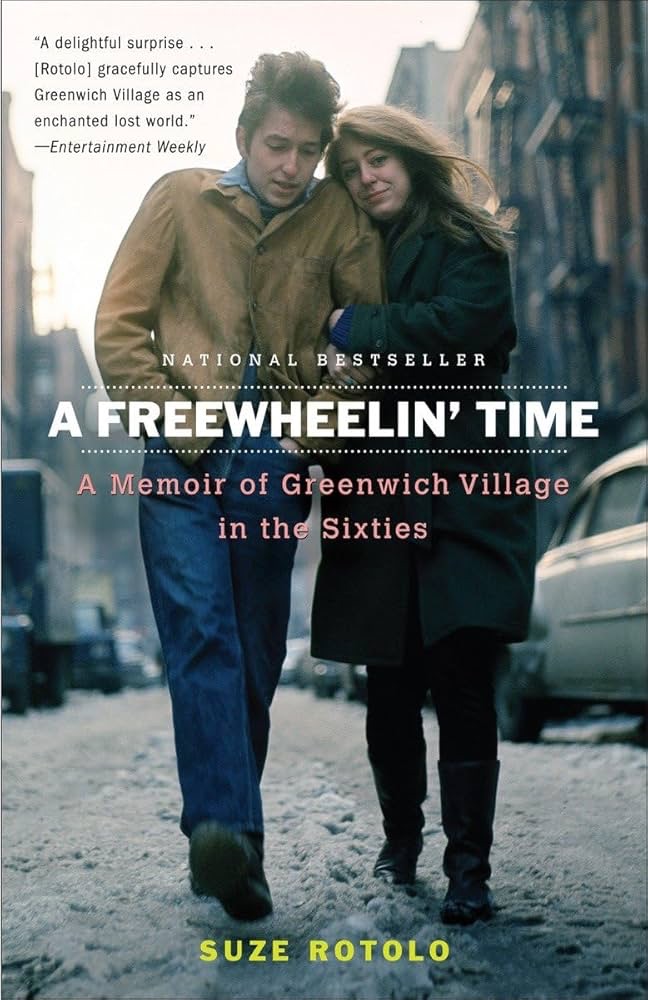
A Freewheelin’ Time: A Memoir of Greenwich Village in the Sixties (2008, Autrum Press) Suze Rotolo.
Suze Rotolo met Dylan in 1961. He was a folk singer working the clubs, getting his act together. She was a young woman, on her own, trying to figure out what to do with her life. They clicked right away, he was her first relationship. They would be together during Dylan’s early years, before success hurled him into the national spotlight and a world that was a-changein’.
The times certainly were in transition between the conservative Eisenhower 1950s and the Kennedy 1960s. Rotolo was part of community of socialist thinkers, and some actual communist party members, like her parents. She refers to herself as a red-diaper baby, of not fitting in, and finding the cultural and political climate of Greenwich Village welcoming and exciting.
Greenwich Village in the late 50’s and early 60’s was a landing spot for social misfits, and fertile with politically charged music and writing. Greenwich Village became a destination because of its bohemian history, which encompassed rebellious politics as well as revolutionary art, music, poetry, and prose. It was a safe community of diverse people and ideas. Rotolo writes of seeing such iconic figures like Odetta, Ramblin’ Jack Elliott, Pete Seeger, Jose Feliciano, Judy Collins, Nina Simone, Mose Allison, Modern Jazz Quartet, Lionel Hampton, Lenny Bruce and many others who performed in the clubs.
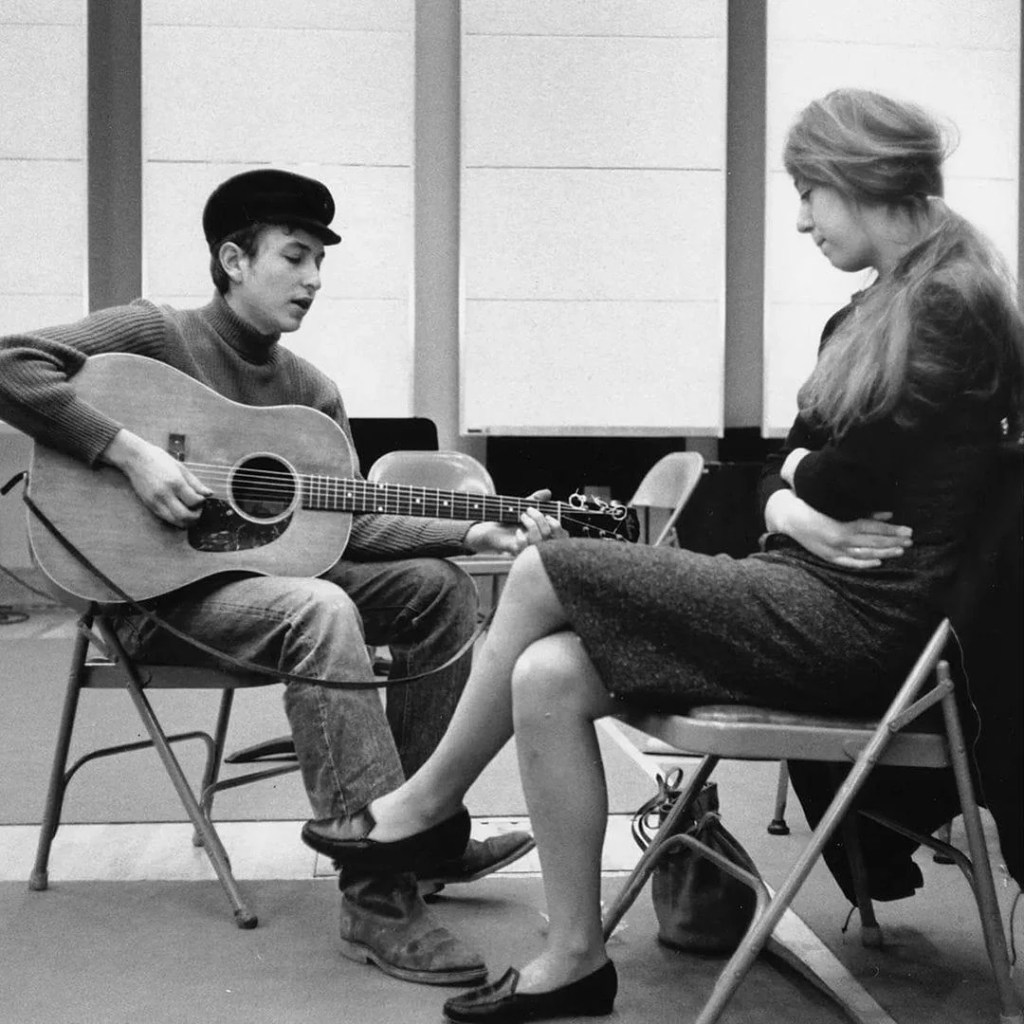
Rotolo accompanied Dylan to his various gigs, and was a sounding board as he wrote was busy writing, and then was in the studio as he recorded his first several albums. She was supportive, but not quite the devotee that described other musicians’ girlfriends, and was used in articles written about her. Rotolo was adamant that she was not like the standard musician girlfriend of the early 1960s. Her memoir reinforces her assured and self-reliant personality. According to Rotolo, Dylan depended on her to tell him the truth and to look out for him, the music world even for unknowns was not generally kind.
“I don’t like to claim any Dylan songs as having been written about me, to do so would violate the art he puts out in the world,” she writes. “The songs are for the listener to relate to, identify with, and interpret through his or her own experience. Our time together fed his work. I know I influenced him. We marked each other’s lives profoundly. He once told me that he couldn’t have written certain songs if he hadn’t known me. But that doesn’t necessarily mean a particular song. It means I served as muse during our time together, and that I don’t mind claiming.”
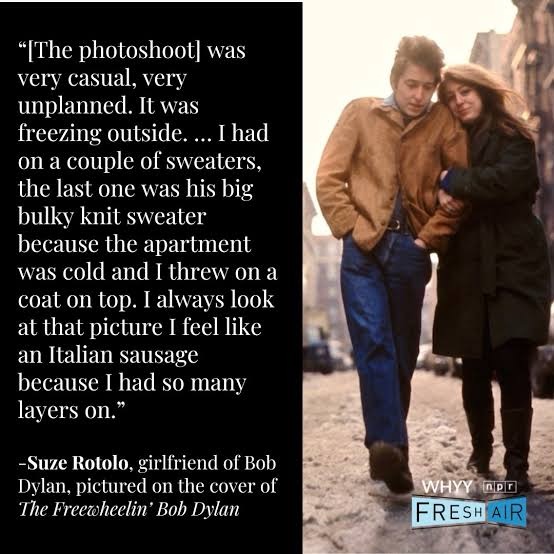
The photo on The Freewheelin’ Bob Dylan album, released in May 1963, has Dylan and Rotolo walking down a cold, wintry New York City street, not far from where the two lived, with Rotolo clinging onto Dylan. “I was expected just to be there by his side as he went about his business, Rotolo writes. “Women and girls were permitted to sit at the table, where they would be served without any hesitation, but they were not to ask for any more. The concept of equality between men and women was unheard of.” She didn’t want to be thought of as a string on Bob Dylan’s guitar, or presumed to walk a few steps behind him.
Rotolo was aware of Joan Baez, and the rumors of an affair, although hurtful, was not surprising. “Baez would be good for Dylan. She was a woman who knew what she wanted and set out to get it. She wanted to get his songs to her audience.”
She called Dylan a beacon, but also a black hole. He required her total commitment to him and pleaded with her to marry him, which made no sense to her, even after she became pregnant. An abortion was arranged, and they continued on, but the relationship was not the same, and she moved out.
As much the book is about Rotolo and Dylan, it is about Rotolo’s relationship with living in Greenwich Village, and the world of Andy Warhol, art, New Wave cinema, poets, music – a witch’s brew of radical ideas, abstract images and lyrics, and a glimmer of the future.
Rotolo had her own artistic interests, art, jewelry and the theater. Between theater jobs, she worked as a waitress in a kosher deli.
The book is not about her later life, just her early life and the Dylan years. She did marry and had a son, for whom she wrote the book. She was an artist and illustrator, and taught art. She passed away from cancer in 2011.
At first, as I read a few chapters, I didn’t know if I’d continue reading, but I’m glad that I did. The world of Greenwich Village in those years is fascinating to visit. The poets, comics, musicians, writers – all interesting stuff. Suze Rotolo was no bimbo girlfriend hooking her cart to an up and coming talent. Her story and her telling of it was well worth the read.



 Ticket 2 Ride
Leave a reply to greenpete58 Cancel reply