
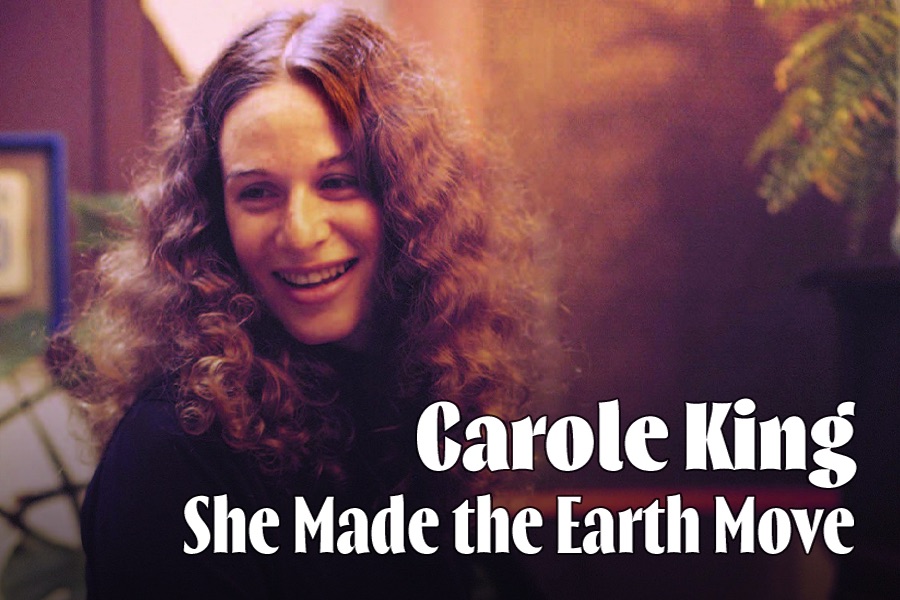
I’m told that Jane Eisner’s book is the first biography of Carole King. How can that be? King is one of the most successful songwriters in popular music, and for many years Tapestry held numerous chart and sales records, plus she had a very successful Broadway musical written about her. Yet, even with a career spent the spotlight, Carole King is a very private person.
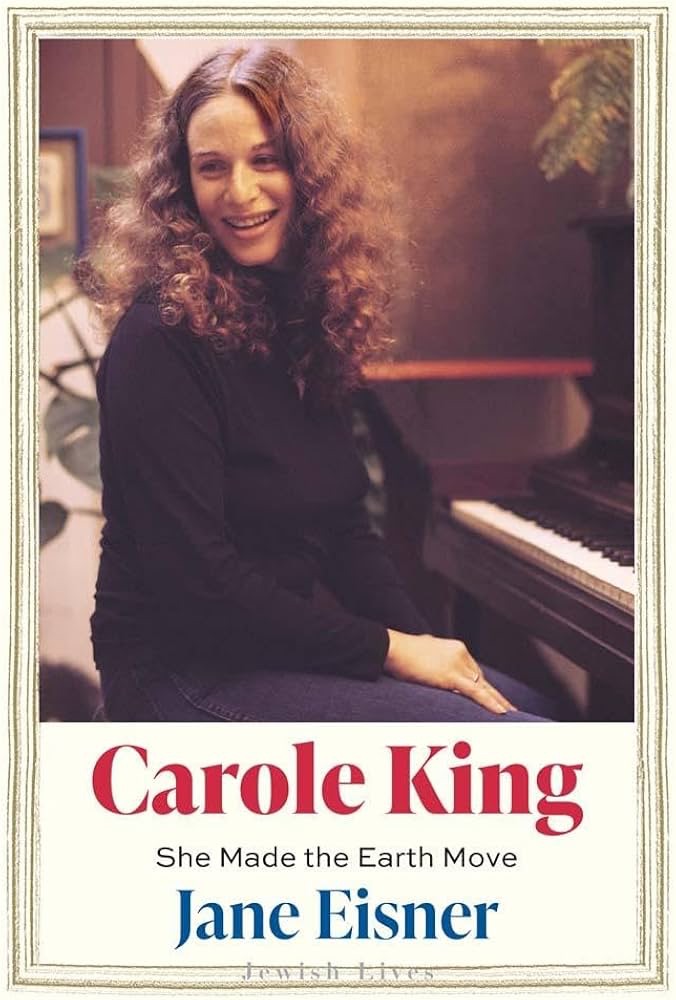
Eisner had to write Carole King: She Made Earth Move (2025, Yale University Press), without an interview with the book’s subject. The first story in Eisner’s book is about the challenge of getting King to approve the Beautiful: The Carole King Musical. She finally agreed with the following condition: King would not see it or help promote it. The past was too painful, even after several decades. Well, she eventually did see the musical and embraced it, but the project was difficult for King and according to Eisner, King prohibited mentioning several aspects and modified the portrayal of the Gerry Goffin character.
In telling King’s story, Eisner provides a grand scope of King’s life and the influence, history, culture and events that made Carol Klein into Carole King. The book is equal parts music and King’s personal life. We learn about the America she was born into, the roots of her family, the influence of New York City, the challenges of being Jewish and a woman, and the hurt that along the way that King buried. A side note, Eisner frequently provides nuggets about King’s life that King chose to leave out of her own memoirs.
King and Goffin had a complicated relationship. Eisner states that King’s relationship with Goffin is very substantive in King’s life going forward, yet never conveys what that means.
King was pregnant and a bride at 17. “They looked like a couple at a high school prom. Forget any idea of a honeymoon—instead, the new couple moved to a one-room basement apartment on Bedford Avenue, a block away from her childhood home. He continued to work as a chemist in downtown Brooklyn. She quit college and took a job as a secretary in Manhattan. At night they wrote songs, which she tried to sell to publishers and record executives on forays into the city that became so frequent, she lost her job.”
Goffin and King made a deal, he agreed to provide lyrics to King’s rock n’ roll melodies, and in turn she would write the music for a musical he had started. Together, they would write dozens hit songs, even continuing to occasionally work together even after they divorced, and Goffin siring a child while they were still married. I never read that in King’s memoirs. Again, part of the hurt that stayed personal.
The story of Tapestry is worth reading the book. The album sold millions, won four Grammy Awards, and influenced a generation of kids to pick up an acoustic guitar or take piano lessons. The songs were intimate, poignant and mature. Producer Lou Alder knew as soon as heard them that King had something special, and he needed to keep the production sparse and focused on King’s vocal and her piano. James Taylor, Joni Mitchell and a few musician-friends worked on the album. Adler told Eisner that it was important to find the right running order, for each side of the album. “It (the album) was a play in two acts. To get to the second half, the record would need to be turned over, and that could provide the ambivalent listener the excuse to tune out, to stop right there. Just as in print newspapers, the reader needs a compelling reason to read past the jump of a story, the album listener needs a compelling reason to continue to that other side.” Adler got it right.
King found stardom intrusive, and still does. Her success as half of a successful songwriting team was much different than success as a singer-performer. As just a songwriter, she was behind the scenes; as the performer, she was the scene. Adapting to the publicity, demands on her time, intrusion into her private life, and impact on her family, were all new, and difficult to her.
King would find success would also prove allusive to hold onto. The time of the singer-songwriter would recede, audience tastes changed and the hits stopped coming. King would enter a puzzling time of her life. Twice divorced in her 20’s, her next choice as a husband would be a violent, drug user, a younger man who would move her to rural Wyoming and die of an overdose. Soon after his death, King would move further off the grid, marry a survivalist and drop off the map.
Eisner writes that King divorced her fourth husband at age forty, having endured a “self-destructive cycle of dependency and abuse.” Which is head-scratching given King’s drive and ability to direct her career. Eisner offers Gloria Steinem’s comment about King, as being the first woman to give a downbeat, alluding to her writing, arranging, playing her own music and distributing her own records. King proved that a woman could do that.
Eisner also dissects King’s music, even discussing song structure, her musical tendencies, and piano style. Eisner reveals that she took piano lessons and studied music theory for two years before undertaking this book.
Eisner interviewed those around King in addition to her other research on the singer-songwriter. These days, King apparently refuses most or all interview requests, preferring to not speak about her life. That’s her choice, she’s published her autobiography and allowed a popular stage musical of her life – isn’t that enough? That’s a rhetorical question.
Carole King is among the last of her generation – the Brill Building songwriters who shaped contemporary music in the 1950’s and 1960’s. Certainly the Beatles and Bob Dylan changed the dependence on outside songwriters. Or did it? Writer/producers are popular in modern music again, they just operate differently today. If you look at the pop, country or hip-hop charts, you see a lot of writers for hire listed on those hits. Even some rock groups will use Diane Warren, Linda Perry, Desmond Child, HARDY, Shane McAnally, Josh Osborne and Ashley Gorley.
Carole King will be remembered for being half of the Goffin-King hit factory, and for the introspective mega-hit Tapestry, and other solo works. Her story is a fascinating one for a variety of reasons.
Carole King: She Made Earth Move is an engaging read about an incredible person who made a lasting impact on popular music.




 Ticket 2 Ride
Leave a comment