
Here’s a challenge: Name five romantic films of the 1970s? Most of the films that come to mind are somewhat tragic in nature, or the love story is just a plot device, not the main theme of the film. Did I mention Love Story? It was the Romeo and Juliet story of the new generation. Not exactly a classic. How about Harold and Maude, Klute, Shampoo, Chinatown, Annie Hall, Cinderella Liberty, The Heartbreak Kid, Smokey and the Bandit, Grease, Last Tango in Paris or Summer of 42? Not your typical love stories. A Star is Born was one of the most popular romance films of the decade; a remake and a tragedy.
Traditional romance was not hip in the 1970s. Not only did there need to be heartbreak, but usually death. Even in a film like Heaven Can Wait or The Great Gatsby – death.
This year (2023) marks the fifty year anniversary of The Way We Were. This film was the most impactful love story of the decade, and still ranks high on the all-time list of romance films.
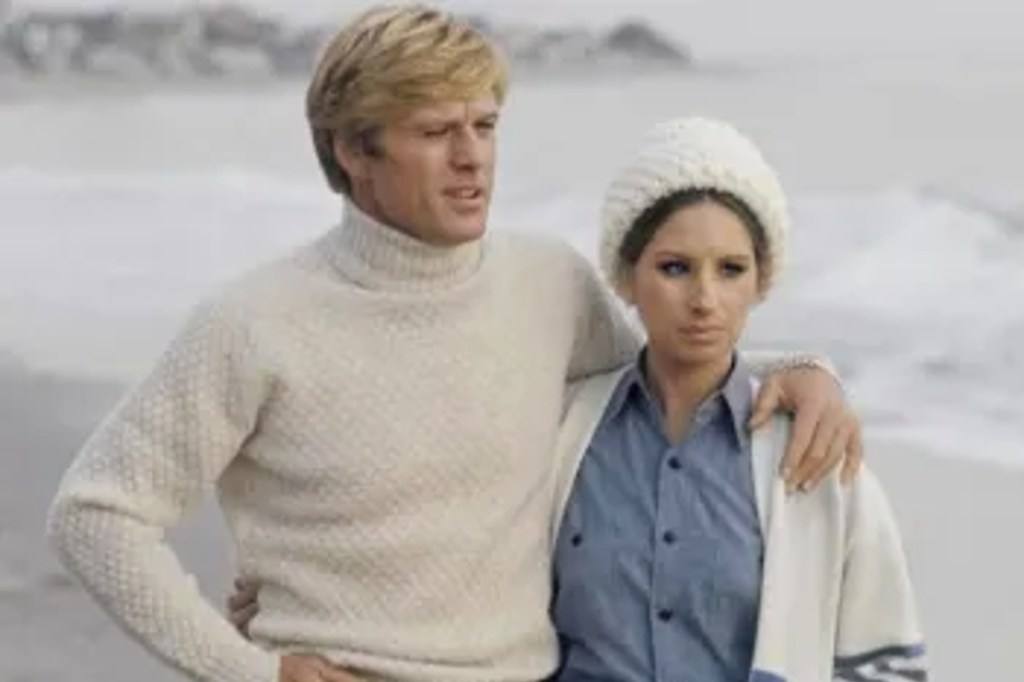
The Way We Were paired Barbra Streisand and Robert Redford, who were both at the peak of their film careers. The film was a huge hit, it certainly had all of the ingredients for success, but that’s no guarantee of anything. Just hiring the top stars, a young and respected director at the helm, an established producer guiding the process, and a great theme song – all great assets, but the production faced major hurdles.
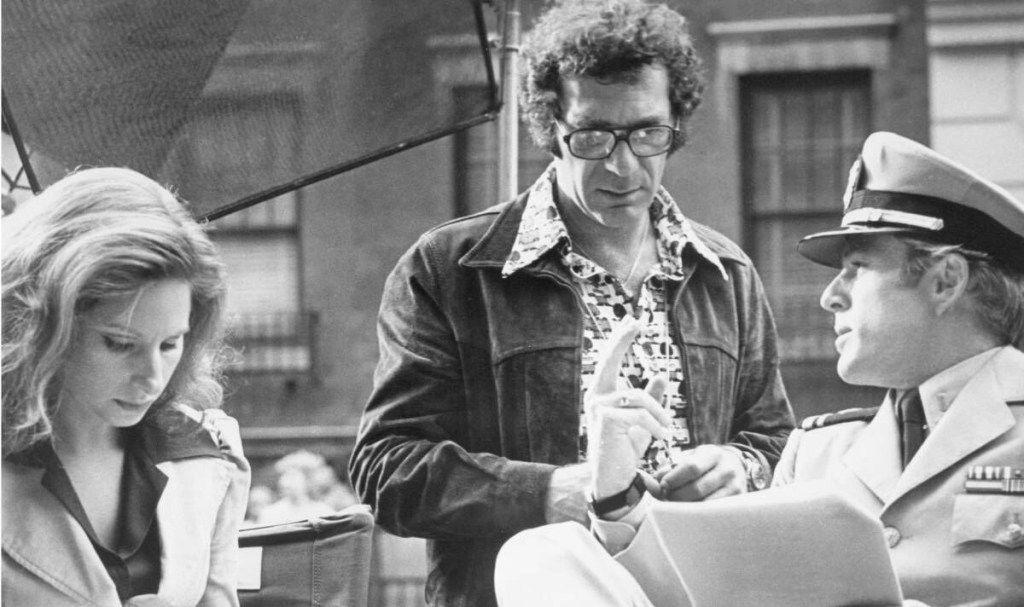
In the early 1970s, Streisand and Redford were hugely bankable stars. The thought of them together should have guaranteed a hit. Should have; but again, no guarantees. Streisand would sing the theme song, but she wouldn’t sing in the film, this worried the studio, which like the other major studios, was experiencing financial issues. Redford took a longtime to be convinced to take the role; he initially hated it, finding no meat on the character, despite fitting the symbolism of the character perfectly. Redford and Streisand could both be difficult and their styles of acting were quite different. Director Sydney Pollack was hired in part because he could navigate their differences and get the best from each.
The film is beautiful, like the two stars. The film is a huge production and it’s all on the screen. The film’s design and photography give it a warm, bright look, and certainly nostalgic at times. The 1970s was known for downbeat, aching relationship films, and The Way We Were certainly has a sad ending, but it also has characters who have spent years cultivating a life together that simply does not work in the end.
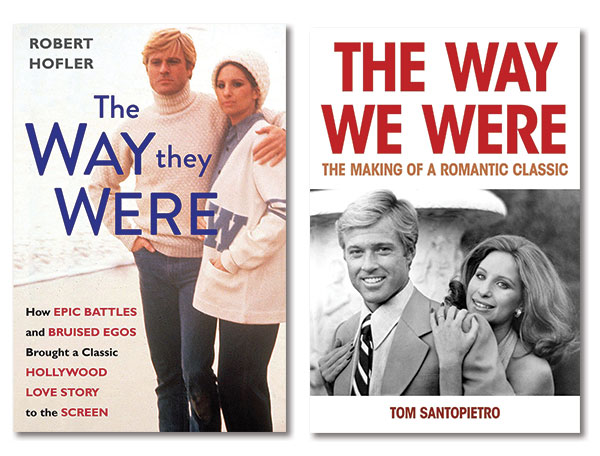
To recognize the film’s 50 year anniversary, two new books each go behind the scenes to look at this film. The books cover much of the same ground, as one would expect, but used different filters to look at the production and legacy.
The film was based on an original script by Arthur Laurents and told the story of two very different people against events, and politics of before and after World War II, specifically communism and the Black List. The story was drawn from Laurents’ own life, and while an epic love story, a film that centered on a character that believed in the plausibility of communism and the stain of the Black List of those suspected of communist leanings and associates. Laurents was fired from the film. Pollock brought in many writers to tailor the script to build up Redford’s character, and keep the love story in the foreground.
Basically, can polar opposites attract? Yes. But stay connected? That’s the drama in this historical love story. Hard times unravel relationships, but in this film it’s success that magnifies their differences until it breaks them.
Tom Santopietro has authored eight other film and celebrity books. He knows his way around the film and theater world. Here, he has put together a very effective look at The Way We Were, using extensive research and offering an insightful analysis of the film. He organizes the book in logical pieces: script origins, the deal, the director, Streisand and Redford, the evolution of the script, shooting, post-production, music, awards, reviews, etc., and then goes through the film’s plot discussing each key scene. All of these are great stories.
The Way We Were is a grand attempt to create a lush, big production love story, with the emotional appeal of a film made in the period this story takes place. Somehow, the pieces not only fit, the pieces formed one single creation. Not all of the pieces were easy fits; failure lurked with this high-wire act with no net.
Santopietro writes that Streisand was an easy hire, she loved the Katie character, and initially, the Hubbell Gardiner character was almost a secondary role to Katie. Redford was cagey about committing to the film; he pushed Pollack and producer Ray Stark to develop Hubbell into more of a three-dimensional character and less of the second-fiddle pretty boy in the script. That was a driving force by Pollack and much of the reason there were about a dozen writers constantly revisiting the script, much to the displeasure of original writer Laurents. Francis Ford Coppola (Patton, The Godfather), Alvin Sargent (Paper Moon, I Walk the Line, The Sterile Cuckoo), David Rayfiel (The Slender Thread, This Property Is Condemned, Jeremiah Johnson) and Dalton Trumbo (Roman Holiday, Exodus, Spartacus) were amongst the writers brought in to rewrite and polish. Trumbo was himself a victim of the Black List.
Katie’s love affair with privileged WASP Hubbell Gardiner was initially rejected – again and again – by Redford who didn’t want to be the “Ken doll” opposite Streisand. While Redford and Streisand got along swimmingly on the set, Redford had been fearful of her big personality and that she might burst into song in the middle of the film. Only over the main titles. Streisand, according to history, had a crush on Redford and had been friendly with some of her past leading men. Redford was married at the time and was aware of the attraction between he and Streisand during their love scenes. As he admitted later, he wore extra padding down below to insulate himself from being too much in character while in bed with “Katie.”
Robert Hofler has also written a very dense book about the film and interestingly goes deeper into many areas that Santopietro does not. Hofler is a theater critic and author of several best selling books on celebrities and show biz. Hofler’s book covers the same facts, but seems more focused on the background of the participants and the controversies, of which there were many. Battles were everywhere, but mainly between Laurents and Pollack, and Redford and his character. Hofler seems to suggest that Streisand cared less about the politics in the film than the love story, and that Redford cared more. I don’t know if that’s true, but from what I’ve read, and Streisand’s comments in the twenty-fifth anniversary film commentary, the politics of the Black List were central to her character.
The Blacklist was the spine of Laurent’s story, it was his story, and it appealed to Streisand, as it was central to Katie’s core values. As the politics of the film were reduced to enhance the love story and quicken the pace of the film, Streisand saw key story moments removed. There is a deleted scene of a pregnant Katie stopping to hear a young female student lead the charge on a political issue – in essence a younger version of herself. Katie is tearful because that used to be her, but not now.
It’s unfortunate that the conflict between Laurents and Pollack was so consuming. For Laurents, it was both professional and personal, and they seem intertwined. Laurent’s was a playwright and believed in the sanctity of the writer. In the film business, films are rewritten even during filming, and reshaped in editing, and even after test screenings, which happened to this film. He felt betrayed and his story unfairly changed. Given the reaction during test screenings, a more politically-focused would have been more accurate to history maybe, but the film would have died at the box office. Pollack was smart enough to know the love story was the key and not only did he need to emphasize it over the politics, but he had Redford and Hubbell to contend. Without Pollack, Redford would have passed on the film, and without Redford, Pollack wouldn’t have been offered the job to direct. They were a package deal in a sense.
The effort to get Redford to agree to the film was only part of the battle. He constantly pushed to beef up the part, but to make Hubbell stand on his own, not just plot device for Katie’s character. Redford might have looked like a “Ken” doll, but he wouldn’t play one. While the other writers fleshed out the Hubbell character, Laurents was annoyed and pushed back. Redford and Pollack were friendly and had worked on other films, but Redford didn’t hold back in his frustrations. Katie’s character was based on Laurents’ own life, and the script was written with Streisand in mind. She was hired first and got top billing (Redford received a larger salary), and sang the title song. In both books, Redford is presented as weary of Streisand, her large personality, her drive for perfection, her difficulty on the set, and the mannerisms she is known to frequent her characters. Redford wanted his character to stand on his own and not just be a “reactor” to Katie. Pollack had his hands full.
Ray Stark was the producer of record, and he would own the film’s negative, but it was Pollack who pulled many of the strings. Stark wanted Redford to play Hubbell and Pollack had gotten him, that gave Pollack clout. Although in hindsight, Pollack would give others the bulk of the credit for the film’s success, but Pollack was the orchestra conductor. Stark was ready to hire Ryan O’Neal (Love Story, What’s Up Doc?), who had a relationship with Streisand and would have fit comfortably in Hubble as a lesser character in the film. O’Neal was riding high at the time, but his star-power wasn’t in the same league as Redford.
Redford and Pollack would make films together. When Pollack died in 2008, Redford told Time magazine: “I think Sydney’s ability to connect the more commercial strain with the more abstract was a special gift.” To Pollack, the the challenge was to balance commercial sensibility with a story of value and purpose. Stark was fortunate to have selected Pollack, both as a director and onset producer. Pollack not only turned in a successful film, he managed the many script revisions and provided the care and feeding of his two stars.
Both books look at the relative difficulty of Streisand and Redford on the set. Streisand it was feared, would be demanding, requiring multiple takes, changing in lighting, problems with the script and temperamental. While she did offer suggestions and was intense, she was not the problem for Pollack; Redford was.
Both Santopietro and Hofler reveal how conflicted Redford was about this film. This would be the biggest film for him, and offered benefits and risks that could help or hurt his career. I believe that Redford was fearful. His star was ascending, but he had not been primarily responsible for a big budget film, where a dramatic performance was demanded, and a convincing romantic performance at that. He wasn’t piloting this film alone, Streisand had been tasked with a non-singing, big dramatic role; a role written especially for her. No pressure. She was also under contract to Stark, who had signed for to a four-movie deal. Stark wanted a big hit and Columbia Pictures needed a big hit to steady their wobbly financial status.
After post-screening edits, The Way We Were opened big, earning $50m at the box office, giving Columbia Pictures an earnings boost. Although reviews were mixed, the film’s legacy has surpassed any lingering criticism, as well as production controversies. The title song, which is probably what people remember most about the film, became a number one hit and won Academy Awards, Grammys and Golden Globes.
If you would like to learn the backstory of The Way We Were, either Santopietro and Hofler will accomplish this.



 Ticket 2 Ride
Leave a comment