
Greyhound is a World War II film about a convoy of 37 Allied merchant ships under fire by German U-Boats in the North Atlantic. Tom Hanks plays the captain of the Greyhound, one of several naval escort ships. In early promotional materials, one might have mistaken Hanks for the driver of a Greyhound bus.
The destroyer’s actual name is the USS Keeling, but the code name is Greyhound. It is 1942, America is new to the war and Hanks’ Captain Krause, is new to naval combat with experienced U-Boats who hunt in packs and harass American ships over the radio. Krause is new to command, and it shows. The film takes place over the five days that the convoy is in the “Black Pit,” the area of the Atlantic the ships are without Allied aircover.
“After the U.S. entered the conflict in December 1941, U-boats enjoyed great success off the East Coast: Between January and July 1942, 90 ships (including four U-boats) sank off the coast of North Carolina, and more than 1,100 merchant seamen died, according to the Monitor National Marine Sanctuary.” – Smithsonian Magazine

The film is based on the 1955 novel, The Good Shepherd, by C.S. Forester (Sink the Bismarck!, The African Queen). Supposedly, after publication, an adaptation was intended for Humphrey Bogart, but never made. Greyhound was made by Sony in 2018, but sold to Apple TV+ at the beginning of the pandemic and premiered in 2020.
Greyhound was directed by Aaron Schneider (Get Low) and adapted by Hanks. His Playtone company co-produced the film. Forester was recognized as an authority on naval battles and the dialogue contains detailed navigational and gunnery commands for Capt. Krause and his officers. Forester wrote a series of Horacio Hornblower novels that were made into television movies.
Krause not only captains the Greyhound, he commands British and Canadian destroyers also providing shield to the merchant ships. He has a great deal of responsibility and struggles to carry it out. From the time they lose their aircover until the time it picks up again, Krause is on the bridge and in command. Without sleep, turning down his meals and withstanding the cold and harsh conditions, Krause is running on just fear and duty. He is so new and focused on doing his job that he fails to remember the names of his crew, including calling his mess staff replacement by the name of a recently killed man he replaced. That, and his moments of difficulty of command, are not lost on his crew.
As an example, a convoy ship is hit and is sinking. Krause has to make a decision, rescue any survivors, or break off and protect two merchant ships lagging at the back of the convey and vulnerable. He chooses to pick up survivors, which number only four. The two merchant ships are hit by torpedos and sink, with only a few survivors. Was his decision wrong? The looks on his crew’s faces make you wonder. Hanks finds great acting opportunity in flawed characters. Krause is a good man, but it appears he is in over his head against more experienced adversaries who hold all of the advantages. Mounting ship losses, exhaustion, a short supply of depth charges, and deaths on his own ship have rattled Krause. The German U-Boats have tricked him to unnecessarily use his depth charges. Inexperienced American naval crews were at a big disadvantage and underwater tracking technology was not what it would be later.
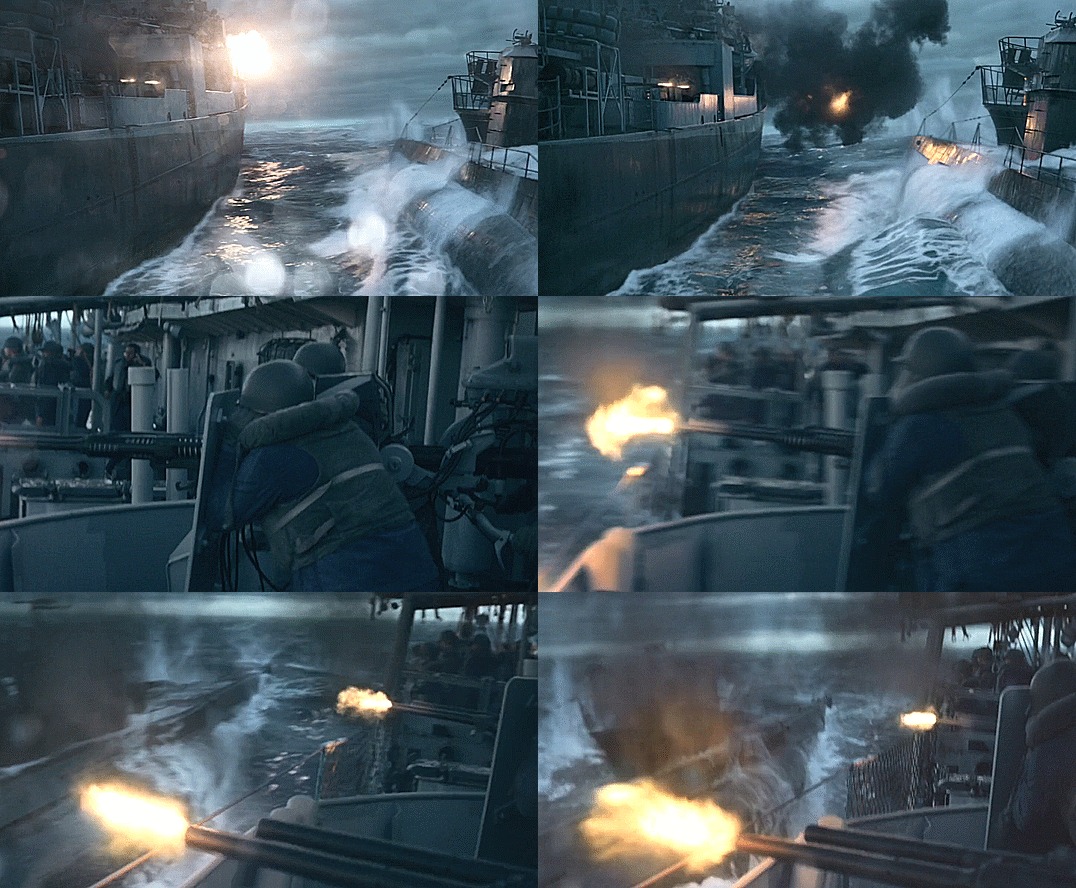
U-Boats also use the strategy of running on the surface too close for destroyer big guns to be effective, but the smaller U-Boat guns inflict damage on the surface ships. This did in fact happen more than once during the war.
A close encounter happened between a U-boat and the Canadian destroyer, HMCS Assiniboine. Rifle, machine gun and small arms fire was exchanged, with the U-Boat sinking. Another example of close contact fighting between a surface ship and a submarine was the U.S.S. Borie and the U-405. “The destroyer was attempting to ram the German submarine when a wave sent its bow crashing down on top of the submarine, trapping the ships in a ‘lethal embrace,’ wrote Howard R. Simkin for Naval History magazine. The U-Boat quickly sank and the Borie had to be scuttled the next day.
There is also a scene where Kruse turns the ship to deflect a torpedo. “A torpedo hitting at an oblique angle so the front tip didn’t hit is something that could happen and did,” says marine historian Gordon Laco, who served as a technical advisor on the film.
An action film like this with a mid-level budget and some large sea battles is fairly dependent on CGI. The production used several real ships for filming and 3-D scanning, but a good portion of the film is CGI, as expected. The look of the film is gray, black and dark blue as the film happens during the night or ocean storms, which matches the grave emotional tone of the story. Only the occasional exploding ships are orange and bright colors.

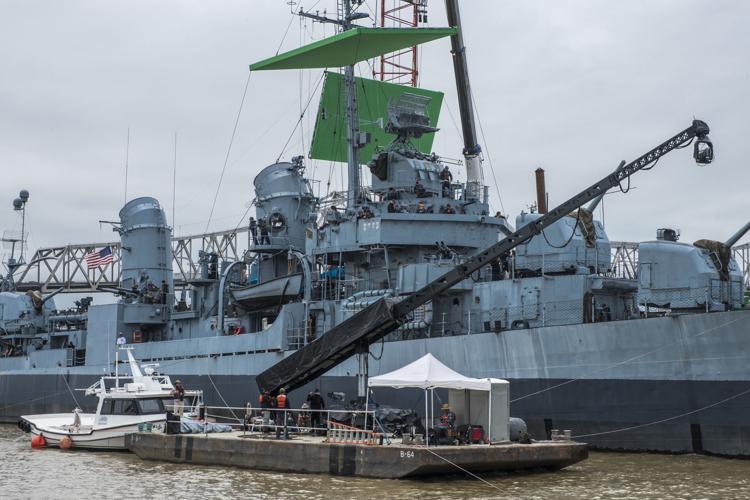
The film has been criticized by some for only being 91 minutes in length and very limited development of other characters. It’s a trade-off. A lot happens in those 91 minutes and the viewer feels the tension and fear of the crew, especially the convoy races to the availability of aircover as the wolfpack of U-Boats are just waiting for the right time to attack. The film flows at a fast pace, keeping the suspense taut and efficient. Unfortunately, the supporting characters remain cloaked in the background.
Is this a great film? No, but it is a very good one. There is a lot of navigational jargon tossed around and one has to understand the capability and limitation of the sonar technology. We have all seen more current-day films of submarine warfare and trickery, this film is more old-school, since it is in the early days of the Battle of the Atlantic. Had the Germans broken the lifeline of war supplies, fuel and food to Britain, WWII would certainly have been quite different. From 1939-1945, it is estimated that 80,000 merchant seamen, naval and air personnel died in the Atlantic. During the first six months of 1942, 86 ships sank off the coast of North Carolina; that’s how close the war came to the east coast. Films about submarine and surface ship engagement are favorites of mine. I look forward to watching this film again to see what I missed the first time.


 Ticket 2 Ride
Leave a comment