
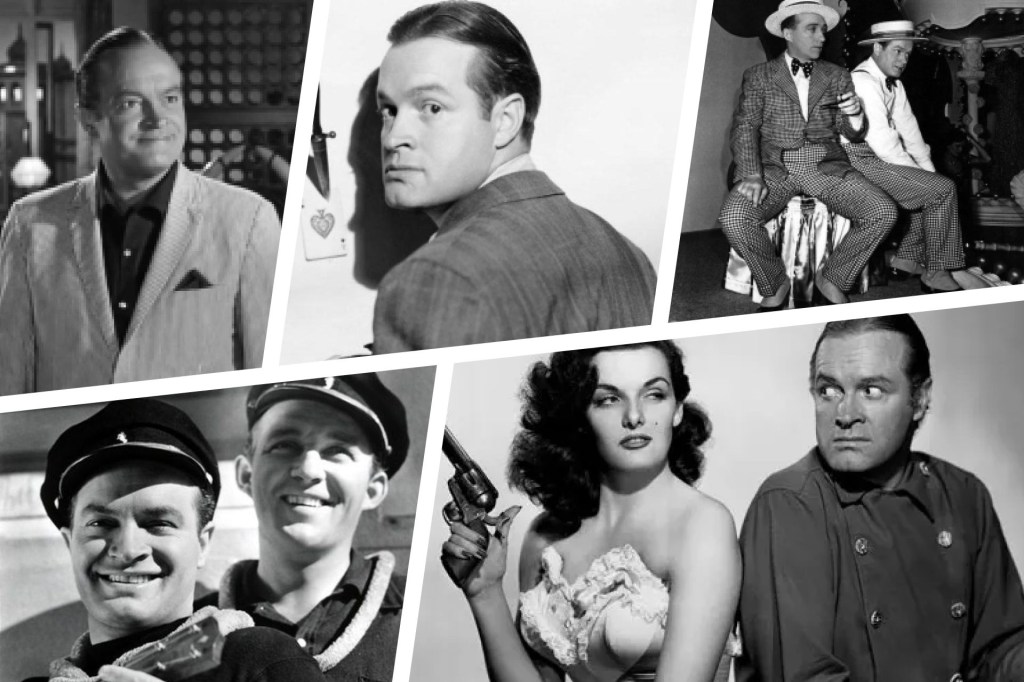
Bob Hope might not have invented the unlucky, wisecracking snook, but he popularized it and rode the character across more than three decades. Woody Allen might not have had a career without Hope films; one sees a homage to Hope in Allen’s 1970s films.
Hope had big successes with the Road films, with his pal Bing Crosby, but I liked Hope’s later comedies, although they definitely ran of out gas by the mid-1960s. Hope played versions of the same character, the bumbler who stumbles into danger and with the help of a companion is able to wriggle to heroics on a joke or song.
One variation of this character was a successful man who is not a boob, but nonetheless winds up with a big problem and tries charm and jokes to solve the dilemma. Many of Hope’s later films like Bachelor in Paradise, Critic’s Choice, I’ll Take Sweden, and A Global Affair all riffed off of this variant. Hope was older and tried to give his character a bit more sophistication. Eight on the Lam, Boy Did I Get a Wrong Number and Call Me Bwana didn’t try sophistication, they went for worn-out jokes and poorly done physical comedy. Audiences weren’t buying the flimsy stunts and production values of Bob Hope films.
Hope knew he needed someone to play off of and wasn’t afraid to share the screen. Besides pal Crosby, Hope paired with Paulette Goddard, Lucille Ball, Lana Turner, Elke Sommer, Jill St. John, Tuesday Weld, Anita Ekberg, Rhonda Fleming, Martha Hyer, Katherine Hepburn, Jane Russell, Jackie Gleason, Eva Marie Saint, Joan Fontaine, Dorothy Lamour, Virginia Mayo, Marilyn Maxwell, Jonathan Winters, Walter Slezak, and many others who played the straight-man or love interest for Hope’s bumbler. His female costars were usually younger, beautiful and out of his character’s league.
Hope maintained a group of writers who collaborated on his scripts and punched up the jokes, in addition to writing his television specials and USO appearances. It’s easy to see the template for most of his films and he didn’t stray far from the formula, although Hope did attempt to stay current with his choice of leading ladies and topical generational humor, but wasn’t Hope a product of his era? Of course he was. As he got older, wealthier and more conservative, his humor skewed those demographics.
A Bob Hope film was a glorified TV movie of the week. Like the Dean Martin films of the era, these were ninety minute sketches sewed together by a flimsy story and punctuated with a song and some jokes. The films might have looked good on the screen, but these were not expensive or well-crafted works. Hope and Martin cranked out two or three films a year. Finish one, move onto the next; headline clubs or Vegas, put in the time at NBC for a special or series; and drop in to chat with Johnny Carson.
Here’s an example of both Hope and Martin on The Tonight Show, with comedian George Gobel. The real party starts at the 11:30 mark.
Hope’s film career bottomed out for several reasons including over exposure. The man worked all the time: six or more television specials a year, appearances on talk shows and other variety shows, personal appearances and concerts, product endorsements, books and magazine articles, and several films annually. His films were poorly written and cheaply made. When Hope took over producing his own films, he was his own boss. His films were made on modest budgets and he employed directors who worked fast and took orders. His writers recycled plots and spent time on jokes rather than developing compelling stories or characters. The edgy, inventive ideas of his early was replaced by conventional and worn scripts. His films became as threadbare as the later television specials. Hope simply stopped putting in the work as a film actor and producer, no wonder as business interests and a heavy travel schedule took him all over the world. He was a wealthy man, heavily invested in real estate and at the time, the largest private landowner in California.
Entertainment in the 1950s-1960s, was a very consumable commodity, a short shelf-life, and keep feeding the machine. Television series were not generally filmed to last, and seasons consisted of more than 30 episodes. During summers, new shows were plugged in while others were on hiatus. Radio focused on hits, so bands like the Beatles were constantly recording and releasing several new singles a year. Even Perry Como and Andy Williams constantly released albums and singles to feed the public’s need for more product. Elvis, Paul Newman and John Wayne moved from film to film, keeping the theater and drive-in supply chain filled. Films might show up on the television late show, but then weren’t heard of much, records were released and might appear again on greatest hit albums, and television shows might make it to syndication, but most disappeared.
Let me pause for a moment and say this – I was a big Bob Hope fan as a kid. It was his films and TV shows of the 1960s that I watched. Most of his films I saw at the neighborhood drive-in theater or a Saturday matinee. I didn’t care that the jokes were obvious or the comedy slapstick. There was an adult quality to his films that was harmless, but suggestive. Hope tried to be suave but was usually a coward of bumbler, great family fare. I look back on those films with good memories, but some disappointment.
Bachelor in Paradise (1961) was a tame sex comedy starring Hope as a best-selling writer of books about the love lives of bachelors around the world. He is forced to move to a new suburban community, Paradise Cove, to write a fast book to pay off an IRS debt. Lana Turner, Janis Paige and lonely wives get mixed up with Hope, wisecracking bachelor. Sex comedies were the rage then, but hardly offensive when Doris Day, Rock Hudson, Tony Randall, Cary Grant and James Garner are the leads. Hope’s character is suave, quick-witted and irresistible to young women, considering he was 58 at the time. The film offers a time/capsule view of California suburbs and the American Dream. The script has some wit and stylish observations, and a cheerful Henry Mancini soundtrack. Hope’s character dictates his book into a tape recorder as he comments on the mores of suburban families. This was the dawn of the Kennedy era in America: big cars with fins, garishly decorated ranch style houses, housewives that patrol the supermarkets, single women on the hunt for husbands, and suggested racy adult behavior. Even a guy pushing 60 was getting into the changing social mores of the new decade.
Call Me, Bwana!, Eight on the Lam, and Boy, Did I Get a Wrong Number! followed and were not good films, but I sure did like them as a kid. Maybe the predictability of the scripts and jokes was what Hope’s target audience wanted and expected? As a member of that audience, I can attest to that.


 Ticket 2 Ride
Leave a comment