
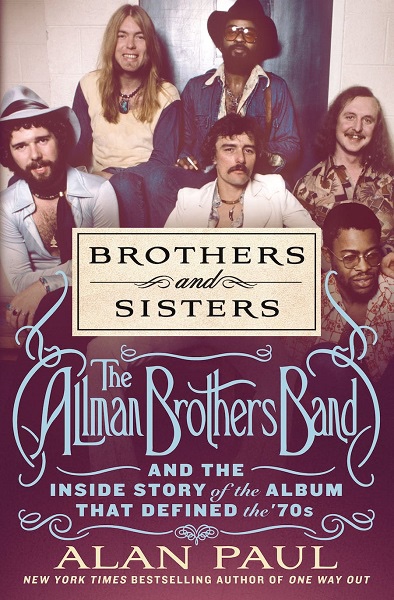
The story of the Allman Brothers Band has been told in a variety of books, including a different book by Alan Paul, but this one, The Allman Brothers, and the Inside Story of the Album That Defined the ‘70s (2023, St. Martin’s Press) focuses on the years 1971-1976, the most successful period of the ABB.
Paul is arguably the biographer of The Allman Brothers Band, conducting years of interviews with ABB members and others in their inner circle, listening to hundreds of hours of taped interviews with the band, record company reps, family and tour crew, and doing just good research. Paul’s book is even advertised for sale on the ABB official website.

To say the one particular album defined a decade is a tall order to fill. Brothers and Sisters is easily the best Allman Brothers Band album, and one of the best of the decade. If you are equating it to sex, drugs and rock ‘n’ roll, Paul may have a point. At any rate, the book is a wealth of information about the greatest five years in ABB history.
For a point of reference, it was October 29, 1971 when Duane Allman died in a motorcycle accident. The band’s third album, At Fillmore East, was recorded at two concerts in March of that years. The ABB had marginal success with their first two studio albums, before realizing that that stage was where the magic happened, so producer Tom Dowd got a mobile recording truck and taped their shows for a live album release. The band was playing 300 shows a year. The album captured the energy and fluid play between the band.
Duane Allman had just wrapped up recording with Eric Clapton’s band for Layla and Other Assorted Love Songs. The year was bringing great reward and recognition to the band, then suddenly, their leader and anchor was gone.
Paul picks up the story, instead of imploding from grief and substance abuse, the band went to work. The entire band dealt with drugs and booze, Paul writes that four of the five were in treatment with only Gregg not dealing with him problem.
Work was underway on their third studio album, which would be called Eat a Peach, when Duane died. According to producer Dowd, Duane was the only member of the band that he worked with on scheduling, songs and the sound. Now they had to figure out how to work without Duane.
Eat a Peach, released February 12, 1972, had some strong new songs and also contained some live recordings with Duane. It sold well, reaching number four on the charts. “Melissa,” “Blue Skies” and “Ain’t Waistin’ Time No More” are the standout tracks.

It looked like the band was getting its feet on the ground when bass player Berry Oakley was killed in a motorcycle accident. Oakley had taken Duane’s death hard and his large presence in the band was another loss for a group struggling for leadership. Paul writes that Oakley’s drinking caused him to be unpredictable and undependable, even falling off the stage while playing. A crew member was assigned to stand at the edge of the stage in case Oakley fell.
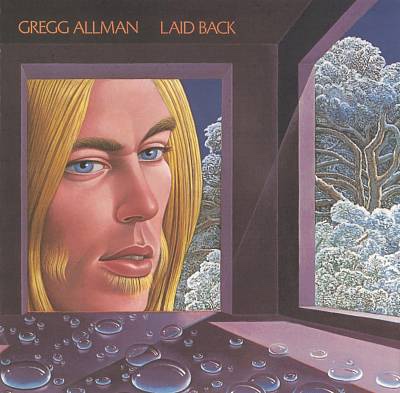
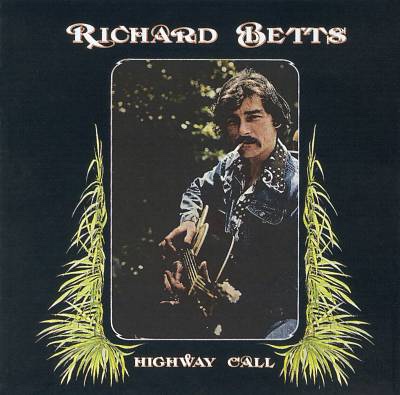
Gregg began recording what would be Laid Back, his first solo album. The making of this album would overlap with the ABB’s Brothers and Sisters. Dickey Betts would also begin recording his own solo album, Highway Call, and both Gregg and Dickey would both launch solo tours at the same time. Interestingly, both albums would sound quite different from ABB albums. Gregg went searching for ballads, soulful and aching, and songs augmented by strings and horns. Gregg would record his own version of Midnight Rambler,” and cover his friend Jackson Browne’s “These Days,” perhaps the definitive version of his reflective song. Dickey Betts moved toward country and Western swing, using fiddle player Vassar Clements prominently on the album.

Brothers and Sisters was the ABB’s high water mark. The band hired Lamar Williams to play bass, and Chuck Leavell as a second keyboard player. Gregg focused on the organ and occasional guitar. Dickey was the only guitarist in a guitar-band. He continued songwriting and stepped out to be a co-lead vocalist. The vacuum left by Duane and Berry Oakley was now filled by Dickey. His “Ramblin’ Man” became a number one hit, the only one the ABB had.
The addition of Leavell and Williams changed the sound of the ABB. Paul writes that Williams’ playing was much different from Oakley’s. Paul says that Williams “stayed in the pocket,” meaning he carried the groove instead of playing the bass like a guitar. The drummers could count on Williams being where they expected to be. Leavell was a second lead on piano, freeing Gregg to focus on the organ, and doing creative fills and support for Dickey. Paul implies that the band was tighter and a more structured style of jamming.
Brothers and Sisters cruised to the top of the Billboard chart and surpassed a million copies sold. The best songs are: “Wasted Words,” “Jessica,” “Ramblin’ Man,” and “Southbound.”
The new version of ABB were riding a wave of success, both commercially and artistically, yet it coincided with both Gregg and Dickey interested in side projects, that although were well-received critically, did not sell like ABB albums, nor were their solo tours as commercially successful. The ABB organization had a high overhead, a lot of people on the payroll, so with the ABB off the road for a big part of 1974, it was costly to the band. Paul writes about the huge number of roadies on the payroll, some who were simply friends who needed work or people who were simply there to hang out with band members on the road. The roadies even had their own band that played during sound checks. Rock and roll excess during the 1970s.
Paul gives ABB a lot of credit, rightfully so, for the evolution of the Southern Rock genre. The Marshall Tucker Band and Lynyrd Skynyrd both received a lot of mention in the book. While MTB were label-mates, Skynyrd was not, so while the history is interesting, it’s not essential to the ABB story. What’s noteworthy is that these bands also got screwed financially by greedy management and record companies.
One of the best sections of the book covers the relationship between the band and Governor Jimmy Carter, who was a huge fan of rock music and the ABB. Carter, who told them early on that he was running for president, was helped out financially by benefit concerts to pump some cash into Carter’s strapped campaign. Although the amount was not huge, it was critical to keep Carter afloat. There are some very good books that cover Jimmy Carter’s love for music and the arts.
As Gregg and Dickey developed their styles and comfort in the limelight, the band was changing, and that increased tensions and chipped away at the unity, particularly the onstage feeling of brotherhood. Paul quotes drummer Butch Trucks as saying the band stopped talking to each other onstage. Percussionist Jaimoe said the solos became self-indulgent and the other musicians had to adapt to what Gregg and Dickey were doing; rather than being in a joint groove and feeding off of each other.
Tensions with the record company and Phil Walden heated up when band members demanded to see contracts and financial records, and even began hiring separate management and lawyers. Trucks said they weren’t asking questions and put their trust in Walden and his people.

The ABB did not record an album in 1974; Dickey and Gregg were pursuing solo projects. The next album would be Win, Lose or Draw, which producer Johnny Sadlin said was the hardest album to make. Gregg was in L.A. with Cher, who he would marry in 1975. Jaimoe, Lamar Williams and Chuck Leavell had so much time without the others in the studio that they would soon form the jazz-fusion band, Sea Level.
After the new album came out, the band toured, but some of the concerts were canceled because Gregg was ensnared in a federal drug probe that forced him to testify and one of the road crew was sentenced to prison. The band was angry with Gregg for testifying and being a “rat.” Cher gave birth to Gregg’s son. What should have been a happy time was less so.
The band broke up, but would reform several times over the next few decades. Dickey Betts was fired from the band in 2000, never to play with the band or any members of the band. The addition of guitarist/songwriter Warren Haynes in 1989 gave new life to ABB, and in 1999, Derek Trucks, the nephew of Butch, joined as a second guitarist. This version of the band with Haynes and Derek Trucks was very good. When both left the band in 2014, the Allman Brothers Band was retired.
##
Things I learned from this book:
The Allman Bothers Band and the Grateful Dead had a mutual respect and developed a close relationship. They performed together in the early years. Dickey’s guitar sound was heavily influenced by Jerry Garcia’s guitar sound.
In July 1973, the ABB, The Band and the Grateful Dead headline Summer Jam at Watkins Glen. While 200,000 tickets were sold, an estimated 600,000 were in attendance.
The ABB had a difficult relationship with Phil Walden, the founder of Capricorn Records. Walden was also their manager, songwriting publisher, head of the touring company, merchandise company and stage rigging company. Walden signed the band to some bad contracts and earned a big share of every dollar the ABB made.
Gregg and Cher quickly realized their marriage was a mistake – like the very day they tied the knot in Las Vegas.
New Year’s Eve 1973, the ABB were headliners of a radio concert heard by an estimated 40 million listeners.
Gregg’s solo tour in 1974, like his album Laid Back, was a departure from a ABB tour. He used a set designer (which ABB didn’t use), began wearing the white suit onstage, and used backing singers and orchestral backing.

 Ticket 2 Ride
Leave a comment