
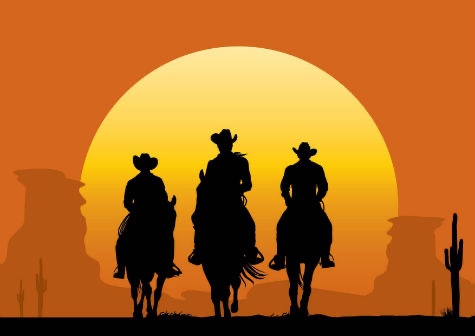
No, this is not of list of locations of the Best Western hotel brand, although I did stay at numerous hotels in my youth. This blog is about Western films. I can’t say I’ve seen every Western made, just a healthy number of them. The Western, like jazz, is a truly American art form and experience.
The Western was not defined specifically by time, but is generally the second held of the 1800s. The Western is a story of conflict, heroism, freedom and morality. It’s a genre that was as wide-open as the prairie or the mountain range. Any type of story could be framed as a Western, which made the genre very popular in the 1950s and 1960s.
Heroes were easy to spot in the traditional Western, as was the line between right and wrong. Themes were bright and crisp, even when studios sought to expand the genres with comedy, thrilling action, and social commentary. Westerns were so popular that writers had to pull the genre out of the well-worn wagon ruts to create increasingly interesting plots and characters the public couldn’t see on the new invention of television. Funny thing was, the suppliers of television and film Westerns were the same people.
There are many sub-genres of Westerns, including the revisionist stories that folded the genre back onto itself where the hero might be less than righteous and the West is a confusing and uncertain place. The revisionist Western is similar to the film noir shades of gray and psychological undercurrents of film dramas of the 1940s-1950s. There are also cavalry Westerns, singing cowboy Westerns, comedy Westerns, revenge Westerns, cattle drive Westerns, wagon train Westerns, mystery Westerns, modern day neo-Westerns, and the good ole traditional Westerns.
Here are some of my favorite Westerns across a myriad of genres.
Once Upon a Time in the West (1968) – For my money, the best Western ever. It was everything: evil villain, flawed heroes, grand vision, beautiful scenery, thirst for progress, great music. Sergio Leone directs, Charles Brown, Jason Robards, Claudia Cardinale and Henry Fonda star in this epic. A great Ennio Morricone score.
City Slickers (1991) – Not a Western? Sure it is. Cowboys, cattle drive, heroism, camaraderie, purpose. And humor. Billy Crystal co-wrote and produced.
High Plains Drifter (1973) – The best of the Clint Eastwood Westerns, and the first he directed. A ghoulish sense of humor. Odd, off-balanced, an almost a surreal feel to this film.
Rio Bravo (1959) or El Dorado (1967) – These are generally the same film. Howard Hawks directed, John Wayne starred and both films co-written by Leigh Brackett. Drunken sheriff, holding a prisoner his men want to break out of jail, sheriff’s friends hold them off till help arrives. Directed with a light touch and a dab of romance.
The Magnificent Seven (1960) – Majestic musical score, David v Goliath story, rising young stars, exciting action, a colorful villain. A new Western for a new generation. Steve McQueen, Yule Brenner, Eli Wallach, Robert Vaughn, Charles Bronson and James Coburn star.
The Wild Bunch (1969) – Sam Peckenpah’s bloodbath of robbery, escape and vengeance. Another David v Goliath story. Anti-heroes out to right a wrong. Death filmed in slow-motion with lots of blood. Controversial when released, it changed Westerns.
Butch Cassidy and the Sundance Kid (1969) – The classic anti-heroes, flawed but really not totally bad. Newman and Redford, with a terrific script by William Goldman. The dying days of the West, outlaws on the run, all the way to Bolivia. Lighthearted and melancholy.
Hombre (1965) – Paul Newman as a Native American-White man who tries to live in the White world, but finds no peace, only greed and killing. Taut, dusty, downbeat. The morality is blurred.
Stagecoach (1939) – Strangers traveling by stage in dangerous territory. Each with a unique story, and their own personal baggage. They must put aside their differences to survive. John Ford and John Wayne. Monument Valley. Will the cavalry arrive in time? A final shootout for the Ringo Kid against three murderers. Thrilling and tense.
Support Your Local Sheriff (1969) – James Garner, a great supporting cast, in a comedy Western. Smartly written and acted. For me, the best comedy Western, with the exception of Blazing Saddles. Joining Garner is Jack Elam, Joan Hackett, Harry Morgan, Walter Brennen, Bruce Dern and many other familiar faces.
Blazing Saddles (1974) – Mad Magazine meets the Marx Brothers. Absurd and gut-wrenching. Profane and insulting. Prepare to laugh. This parody of not only Westerns, but big Hollywood films in general was a bullseye for Mel Brooks.
Shane (1953) – “Shane, come back!” That line is a heartbreaker as the little boy calls after this man he has come to idolize. But Shane doesn’t want to be idolized. An anti-hero? Yes, in deed. Alan Ladd was often dismissed because of his short stature, but he is large and powerful, in an understated way. Like the James Stewart-Anthony Mann Westerns of the 1950s, Shane has a dark undercurrent despite the Technicolor landscape. The fight scenes are brutal and the viewer can feel the punches.
Ride the High Country (1962) – The precursor to Butch Cassidy and the Sundance Kid, and maybe the first buddy picture. Joel McCrea and Randolph Scott team up to transport gold and it brings out the best and worst in each. One of the first revisionist Westerns, these two old cowboys know the trail ends soon, but they go anyway. Directed by Sam Peckinpah.
Open Range (2003) – A cattle drive results in a battle of wills between the cattle drivers and a land baron who refuses crossing and sets off a deadly battle. The film is at the heart of what Westerns represent, ideological and cultural conflicts, settled by primal means, being the law of the land. The gunfight at the end is to die for. Literally.
Lone Star (1996) – A neo-Western, written and directed by John Sayles, starring Matthew McConaughey and Kris Kristofferson. Tale of a crooked sheriff who may have been murdered by the man who took his place. The complex story alternates between the present and 40 years ago, as the new sheriff investigates his father and the crooked sheriff.
Jeremiah Johnson (1971) – Johnson leaves civilization for life in the mountains. He doesn’t want to rely on anyone, but has to until he can learn to survive. His new idyllic world is destroyed as he violates the boundaries of a Crow burial yard. He has coexisted with various tribes until then. He seeks revenge, and once again is on his own, wiser but not happier. Robert Redford is directed by Sydney Pollack in a beautiful, quiet story. A simpler version of Dances With Wolves.
Hidalgo (2004) – A distressed cowboy and his Mustang travel to Arabia for a long distance race against purebred horses. This is a film about redemption and courage. At the end of the film, the cowboy turns Hidalgo loose to return to his own tribe of wild horses.
McCabe & Mrs. Miller (1971) – Robert Altman’s story of a gambler who builds a brothel, partnering with a prostitute, in a remote mining town, then gets squeezed out of business. This is a dark, stylized film, downbeat, with characters that are difficult to like, but you learn to care about them and get drawn into this murky, unsympathetic film.
My Darling Clementine (1946) – I had forgotten what an incredible film John Ford made of the Earp-Clanton conflict. Largely fiction, it replaces fact with high-powered action and drama. One of the most beautiful Westerns ever filmed. Henry Fonda, Victor Mature, Walter Brennan, Ward Bond, Tim Holt and Linda Darnell – what a great cast.
Tombstone (1993) – An updated and stylized version of Earp-Clanton story. Kurt Russell leads a marvelous cast. Bushy mustache galore! The Cowboys, which includes the Clantons, Johnny Ringo, Curly Bill Brocius and others) are depicted as hotheaded sociopaths which amps up the body count.
The Hateful Eight (2015) – This is a murder mystery, unusual for a Western, so it’s on my list. Tarantino is a masterful filmmaker, so argument. Kurt Russell and Samuel L. Jackson are to Tarantino as what Robert De Niro and Leonardo DiCaprio are to Martin Scorsese. The Hateful Eight is full of Western television and film parables, it’s what Tarantino does and excels at.
Winchester ‘73 (1950) – Post WWII saw a dark complexity creep into American cinema. James Stewart and director Anthony Mann made a handful of these flawed protagonist Western in the 1950s. Brooding and vengeful, against the unromantic, but the haunting and beautiful Western landscape.
3:10 to Yuma (1957) – Westerns force common people to do uncommon things, to fight for what’s right, despite the cost. Van Heflin plays failing rancher Dan Evans, who witnesses a stage holdup and murder. Desperate for money, and needing to show his sons to do what’s right, Dan volunteers to escort the captured outlaw to Yuma. Trouble follows and Dan must decide whether to risk his life. Glenn Ford plays Wade, the charming but deadly outlaw, whose gang tries to spring him. As tense as High Noon, but less known.
The Shootist (1975) – A bittersweet film for many reasons. John Wayne stars in his last film as a dying gunfighter. He knows it, as he prepares for his death, while others are gunning for the fame of killing him first.
The Treasure of the Sierra Madre (1948) – John Huston’s tale of gold fever and madness as three prospectors find it and lose in Mexico. Humphrey Bogart turns in the performance of his career.
Honorable Mention:
Django (1966) – Not to be confused with Django Unchained or any other film with a Django character. Django was written and directed by Sergio Corbucci and filmed in Italy. Like other Spaghetti Westerns, the mysterious stranger gets tangled up in a dispute, this one being between Mexican revolutionaries and Southern Klansmen. This film led to many knockoffs and helped fuel the Italian Western genre.
McClintock! (1963) – A light, comedy starring John Wayne as a cattle baron who has everything but his wife. A battle of the sexes. The West is changing and the film shows a changed perspective toward Native Americans. One of Wayne’s best roles.
Silverado (1985) – One of the best Western films of its era, but the 1980s was not a great time for the genre. A rousing, old-fashioned film of loyalties and duties.
Red River (1947) – A classic, but never an enjoyable film for me to watch. One of John Wayne’s best early performances.
The Man Who Shot Liberty Valance (1962) – John Ford’s last great film. Sentimental and melodramatic. Offbeat performances by John Wayne and James Stewart. Over-the-top acting by Lee Marvin, perhaps the most menacing villain ever. The end of the frontier was in sight.
The Searchers (1956) – Another John Ford-John Wayne film. One of the most beautifully framed and photographed Westerns. The themes of racial prejudice and vengeance are wrapped tightly around this story.
High Noon (1952) – Gary Cooper’s performance is certainly Oscar worthy, as is Fred Zinnemann’s taut, stark direction. Not one of my favorites, though it is a classic suspense film.
A Fist Full of Dollars (1964) – I’m not a fan of this Sergio Leone-Clint Eastwood trilogy, but I respect their place in film history. The popularity of the Spaghetti Western really launched with these films and produced hundreds of copies.
Rango (2011) – Yes, there are great animated Westerns. This is a fine example.
The Professionals (1966) – Lee Marvin, Robert Ryan, Claudia Cardinale, Jack Palance and Burt Lancaster, in this Richard Brooks film of rescue and revolution. Tough and violent, with a strong scent of morality.
Big Jake (1971) – John Wayne as the estranged husband and father, called in the rescue a grandson he’s never seen. This film is significant because of its mix of old-fashioned Western values and modernism as the days of the frontier are on borrowed time, but they won’t give up.
The Paleface (1947) – Jane Russell as Calamity Jane and Bob Hope as Painless Potter. A comedy Western with songs. Later remade starring Don Knotts as The Shakiest Gun in the West, an enjoyable update. Comedy and music have always been successful ingredients in Westerns.
Hud (1963) – A modern Western, a tale of sick cattle that symbolizes the rot of a family about to break apart. One of Paul Newman’s best performances as a selfish and ungrateful young man whose lack of character destroys everything around him.
The Misfits (1960) – Marilyn Monroe, Eli Wallach, Montgomery Cliff and Clark Gable, in a story by Arthur Miller and directed by John Huston. A neo-Western of lost souls trying to somewhere to roost, find each other as they work to round up wild horses. The emotional underbelly of the Western search for oneself.
—
There you have it. Certainly not an exhaustive list, but a couple of saddlebags of memorable and

 Ticket 2 Ride
Leave a comment