
A love story: a man and woman (sometimes a man and another man), and a man and his music. Maestro (2023) is not really a film biography, although that’s what the film projects to be.
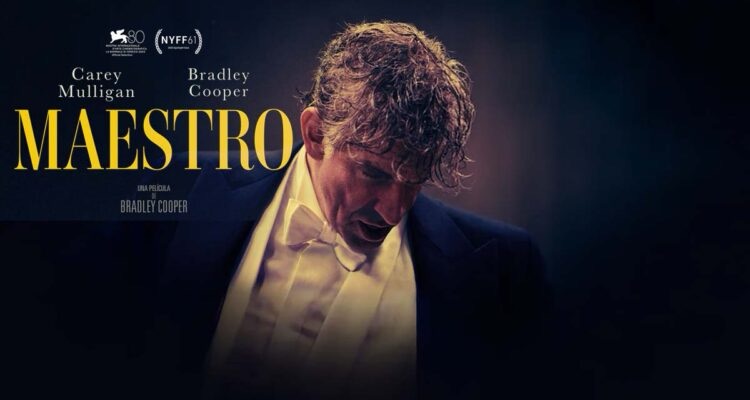
Bradley Cooper, co-writer-director-lead actor-co-producer, goes all in on this project. I have to admit, I know relatively little about Leonard Bernstein’s life. The film did not really tell me about his work, and only slightly more about his as a person. What it did provide was insight into his marriage. In that regard, you have two performances certainly deserving of award consideration.

Carey Mulligan as Felicia Montealegre, Bernstein’s wife has the less flashy role, yet her transformation into the character was even more convincing. Because her character ages 30 years in the film, the camera (and critics) is less forgiving for women who must bend time. Mulligan studied Montealegre’s voice recordings, her acting style and her paintings, while spending time with Montealegre’s family, and a noted voice coach to more adequately absorb the person she was portraying. It’s easy to miss much of Mulligan’s performance if you wait for her to act. There are moments, many of them, when Mulligan is silent, and reacting in the slightest of ways, yet you feel her pain or excitement or confusion.
Cooper as Bernstein is constantly in motion, expression or painting the screen with the larger than life character. Certainly, Cooper looks, moves and mostly sounds like Bernstein, but I’m too aware of his acting. Cooper is a fine actor but he would have been more effective had he turned it down a notch. Yes, Bernstein seemed to take up more space than other mortals, but playing him that way feels less realistic. Don’t get me wrong, I thought Cooper did a superb job, especially considering all the hats he wore. His makeup and physical transformation was remarkable; why the criticism I don’t understand.
Even better than his acting is the direction and staging. The film, partially shot in black & white, but mostly in color, emotes a dramatic romanticism of the times. The viewer is watching something daring, resembling the New French cinema of roughly when this story takes place. Cooper uses long, edited tracking shots that are quite cinematic and dazzling. Scenes overlap, as does the dialogue. The editing is remarkable in presenting what one almost concludes as fantasy. Cooper’s camera placement is sometimes odd, making the viewer a voyeur, not quite a part of the scene, with his use of long shots and partially obscured actors. The danger is in drawing too much attention to style and appearing self-indulgent. I hope that Cooper realizes this and eases back on the artsy approach.
Matthew Libatique is an Academy Award nominated cinematographer (A Star is Born, Black Swan). Michelle Tesoro was the editor, with a background of working mainly on miniseries (House of Cards, The Queen’s Gambit).

Maestro is a dazzling and seductive two hour viewing. Unfortunately, it taught me very little of his music and artistic impact. What it did focus on were two people, intertwined, but always searching for the true connection. Approaching it on the level of appreciating, but not needing to understand beauty, Maestro can be intoxicating, but leaving you unsure of what you just experienced.
2.5/5




 Ticket 2 Ride
Leave a comment