
I wasn’t looking to read another book about the Eagles, but I kept coming back to this Life in the Fast Lane: The Eagles Reckless Ride Down the Rock & Roll Highway (2023, Diversion Books) on the library new books shelf. I’ve already read about the band from a number of perspectives, including former Eagle Don Felder’s book (Heaven and Hell: My Life in the Eagles).
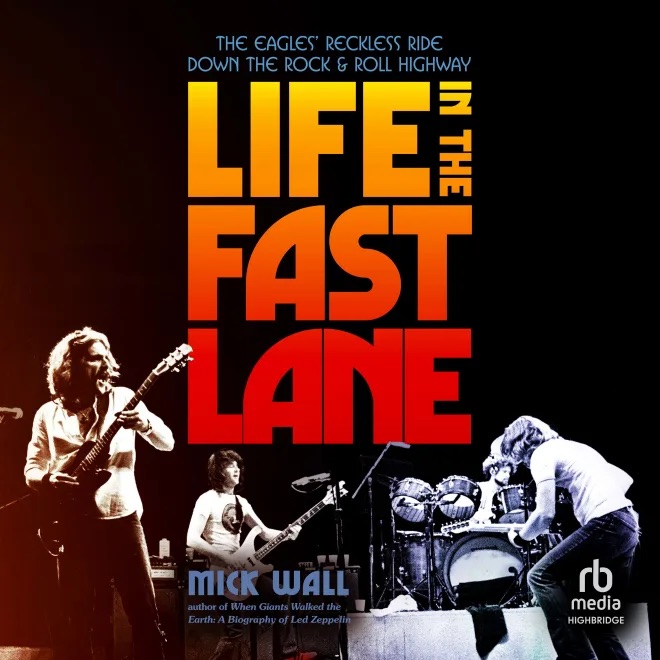
Thankfully, author Mick Wall is more like James Ellroy than Cameron Crowe, so the reader not only gets the road, but the off-road Eagles stories. Wall doesn’t just provide the juice, he gives you the squeeze, and it ain’t always pretty. Wall has written books on Led Zeppelin, Black Sabbath, Lou Reed, Foo Fighters, AC/DC, and many others.
Dark side. Light side. Sun and moon. Fire and water. Not so much good cop bad cop, though, as enjoying taking turns. Ganging up together. It is established early on that Frey and Henley, Glenn and Don, are the A-Team, the golden geese, the gruesome two-some, the alpha-and-omega, fuck-you-very-much. – Mick Wall, Life in the Fast Lane
If you want, I can tell you the jest of the book: the Eagles became wildly successful and Henley and Frey were pricks, driving the other members out of the band. The end.
Life in a band is an ugly, difficult partnership. Life in the Eagles was never easy or fair. Between their first and second albums, Glenn Frey and Don Henley had already redrawn the map, putting Randy Meisner and Bernie Leadon on the wrong side of the boundary.
Henley and Frey were known as “the Gods” by the band and crew. They fought amongst themselves for control of the band, powered by drink, drugs, success and ego. According to Wall, everything began to change after the first album, it happened that quickly. Henley and Frey didn’t want to be labeled a country-rock band, that was too confining. They also wanted to write serious, meaningful songs, and that included concept albums. They had vision and together would lead the band. Even after their second album was a resounding disappointment, Henley and Frey redoubled their efforts and the next three albums were hugely successful. One of These Nights was a watershed for the Eagles, they added Felder to toughen their sound, fired Bernie Leadon, hired Joe Walsh, and Henley-Frey cemented their control of songwriting. Not only did songwriting control the music, but that’s where the big money was.
Wall traces the long and draining journey to deliver Hotel California. The result was a massive success and acclaim, but there was unexpected competition, Fleetwood Mac. The two bands competed for awards, concert headlining and top album sales. Rumours and Hotel California were released within months of each other. Ironically, Henley and Stevie Nicks began a romantic relationship that essentially ended with an aborted pregnancy.
After Hotel California, the band was on life-support. The journey to finish The Long Road really broke the band; they didn’t just break up, the Eagles imploded. The Eagles story is about excess as much as it is about success. Stadiums, helicopters, Lear jets, Beverly Hills mansions, expensive hotel suites, separate limos, mountains of cocaine; crazy times indeed.
After the band came back together, new music was really an afterthought. They released a double CD set of new music, but quickly discovered that fans weren’t really interested; just play the hits. For the past several decades, the Eagles were just a touring machine, and a profitable one. Boomers were prepared to shell out big bucks for the experience, even after Glenn Frey died, the band kept going.
In the Eagles universe are a list of associated bodies in various orbits around Frey-Henley. Manager/label owner David Geffen, later manager/label owner Irving Azoff, fellow singer/songwriters Jackson Browne and J. D. Souther, Linda Ronstadt, ex-manager Elliot Roberts, Stevie Nicks, producers Glyn Johns and Bill Szymczyk. Wall ties in a lot of contemporary events and stories that touched on, or influenced, Eagleworld. The story of the Eagles, particularly in the 1970s, is not only about music and the music industry, it’s about pop-culture and changing American values.
Life in the Fast Lane is an easy, mostly enjoyable read. It’s a lot of Henley and Frey, who are the mean-girls, and that gets a bit tiring in the end. It’s rather short on their personal lives, philanthropic efforts like the Walden Woods Project, which Henley founded to protect the Walden Woods and pond from development.
Wall draws upon a lot of interviews and source material in fusing together his book. Wall certainly puts his own spin on the Eagles and its members, emphasizing actions or moments with his literacy exclamation marks. That’s a bone of contention among some reviewers. I found Wall’s comments entertaining.
3.5/5






 Ticket 2 Ride
Leave a reply to Mike Miller Cancel reply