
Career suicide, Columbia Records executives said. There’s no hits. After three groundbreaking albums of Latin inspired rock, R&B, jazz and funk, Carlos Santana and Michael Shrieve had something else in mind. The direction they took was risky, but Santana would take a lot of risks, some successful, some not. Santana called Caravanserai World Music because he’s heard people from diverse parts of the world tell him how much the album meant; it spoke to them.
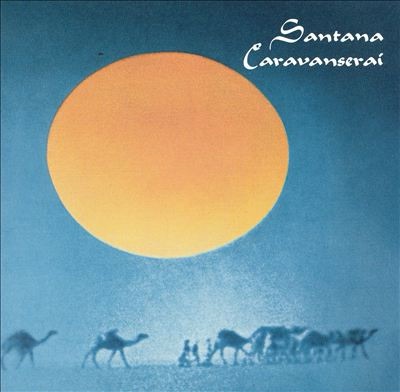
Even the album art is amazing. A caravan of camels in some faraway desert under a blazing sun or moon. Santana band albums had dramatic covers, Caravanserai would be no different, but the music inside would.
Here is an interview with Santana and Shrieve about Caravanserai.
“Not even songs, just slices of life,” said Carlos Santana. “We visualized the music. Caravanserai means spiritual discipline.”
Shrieve exposed Santana to the happenings in jazz, playing Miles Davis‘ Bitches Brew and albums by John Coltrane and others that expanded the boundaries of contemporary jazz, taking it in a direction known as jazz-fusion, which was already embraced by art-rock bands like Yes, King Crimson and Genesis that mixed classical, folk and other diverse musical genres. Santana was impressed by Latin percussionists teamed up with Mariachi players, and the emergence of Latin-jazz.
Caravanserai yielded no hits and it sold less than previous albums, but it would prove to have an artistic significance, and develop a long-term cult appreciation. Influenced by Miles Davis and Weather Report. Divine energy, whatever the musical form.
Even some hardcore Santana fans may not remember this album. Caravanserai signaled a shift in musical direction for the Santana, and the departure of Neal Schon and Gregg Rolie, who would go on to form Journey.
The songs:
“Eternal Caravan of Reincarnation” (instrumental) Rutley, Schon, Shrieve – A rather unconventional opening. Crickets and a quiet, reflective instrumental. You are in for something different.
“Waves Within” (instrumental) Rauch, Rolie, Santana – A more rousing instrumental track, Santana blazes on guitar, and thunderous percussion.
“Look Up (To See What’s Coming Down)” (instrumental) Rauch, Rolie, Santana – This sounds more like the old Santana sound, particularly with the Rolie’s organ and punchy guitar work of Santana and Schon, but there is something jazzier and boundary pushing going on.
“Just in Time to See the Sun” Rolie, Santana, Shrieve – The music ramps up in intensity, as the first appearance of vocals on the album. This song also has that classic Santana pulsating groove.
“Song of the Wind” (instrumental) Rolie, Santana, Schon – Arguably the best song on the album, and one of Santana’s overall best. This is a sweet, rollicking track, where Carlos lays down a lovely and melodic guitar lead that runs the length of the song. If you enjoy one song on the album, this is it.
“All the Love of the Universe” Santana, Schon – A combination of a more traditional Santana sound with an injection of jazz-fusion, a great interplay between guitarists Carlos and Schon. Nominally a song with lyrics, more of a jazz-fueled instrumental. Listen for David Brown’s soaring bass, unfortunately down in the mix.
“Future Primitive” (instrumental) José Areas, Mingo Lewis – Percussion heavy, spacey keyboards.
“Stone Flower” Antônio Carlos Jobim (music) Santana, Shrieve (lyrics) – An adaption of “Stone Flower” by Antonio Carlos Jobim, added lyrics Santana/Shrieve. Sung in Spanish. Shrieve said he wrote the lyrics on acid.
“La Fuente del Ritmo” (instrumental) Lewis – The pulsating, jazzy vibe, a hot mix of styles.
“Every Step of the Way” (instrumental) Shrieve – A fine instrumental piece, maybe the most jazz-fusion track on the album. It still grinds with heavy percussion and a blazing Carlos guitar.
Rolie and Schon would depart and emerge as the cornerstone of Journey. Replacing Rolie was Tom Coster, who would play a major role in Santana for the rest of the decade, and be featured on some of the band’s best work.
If you have the time, this video tells an in-depth story of the making of Caravanserai. This video delves into the spirituality and influences that run through this album. It’s worth the time if you have the interest.






 Ticket 2 Ride
Leave a comment