
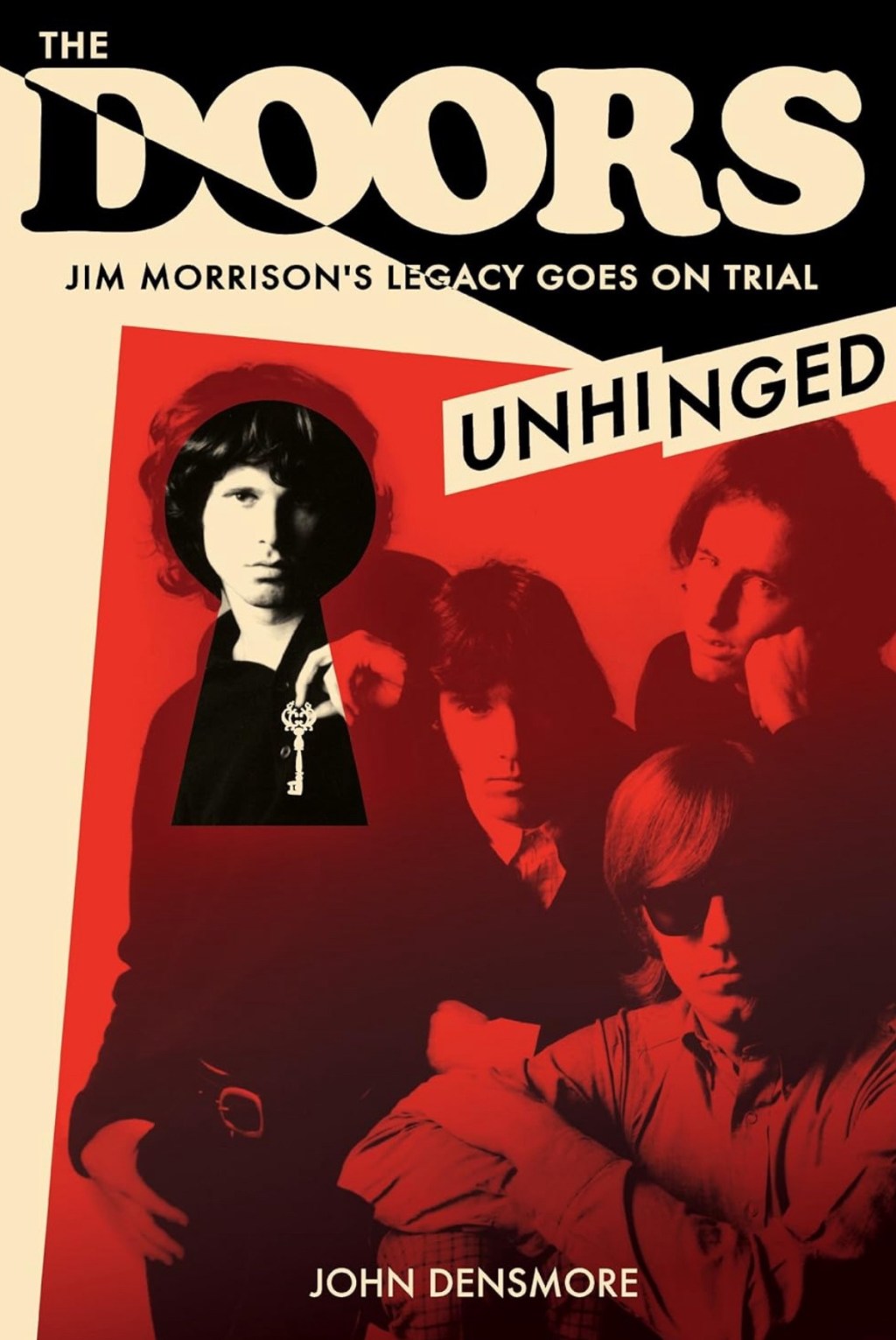
It’s been more than 50 years since Jim Morrison died in Paris, but the world has never lost its fascination with The Doors.
The Doors Unhinged: Jim Morrison’s Legacy Goes on Trial (2023, Akashic Books), is not a memoir of either drummer John Densmore, or of the band. While there is a little of both in the pages of The Doors Unhinged, the story is of success, greed and the battle over The Doors’ legacy.
Name a classic rock band whose legacy is intact, or free of legal strife. There are a few, but not many. It usually boils down to power and money, that two-headed beast that seems to destroy anything in its path.
The Doors’ partnership agreement, at Jim Morrison’s insistence, stated that all songwriting credit and money, no matter who wrote what, would be shared equally between the four members of the band. Further, decisions to license their music required a unanimous approval. These provisions were made in the spirit of brotherhood and equality, certainly very much of the time. This agreement was tested when Morrison discovered the others had approved the use of a song to be used to sell Buick automobiles. Morrison is noted to have gone ballistic and the deal was rescinded. Additional language was inserted into the partnership agreement to restrict their management from having the power to license their music without a unanimous authorization. Morrison felt strongly preserving the artistic purity of The Doors music. That worked, while he was alive.
After Morrison’s death, the other three Doors carried on, for two albums, but decided that The Doors without Jim Morrison wasn’t The Doors. They disbanded and left a lot of money on the table from concerts and their album deal. But that’s not the end of the story, and certainly not the conflict that would grow between the former bandmates.
John Densmore is the hero of the story, but it comes at a great cost. Densmore details how profitable the following decades were for the former Doors and the estates of Jim Morrison and his late wife, as new generations discovered the band through rereleased albums on CD and the very profitable licensing to film producers. However, use in commercials was still off the table, until Cadillac came calling. The $15 million dollar offer was more than tempting. Densmore voted no, because he felt it wrong to The Doors legacy (remember Morrison’s outrage), and that killed the deal. Keyboardist Ray Manzarek pushed for the deal and was extremely unhappy, blaming Densmore for a missed, lucrative opportunity for all of them. Manzarek claimed that Densmore violated his fiduciary responsibility to the band, and that today, Morrison would actually endorse deals with advertisers. The angst over the missed Cadillac deal had not been forgotten.
A few years later, Manzarek and guitarist Robby Krieger thought to seize an upturn in Doors popularity by going on tour to take The Doors music to the fans. Densmore had long made it clear that he was no longer interested in reliving that experience, so drummer Stewart Copeland (formerly of The Police) and Ian Astbury (The Cult lead singer) were recruited to fill the lineup. To add fuel to the fire, Manzarek and Krieger called the band, The Doors of the 21st Century, and incorporated Doors imagery and logo into their tour. Densmore protested, requesting changes to the advertising and cease using the imagery and logo. Densmore believed fans were being led to believe that The Doors had reformed. Densmore stressed that he had no problem with them playing Doors music or advertising them as “formerly” of The Doors, but Manzarek and Krieger didn’t see the issues that Densmore saw, so Densmore sued. Manzarek and Krieger counter sued (for $40 million), and the Morrison/Courson estates sued Manzarek and Krieger.
This is where Densmore’s story really begins. The book, based on the ensuing trial (using the court transcript and Densmore’s reflections), is the story.
For thirty years we were a band of musicians with one of the most unique four-way agreements ever— nothing could be contracted unless we each gave it the okay. And now we are enemy combatants on the fourth floor of the courthouse in downtown Los Angeles. – John Densmore, The Doors Unhinged

The Doors Unhinged is one of the saddest books I’ve read. The Eagles’ demise was sad, and of course The Beatles, but somehow the litigation described here, picked at the bones of Jim Morrison, destroyed friendships between the surviving Doors members, and showed how the idealism and brotherhood attitudes of the 1960s were recycled into profit and rich living in the 2000s.
If you can stand the bitterness and sense of betrayal (to the band’s original vision, to Jim Morrison’s legacy, to each other), Densmore’s book is a fascinating read. Densmore remained true to his 1960s philosophy and the brotherhood of the band. He was an old hippy. Krieger less so, and Manzarek not at all. This story, is representative of the great divide in the Baby Boom generation. It’s generally true that people get more conservative with age. And it’s generally true that older people are more affluent as their earnings increased and assets become more valuable heading towards retirement. That’s true of me. It’s also true that these Boomers will pay to relive their youth, and that was the market The Doors of the 21st Century was aimed.
What’s saddest is that the sides were inflexible in figuring out how to achieve both. The result was an expensive trial that only caused more anger and entrenchment.
As a side note, Robby Krieger’s book, Set the Night on Fire: Living, Dying, and Playing Guitar With the Doors is a must-read for Doors fans. Read here.
Densmore uses this phrase several times in his book. Money is like fertilizer: When hoarded, it stinks. When spread around, things grow. He doesn’t credit a source, so it might be his own philosophy. Whoever originated it, the phrase sums up the divide between the former Doors.
I recommend both of these books. One doesn’t need to be a hardcore Doors fan to find enjoyment and values in either book.


 Ticket 2 Ride
Leave a comment