

Elaine May, now 92, is one of the last of her generation. She is a comedian, writer, director, and member of the 1960s comedy duo Nichols & May. Profiled by Carrie Courogen in her new book, Miss May Does Not Exist (St. Martins Press, 2024), was a challenging read for me.

Miss May does exist, but is not easy to understand. To really understand her, removes the mystery and somehow diminishes a soul that wants to remain an enigma rather than just a complicated person. That’s my reading of her story.
As a child, Elaine Berlin moved on the fringe, but according to Courgoen, it was not a slight, it was territory she would own. People were afraid of her, men were both attracted to and frightened of her at the same time.
Briefly married (becoming Elaine May) and with a child, she left her child in the care of her mother and wanted to attend college, although she had not graduated from high school. She was drawn to the University of Chicago and the theater. That’s where she found the theater, and her comic partner, Mike Nichols. Chicago was also the location of Second City, the standup comedy training ground.
In the mid to late 1950s, Nichols & May were the hottest comedy duo in the business. Nightclubs, television, commercials – they were everywhere. Hip, innovative, irreverent but significant, they blazed a new trail for standup in the 1950s. May was the writer, Nichols the editor in the duo.

Courgoen describes May in the duality of engaging, but difficult. She was direct, had high expectations and had an energy that kept people at a distance. That was also a time when any woman who wasn’t perceived as demur, was labeled as difficult. Standup comedy was also mostly a man’s world at the time.
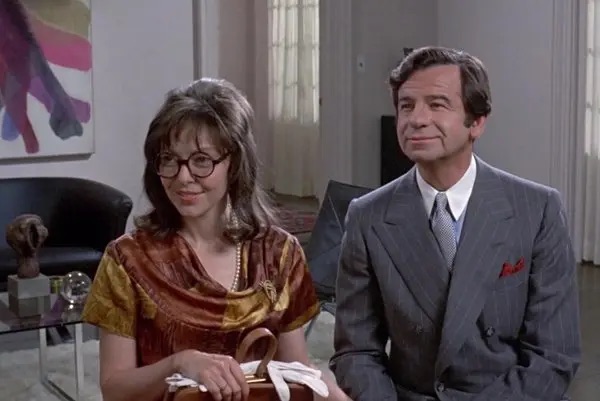
At the end of the 1960s, May found herself a hot property, with a solid Broadway hit, film roles, and an offer to write, direct and co-star in a features. The years of failed projects, and people wondering what became of Elaine May, seemed behind her. A New Leaf starred May and Walter Matthau in a script adapted by May from someone else’s short story. Courgoen describes the series of events that landed May in the director’s chair of her first film. Paramount finagled a deal to give May the multiple jobs at a minimal cost. The ordeal would end up in a lawsuit between May and the studio, which took the film away from May and purged most of the dark elements and subplots from the film to make it releasable. May would dismiss the studio’s version, although it made money and garnered some decent reviews. As a first time director, May struggled on the set, went over-budget, fought with the studio, but survived the experience.
Hired to direct Neil Simon’s screenplay, The Heartbreak Kid, she had a tight budget and wasn’t not permitted to change Simon’s script. The film made money and everyone survived. Then came another opportunity to write and direct her own film, which became the disaster, Mikey and Nicky, starring Peter Falk and John Cassevettes, which spend years filming and in post-production, over budget and in legal entanglements.
Why, any studio made a deal with her, giving her such discretion, and final cut, is the lengthy chapter that Courgoen spends a lot of pages on, but doesn’t clearly resolve my befuddlement. Of course, sexism played a part in the few female filmmakers who tried to operate, and failed, in the studio system. May had no training program, mentors or industry support. She was initially hired on the cheap and left to navigate mostly all male crews. She did parlay her success into a powerful, but high failure deal with Mikey and Nicky. That failure would sideline her directing career until – Ishtar.
May offered a unique talent, something studios and theatrical producers attempted to mine during her seven decade career. Some succeeded, others failed miserably to match her immense talent, and personality, to specific projects.

Ishtar was of course a flop, one that buried May as a director, but everyone else walked away from the disaster with minor bruises. Dustin Hoffman and Warren Beatty rebounded and continued on their way. The book discusses the film’s problems, but also compares it to other big budget films that underperformed, the point being that May was the only female director in the bunch.
When given the opportunity, May would continue to film, depending on her films to be shaped and her vision realized in the editing room. Months would turn into years, and trigger lawsuits. Her stories were complex, or at least her characters needed sculpting to fully bloom, but more doesn’t mean better. The production of Mikey and Nicky resulted in 1.4 million feet of exposed film, equal to 259 hours of raw film. Surprisingly, no editors died in May’s editing suites.
When stumbling in film, May would turn to the theater or reunite with Mike Nichols to refill her bank account or hear audience appreciation. May did find her niche in film – script doctor. Most of her work was done on the condition that she receive no credit. That was her condition.
Tootsie, Reds, Primary Colors, The Birdcage, Heaven Can Wait, Dangerous Minds, Wild and Labyrinth were some of her screenwriting credits or non-credits. In my opinion, May’s strongest creative talent was writing; first, for Nichols and May, then for the screen. She was also a playwright and actress, who won a Tony Award for Best Actress at age 88 for The Waverly Gallery. May would be presented with many lifetime achievement awards and recognition of her contributions to the arts.
At the end of Courgoen’s book I didn’t understand Elaine May any better than I did going in, which does not surprise me. I know more facts about May and that’s the best one can hope for.



 Ticket 2 Ride
Leave a comment