
Born in West Germany, educated and raised in East Germany, Chancellor for a united Germany – Angela Merkel has lived quite a life.
While I can review her book, I’m at a disadvantage in evaluating her performance and political legacy, but I will throw in my two cents viewing her from America.
“‘Over my lifetime I’ve spent endless hours deliberating over the right timing. It’s an incredibly important thing in politics,’ I replied. ‘You have to choose your moment. It’s what makes the difference between success and failure.’” This is probably the best advice for anyone in politics.
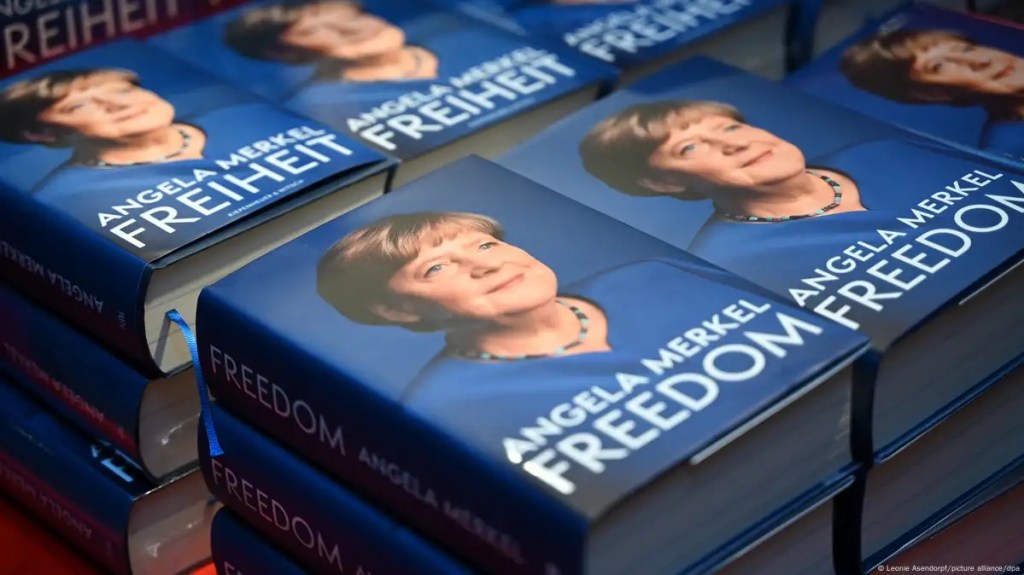
Freedom (2024, St. Martin’s Press) is her story of her political life. Over 685 pages, Merkel tells a fascinating one at that. Trained as a chemist, her scientific-focused mind looked for facts and details, transitioning to life in a political environment, facts are still important, but relationships and analyzing people began a different kind of education.
As a delegation member representing East Germany in unification negotiations with West Germany, the U.S., U.K., France and the Soviet Union, Merkel reflected on how she would have handled the discussions differently had she been in charge at the time. What she came to learn from experienced officials was the need to provide historical context and objectives before getting into the details. “I took this lesson to heart for my future political career, even if – as many people know – I didn’t always heed it,” she writes.
In the book, Merkel admits a number of mistakes along the way; she’s humble, and states what she learned from them. For a head of state to boldly list their errors and missteps is rather amazing. Imagine Putin or Trump ever admitting a mistake, and then even detailing how they changed their approach going forward. Other reviews I read questioned whether she admitted any errors, I believe that she did.
“Of course, it was a mistake to compare baking powder to radiation. My words were lacking in any kind of empathy. Environmental groups criticized me harshly for this, for years to come. Not immediately taking responsibility for this mistake was a serious failure on my part.”
Merkel would step out of her public relations job with her political party to run for a Bundestag seat, and win, as German unification became a reality. Merkel reflected, “I found a political home.” She was also selected as minister of the women and youth department in the new German government. Later, she would lead the environment department, just in time for climate change and Chernobyl.
Merkel describes the German unification process from the perspective of an East German where the social and economic changes were significant, as the East was absorbed into the West. Merkel writes of the daunting process for privatizing all of the state-owned businesses and real estate; now with no state management of production, many jobs were lost, and the predictability that East Germans lived under was suddenly removed. Past economic ties and support from the Soviet Union were now gone. The economies and social structures of the East and West were like night and day. The evolution of two countries into one, as those in the stronger half carefully embraced the struggling half, though it took years for each to begin to feel unity as Germans, instead feeling like citizens of separate countries.
Merkel would become Chancellor after leading the opposition party and serving as minister over environmental matters. Climate change would take up much of her time in the coming years as she was instrumental in developing the Kyoto Agreement and later iterations of that agreement.
Some of her best stories involve American Presidents and their Russian counterpart: Putin.
“In our meeting, he (Putin) snapped at me that the Soviet Union’s collapse was, to him, the greatest geopolitical disaster of the twentieth century.”
“My conclusion from the conversations was: there would be no cooperative work for an interconnected world with Trump. He assessed everything from the perspective of the real-estate developer he had been before entering politics. Each piece of property can only be allocated once. If he didn’t get one, he got another. That’s how he saw the world. For him, all countries were in competition, and the success of one meant the failure of another.”
The one issue that I anticipated reading was about Israel. “What indescribable suffering Germany had brought upon the Jewish people, Europe, and the world with the mass murders committed under National Socialism. And I, the German chancellor, had been asked to speak before the Knesset the following day, the first time this honor had ever been conferred on a foreign head of government.”
My opinion of Angela Merkel is one of strength and reason. I’m impressed not only by her accomplishments, but even more so with her leadership on the world stage.
I agree with Merkel in this assessment: “Wealth and the rule of law will always make Germany and Europe desirable destinations.” Germany has been an example of leadership and investment in a time of regional wars, immigration, disease prevention and the environment.
And finally, “I have observed that a typical characteristic of politicians with autocratic tendencies is that they have unlimited time when they need it.” Numerous democracies have shifted to the right in recent elections as nationalism has grown and the political divisions have deepened along lines of race, ethnicity, wealth and religion. Freedom is an apt title for this book, it seemed a core value Angela Merkel deeply embraced her entire life.
“It was no coincidence that I hadn’t become a politician back in the GDR, but rather only in a free, democratic, and reunified Germany. For me, the purpose and goal of my political work lay in enabling the individual to lead a successful life.”
Wherever possible, I advocated for freedom of opinion and the rule of law, and tried to help the persecuted and imprisoned. This required me to constantly and consistently weigh up my own values and interests.



 Ticket 2 Ride
Leave a reply to greenpete58 Cancel reply