
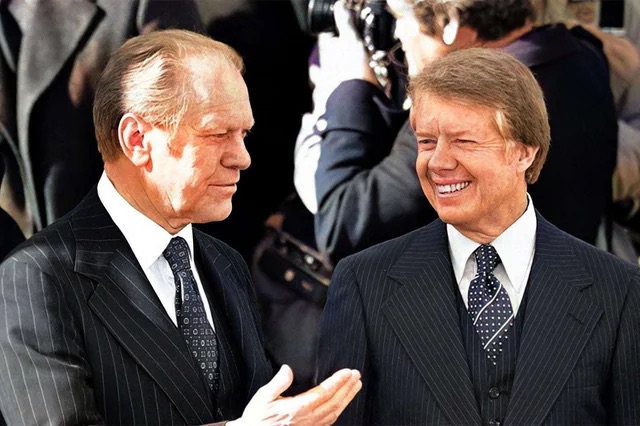
It’s difficult to think of the 1970s and not mention the presidencies of Gerald Ford and Jimmy Carter. They presided over our country when disco music, mood rings shag carpeting, long sideburns and Norman Lear sitcoms were the rage. The time of Ford and Carter is generally thought of as those outlandish 1970s, when Watergate, Vietnam and the anger of the previous decade were over and it was time to party.
Good times, great music and pre-AIDS. But also high inflation, high unemployment, sluggish economy, an oil embargo and long lines at the pump and distrust in government. New York City was bankrupt. The remnants of Watergate. Draft resisters and healing from a divisive war. Ford and Carter inherited many difficult problems, including a negative image abroad and a divided country at home.
These two presidents each had a very different public image, each brought a different personality and both were outliers to assume the presidency. Humble, hardworking and forthright – Ford and Carter were the last of a breed of politician, and that they served in succession, is appropriate.
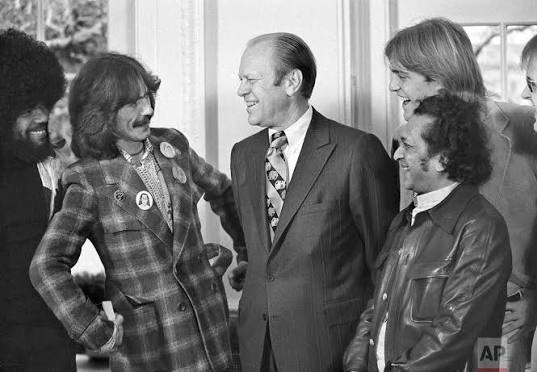
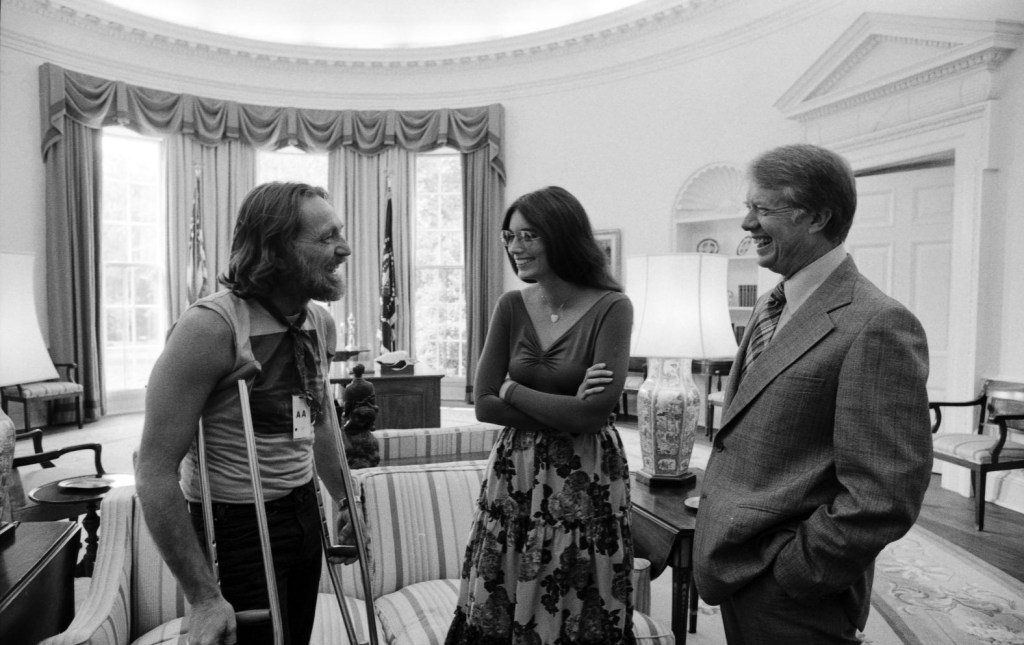
Although Ford’s taste in music wasn’t rock and roll, his children and wife Betty kept him plugged into current issues. Son Steve arranged a visit from George Harrison who was on tour at the time. Carter loved all kinds of music and in particular enjoyed a friendship with Willie Nelson and the Allman Brothers Band. At least this wasn’t disco.
Ford and Carter are often maligned as presidents, and thought to rank low on the lists of effective presidents, but history has been kind to them. Ford, a longtime Congressman, was unelected, pardoned Nixon, presided over a struggling economy and the evacuation by helicopter of the American Embassy in Saigon occurred on his watch. Carter, a relatively unknown, ran a low-budget presidential campaign, coming from the pack to win the nomination and defeat Ford. Carter’s presidency had numerous bumps, and he seemed to confound his own political party as much as the opposition.
Former California governor Ronald Reagan ran against the 1970s as much as he did Jimmy Carter. Both Carter and Ford had to deal with candidate Reagan, who damaged Ford in 1976, and who steamrolled Carter in 1980. Neither Ford or Carter enjoyed much of a relationship with the Reagan following the 1980 election. Ford and Reagan were very different Republicans; and Carter had every reason to dislike Reagan, including a request from Nancy Reagan to vacate the White House ahead of the transition schedule. That still irked Carter years later (the Carters did not move out early).
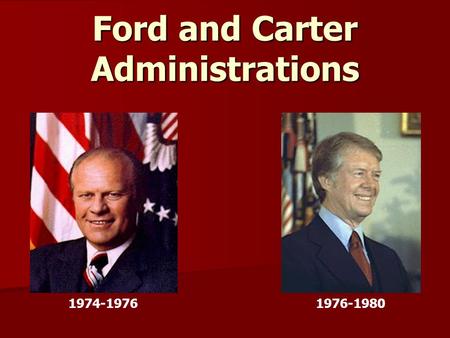
The Presidents Club (2012) by Nancy Gibbs and Michael Duffy, spills the beans on various presidential relationships, including the icy one between Ford and Carter. When Egyptian President Anwar Sadat was assassinated in 1981, President Ronald Reagan asked former presidents Nixon, Ford and Carter to represent him at Sadat’s funeral. Ironically, it would be Reagan’s request that played a large part in the future relationship between Ford and Carter.
There’s probably a good joke there: the wily Nixon, the affable Ford and the frigid Carter all board a jet bound for Cairo. What will it take for the ice to thaw? The answer: Liquor, sweaters and first names only. Ford and Carter had no relationship at that time, and although the 1976 campaign had been difficult, it was not personal, and the transition had been very cordial; still there was some underlying tension, although years later in an interview with Leslie Stahl they would deny any hard feelings. “Their wounds were deeper, their anger fresher,” wrote Gibbs and Duffy about Ford and Carter. Ben though Carter had worked closely with Anwar Sadat and Menachem Begin, the Reagan team had to allow Carter’s wife Rosalynn to also be part of the official delegation.
Nixon wasn’t present for much of the trip and that opened the door for Ford and Carter to talk to each other, especially on the flight home from Cairo. “Besides, death has a way of rearranging perspective and Carter and Ford realized how silly their grievances and disagreements had been,” Gibbs and Duffy wrote.
“Though somewhat formal at the outset, their conversation had quickly turned more casual and everyone noticed that the presidents were virtually finishing each other’s sentences by the end, using their first names, going out of their way to praise each other on various issues. The session was a complete turnaround from the brittle formality of a few days before.”
“We found,” Ford said later, “that we had a lot of things in common.” Carter said, “”We had hours in the plane, in a private compartment, just the two of us, to talk over previous relationships and what our children were doing and the interests Betty and Rosalynn had.”
For the next three decades, Ford and Carter worked on many projects together and became close. Each asked the other to deliver the eulogy at their own funeral.
“I prepared for this eulogy, revealing a list of more than 25 different projects on which Jerry and I have shared leadership responsibilities,” Carter said at Ford’s funeral.
“We enjoyed each other’s private company,” Carter said. “And he and I commented often that, when we were traveling somewhere in an automobile or airplane, we hated to reach our destination, because we enjoyed the private times that we had together.
“During our closely contested political campaign, as Don just reminded me, we habitually referred to each other as ‘my distinguished opponent.’ And, for my own benefit, while I was president, I kept him fully informed about everything that I did in the domestic or international arena,” Carter recalled.
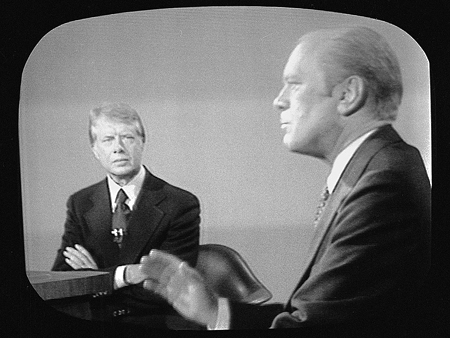
Gerald R. Ford was a longtime member of the House, when he was asked to serve as President Richard Nixon’s vice president, following the resignation of Spiro Agnew. Ford, a moderate Republican, was respected for his hard work, leadership and authenticity. He served as House Minority Leader (1965-1973) and it was his job to shepherd Nixon policy legislation through the House. Although Ford wasn’t the only name Nixon considered, the President was told by Congressional leaders that anyone other than Ford would have a difficult confirmation.
Nixon and Ford had served in Congress together and knew each other quite well. While their early backgrounds had similarities, their personalities couldn’t have been more different.
Nixon knew Ford was a hard worker, a loyal soldier and someone others trust. According to John Robert Greene’s The Presidency of Gerald R. Ford (1995), Nixon wasn’t above using Ford in his role Minority Leader to try and shutdown a House Banking Committee hearing on the possible illegal movement of campaign money tied to the Watergate burglary. Ford indicated at his vice presidential hearings that he simply made sure other Republican committee members were present when the issue of subpoena power was voted on.
By the early 1970s, Ford was contemplating retirement from Congress and returning home to Michigan to play golf and spend more time with his family. Nixon had dangled the vice presidency before, back in 1960, and it resurfaced again in 1968, but it went to Spiro Agnew instead. Ford had really wanted to be Speaker of the House, but with Democrats solidly in control, that was never going to happen. Ford’s political career had been hard on his family, especially wife Betty. As the Watergate investigations and Agnew’s own fortunes led to criminal charges and his resignation, Ford’s retirement plans would have to wait.
As vice president, Ford served in this position for less than a year before Nixon too resigned, and Ford became the 38th President of the United States, and the only nonelected President in history.
Ford’s legacy and Watergate are forever linked, due to his pardon of Nixon. The consensus of opinion, including Ford’s, is that the Nixon pardon cost him the 1976 election.
In Richard Norton Smith’s excellent biography of Ford, An Ordinary Man (2023, Harper), Ford had his suspicions about Watergate, and while he carried water (no pun intended) for Nixon’s polices, he was skeptical of many in Nixon’s inner circle.
Ford inherited the shaky remnants of Nixon’s Presidency. Inflation was Ford’s biggest concern, but he would also deal with the nation’s biggest recession since the Great Depression. Traditional methods of dealing with a weak economy and high inflation were not working. The 1973 oil embargo was a devastating blow to the American economy and standard of living.
The 1974 mid-term elections had given Democrats a comfortable margin in both chambers of Congress. Ford would see many of his vetoes overridden, but does sign major legislation on campaign finance, the Privacy Act or 1974, energy conservation and tax reductions. Ford also tackled the thorny issue of clemency for draft evaders and military deserters.
Nixon had primarily based his presidency on foreign policy achievements. Détente with the Soviet Union had decreased tensions and slowed the arms race, but many conservatives saw the Soviets as untrustworthy and America’s position around the world eroding. The Vietnam War had essentially ended, and the evacuation helicopters of the last Americans and South Vietnamese from the embassy rooftop would be a sad image of more than 15 years of American support in a foreign civil war. That image would burn in the minds of many going forward, including Ronald Reagan. Cambodia, which has just fallen to the Khmer Rouge, seizes the U.S. merchant ship Mayaguez in the Gulf of Siam. Ford orders Marines to island of Koh Tang, but the Mayaguez crew is not there and 15 Marines are killed. Ford order airstrikes on Cambodia, crew is released.
During Ford’s presidency, unrest in Lebanon including the murder of the U.S. ambassador, forces the evacuation of Americans from the country. On the positive side, Egypt and Israel would sign the second Sinai withdrawal agreement.
President Ford was in a precarious place, a Democratic controlled Congress, and a Republican Party that splintered between moderates conservatives. Democrats would paint Ford as an extension of Nixon and hammer on the country’s economic woes. By the end of Ford’s presidency, the country’ unemployment and inflation rates had decreased from 9.2 percent and 12.2 percent respectively, to 7.8 percent and 3.7 percent, respectively.
As Meg Greenfield wrote of Ford’s Presidency: “In his first days and months, it was as if he had liberated Washington — from its personal fears and hostilities and suspicions, from the dark and squalid assumptions that people had come reflexively to make about one another and the way things ‘really’ worked. Mr. Ford has left it an incomparable gift in the detoxified political atmosphere of the capital and the institutions it is about temporarily to inherit.”
Jimmy Carter was in the right place at the right time.
James Earl Carter displayed ambition in very different way than Ford. While both were tireless workers and campaigners, and both a down-to-earth demeanor, Carter could be sharp and distant, and his smile might be warm and friendly, or cool and plotting. Ford was disciplined and direct, and his sharpness was more in his resolve.
Carter took a very different route to the White House than Ford, who spent his career serving this Michigan House district, and running for reelection every two years. Carter proudly ran for office as an outsider. As president, being an outsider was no longer an effective strategy. He was now President Carter and had to find a way to govern, from the inside. Carter had pieced together a coalition to gain the White House, but it did not transfer into the necessary political capital to achieve his legislative agenda. Carter struggled to build support within his own party. Unlike Ford, who served many terms in the House, and worked to build consensus and party unity, Carter did not have political allies and frequently befuddled and angered his own party. Ford worked the inside, Carter relied on connecting his policy initiatives with the people, and principles of each proposal to the logic they represented – human rights, energy efficiency, the environment, peace initiatives – separate from the machinations of Washington politics, which is where Ford cut his Congressional teeth.
Julian E. Zelig writes in his book, Jimmy Carter (2010, Times Books), that Carter struggled with an economy saddled with inflation, just like Ford had faced. Carter found that getting his points across was increasingly difficult; symbols and idealism did not convert into public confidence when life was difficult at the gas pump or the grocery store check out.
In some ways, Carter are Ford were alike: political moderates, hard workers, war veterans, who had strong and devoted partners, and who took the responsibility of public service seriously. Both made unpopular decisions: Ford pardoning Nixon, and granting conditional amnesty for Vietnam draft resisters and outlining a way to work their way back; Carter went a step farther to pardon Vietnam War draft evaders, and signing the agreement to return the Panama Canal to Panama.
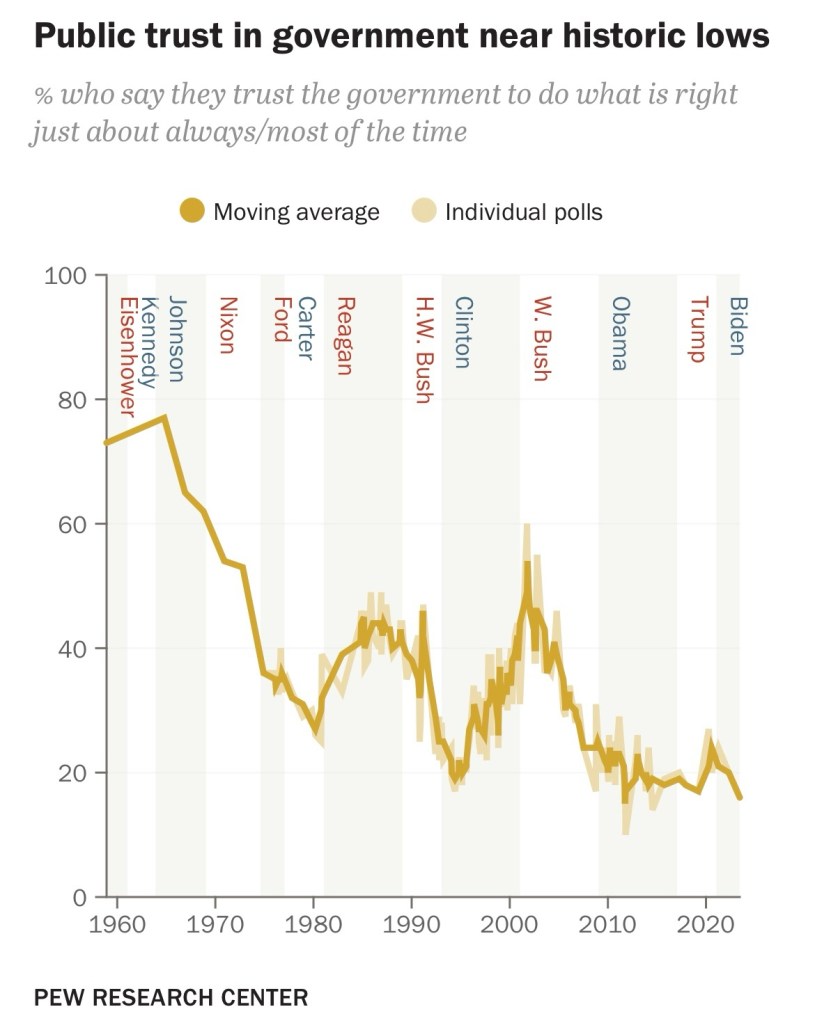
Each had to contend with the fallout from Watergate, Americans did not trust government and were more suspicious of candidate promises. That trend has carried forward.
“During their first months, Caddell kept advising the president that symbolic actions should be a serious part of the White House portfolio given that Carter’s election victory was so narrow and since so many Americans still had only a vague sense of what the new president stood for? The president instructed the Marines Corps band to stop playing “Hail to the Chief” whenever he entered a room. And in another sign that he wanted no truck with the more ostentatious aspects of the presidency, Carter sold the presidential yacht, the Sequoia.”
Carter considered himself a “new Democrat” and at odds with congressional Democrats on many economic policies. Carter believed in the need for fiscal conservatism. One example of that was the introduction of zero-based budgeting, which forced agencies to rewrite their budgets each year to justify annual spending. Carter would find himself at odds with even those in his own administration.
When Carter ran for the Georgia senate, he promised to read every bill that he voted on. That sounds like common sense, but it’s never been a requirement or a practice of all elected officials. Carter disliked business as usual in government, including the back room politicking and horse trading over legislation. He was about the work, and for good policy standing on its own merits, instead of packing a bill with unrelated provisions to garner votes, or watering it down for special interests. Jimmy Carter was an idealist and refused to play the games of politics. This attitude continued to dog him in the White House, and made gaining support of his initiatives difficult, especially with his own party when he upset traditional Democratic allies.
Carter had a trusted advisor in his wife. “Nobody wants to hear it,” said Rosalynn upon reading the first draft of an energy speech; “they’ve heard about new energy programs ever since you’ve been in office, and prices are still going up.” Zelig writes that he didn’t always go with her advice, but she gave it anyway.
Zelig writes: “Washington insider Clark Clifford, watching as the president sat on the floor and scribbled down notes as people spoke to him, couldn’t help but think that it would have been inconceivable to imagine Lyndon Johnson sitting on the floor like Carter and saying, ‘Tell me what I am doing wrong!’”
Foreign policy is where Carter had hoped to excel, especially in hopes of bringing peace to the Middle East. The Camp David Accords brought Israeli Prime Minister Menachem Begin and Egyptian President Anwar Sadat together, leading to the Egyptian-Israeli Peace Treaty, ending more than 30 years of conflict.
When Russian airborne troops landed inside of Afghanistan in December 1979, Carter would have a new foreign policy problem. Muslim fundamentalists had seized the reins of government, and the Soviets were seeking to gain control of the rogue nation. American policy makers saw the invasion as an effort by the Soviets to expand their influence in the region, and undermined the fragile detente that existed between the countries. Carter’s foreign policy approach caused concern by many, especially conservative Republicans, who felt Carter was not tough enough on the Soviets, and would soon point to the taking of American Embassy hostages in Tehran that the Carter Presidency was taking the country in the wrong direction. Ronald Reagan had been waiting in the wings, beating the drum for a tougher, less accommodating foreign policy directive. Carter was even challenged in his own party, Sen. Ted Kennedy pursued the Democratic nomination, but self-destructed right out of the gate. Carter found himself in an uncomfortable position of insider, a role he was not accustomed.
Reagan was in the right place at the far right time (pun intended).
In 2000, Ford and Carter together sat for an interview with Leslie Stahl for CBS Sunday Morning.
The First Ladies
Betty Ford and Rosalynn Carter were somewhat atypical First Ladies. Mrs. Ford spoke her mind, highlighted by her August 10, 1975 appearance on “60 Minutes” where she voiced support for the Supreme Court’s ruling on abortion, and her views on various social issues that seemed quite liberal for the wife of a Republican president. Ford was not always in agreement with his wife, but supported her having her own opinions. He stood behind her when she battled breast cancer, something women at that time talked little and battled mightily in private. When Mrs. Ford came forward with her addiction problems, her husband was there and supported her honestly in talking about it being a hidden problem for many women.
Mrs. Carter was used to working side by side with her husband. As First Lady, she had her own views and although careful with sharing them publicly, she continued to voice them to Carter and to critique his work. He didn’t always follow her comments, but he listened. She worked for years promoting mental health reform, raised money for refugee relief, child immunization and healthcare in developing countries. Both Mrs. Carter and Mrs. Ford worked in support of the Equal Rights Amendment. In “retirement”, they worked side by side on humanitarian projects like building homes.
Final Thoughts…
Looking fifty years into the rear view mirror, it seems like a totally different world than where we are today. Two decent men ascended to the White House by very different means. Both Naval Officers and WWII veterans, both with rock-steady partners. Neither man would inherit an easy job, and both men pummeled by the result of doing unpopular things for the right reasons. Neither man survived the political waves that called for change.
In their post White House years, both men worked diligently on charitable causes, without fanfare, and stepped willingly forward when asked to work on projects for their country. What began as an uncomfortable mission to pay respects to a fallen ally, developed into a lifelong friendship and a reflection of their decency and public minded spirit.
What some call two administrations of few accomplishments, there is evidence of many positives, not the least of which was guiding America out of what Ford called the long national nightmare. That didn’t end with Ford leaving office, Carter inherited a country still reeling from Vietnam, the distrust from Watergate, a continued battle over equal rights, and America’s shifting role on the world stage. The healing process lasted years. Ford was the right person to succeed Richard Nixon, and Carter, the outsider, brought a humility and earnestness, instead of the typical platitudes and rhetoric of overreaching political candidates.





Leave a Reply