
I’m happy to participate in The 4th Master of Suspense Blogathon, hosted by Classic Film and TV Corner.
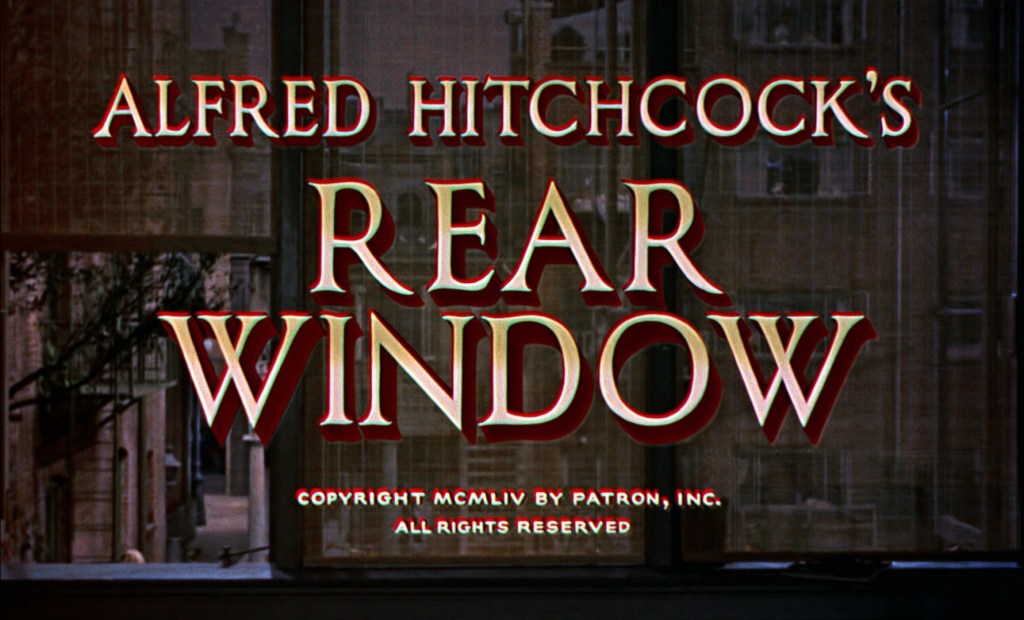
I can’t recall the exact year that I saw Rear Window (1954), it was made before I was born, but it’s still a part of my youth. It was my first Hitchcock film and certainly not my last. Hitchcock was the master of scare. I’m guessing that I saw Rear Window in the mid 1960s, on television, and in black & white, even though the film was in color. I’m old enough that my youth was presented in black & white, like the first of The Wizard of Oz.
This blog is not a review or detailed explanation of Rear Window’s plot, rather how the film fits into the Hitchcock legacy. For a review of Rear Window, see my blog from 2019.
Stage Fright (1950), Strangers on a Train (1951) I Confess (1953), Dial M for Murder (1954), Rear Window (1954), To Catch a Thief (1955), The Trouble with Harry (1955), The Man Who Knew Too Much (1956), The Wrong Man (1956), Vertigo (1958), North by Northwest (1959).
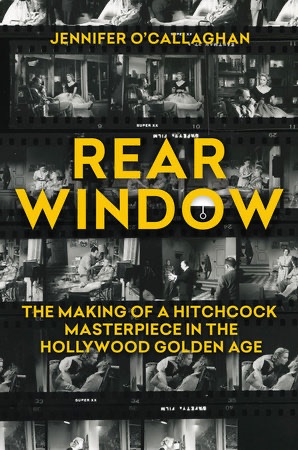
Rear Window was the first film under Hitchcock’s new contract with Paramount, and it was a partnership between James Stewart and himself owning the film. Jennifer O’Callaghan’s book, Rear Window: The Making of a Hitchcock Masterpiece in the Hollywood Golden Age (2025), explores the making of the film and offers insight into the Hitchcock-Stewart relationship. Stewart made four films with Hitchcock, three of them classics, in my opinion. Stewart and Cary Grant were Hitchcock’s most frequent leading men in the 1940s and 1950s. Their appeal and versatility allowed Hitchcock two leading men with wide range and box office muscle.
Stewart’s character was confined to a wheelchair or bed in Rear Window, a role that needed a range of subtle and excitable reactions – the drama is portrayed mostly by what he sees and reacts to. Stewart had starred in a series of Westerns and noir films following World War II, and these characters were known for their inner battles and crossing the line psychologically into dangerous territory. The 1950s found Stewart and Hitchcock to do their most creative and challenging work.
Rear Window is the story of a news photographer who is a prisoner to his broken leg, as he rehabs in a full leg cast in a wheelchair in his small, hot apartment. He has nothing better to do than open his eyes, and his curiosity to life right outside of his apartment window. With the involvement of his girlfriend Lisa (Grace Kelly), his caregiver Stella (Thelma Ritter), and reluctantly an old friend who is now a police detective Lt. Tom Doyle (Wendell Cory), Jefferies is drawn into what he increasingly believes is a murder committed in an apartment across the courtyard. The mysterious man that grabs Jefferies’ attention is Lars Thorwald played by future Perry Mason, Raymond Burr.
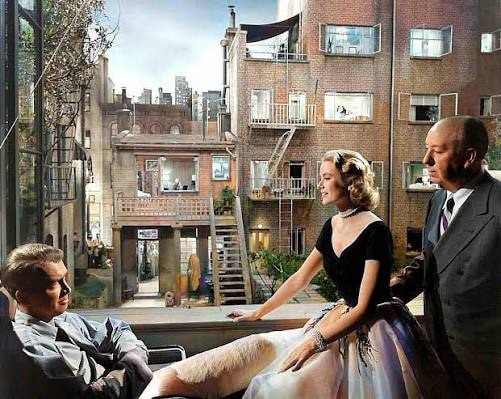
The set for Rear Window was built on the entirety of Stage 18. Based on a real Greenwich Village location, the set was the largest in Paramount studio history. Hitchcock was experienced working on one-set films, he had filmed Rope on an apartment interior set, and Lifeboat entirely using a boat on a water tank stage, but nothing of this scale. The set was designed to represent Jefferies’ view out of his window into the courtyard that several apartment buildings share. This was pre-air conditioning, so every apartment was opened up to get its share of NYC summer air.
Building the set with many apartments, a courtyard, a street with car and truck traffic, smoking chimneys, side street businesses, a skyline in the distance, day and night sky changes, rain falling, etc. was a masterful bit of production design. Studio workers had to dig 30 feet below the stage level to allow for the range of elevations, especially for drainage, lighting and the skyline. The set was forty feet high and one hundred, eighty-five feet long. More than three thousand arc and other types of lights were needed to illuminate the set.
Robert Burks worked with Hitchcock on numerous films, including To Catch a Thief, which earned Burks an Academy Award for cinematography. As Burks told American Cinematographer (February 1954): “I went on the sound stage about 10 days prior to the starting date. Using a skeleton crew, we pre-lit every one of the 31 apartments for both day and night, as well as lighting the exterior of the courtyard for the dual-type illumination required. A remote switch controlled the lights in each apartment. On the stage, we had a switching set-up that looked like the console of the biggest organ ever made!”
The set is the unnamed star of the story. Actually, there are stories going on in each apartment as Jefferies discovers. Each apartment has a story, or at least Jefferies assign one based on what he’s observed. That’s the thing, with a little information, correct or way-off-base, our mind fills in the rest. Jefferies observes, first awkwardly, and a bit embarrassed by doing it.
A film about a man who watches his neighbors and forms opinions on what he sees, or thinks he is seeing, is both fascinating and concerning. In the hands of a less talented filmmaker and crew, this film might have only been exploitative and remembered for the subject of voyeurism. Rear Window delves deeper into the issue of social isolation in a dense community of strangers.

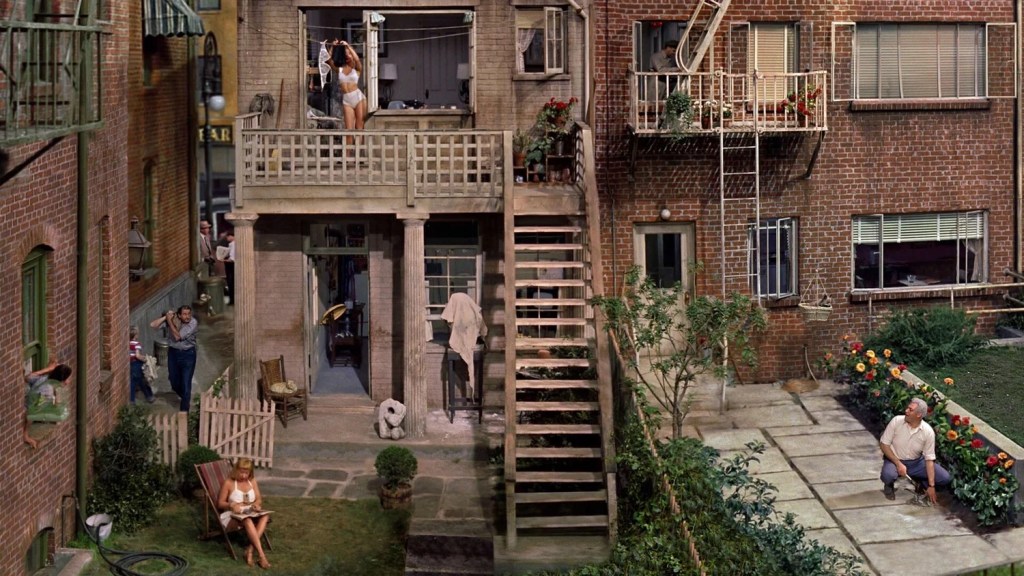
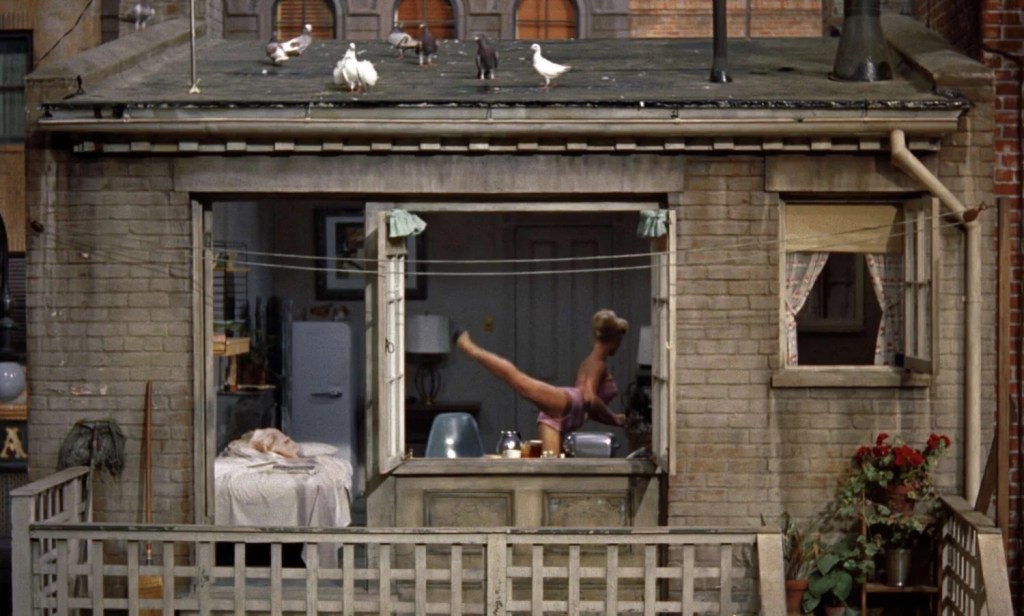

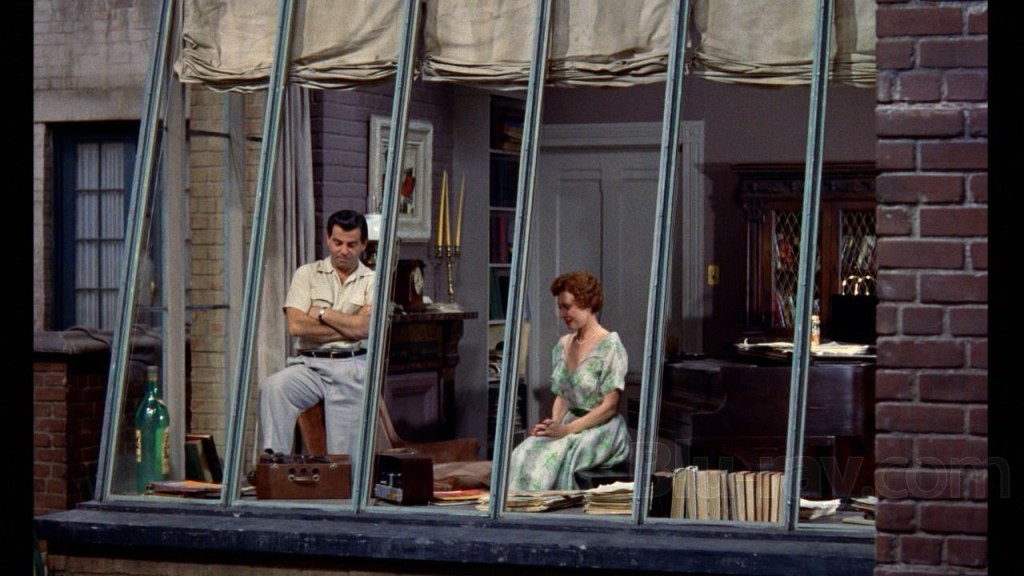
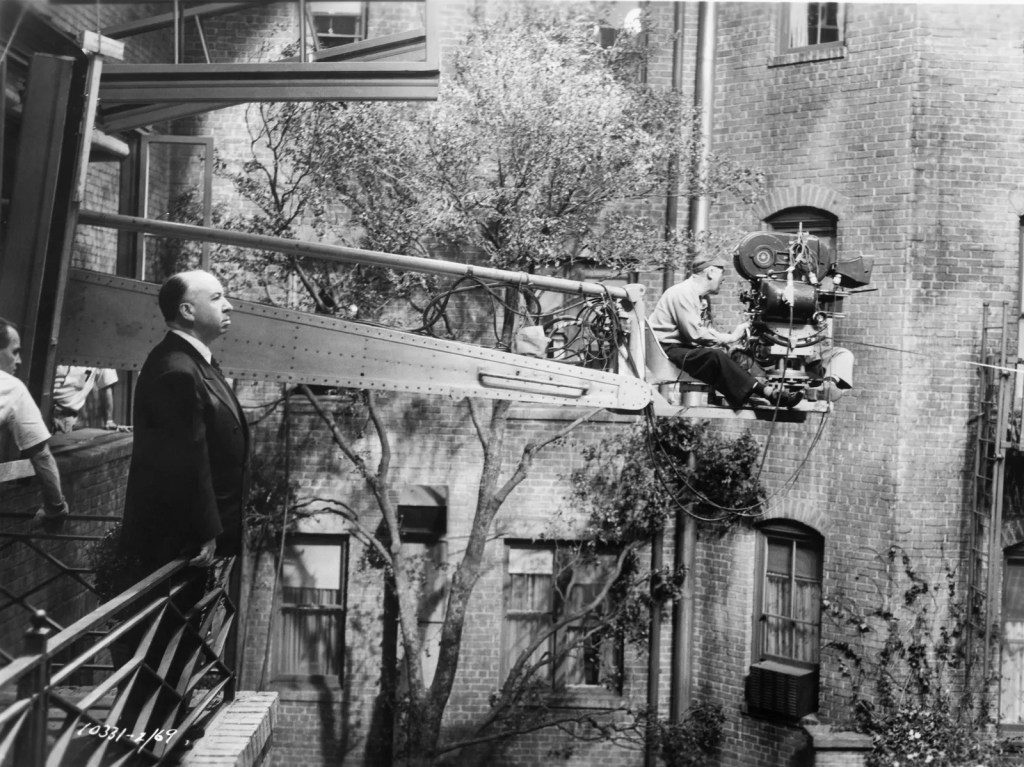
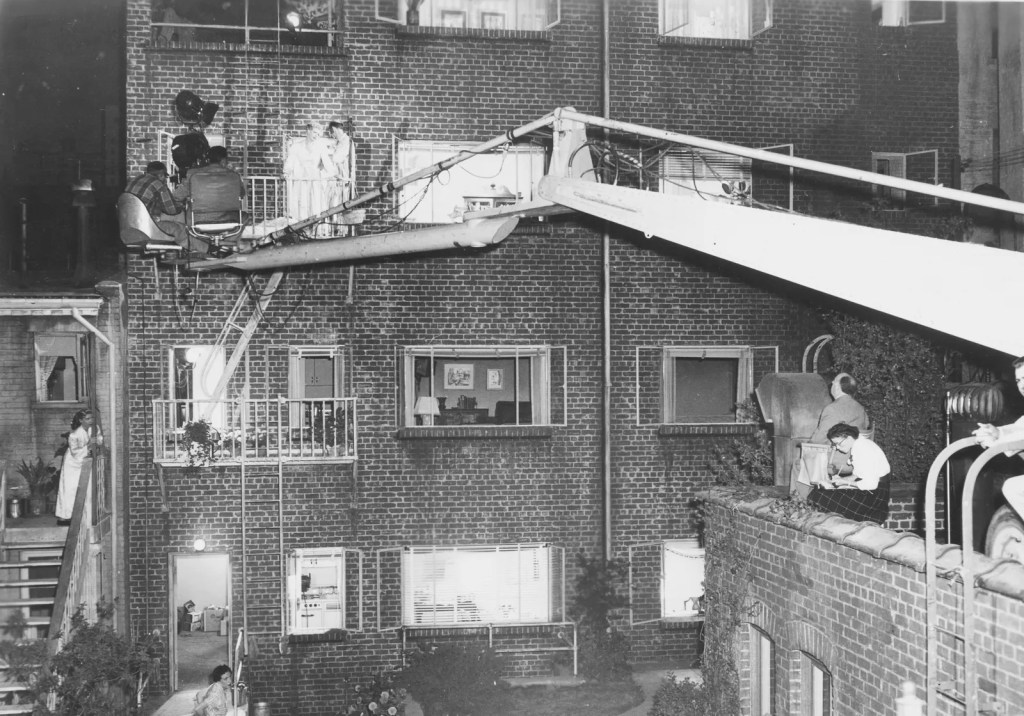
Some might think that filming on one set would be easy and allow the director to comfortably control every element of production. Thirty-one apartments/businesses required their own lighting, special wiring, rain and drainage, and the challenge of directing concurrent activities throughout the expansive set. When multiple actors were used in different areas of the set, assistant director Herbie Coleman utilized radio ear pieces for Hitchcock to communicate with whichever actor he provided direction. [Herbie Coleman is a very interesting member of the Hitchcock crew, he functioned as a second unit director, associate producer and Jack-of-all-trades on numerous Hitchcock films.]
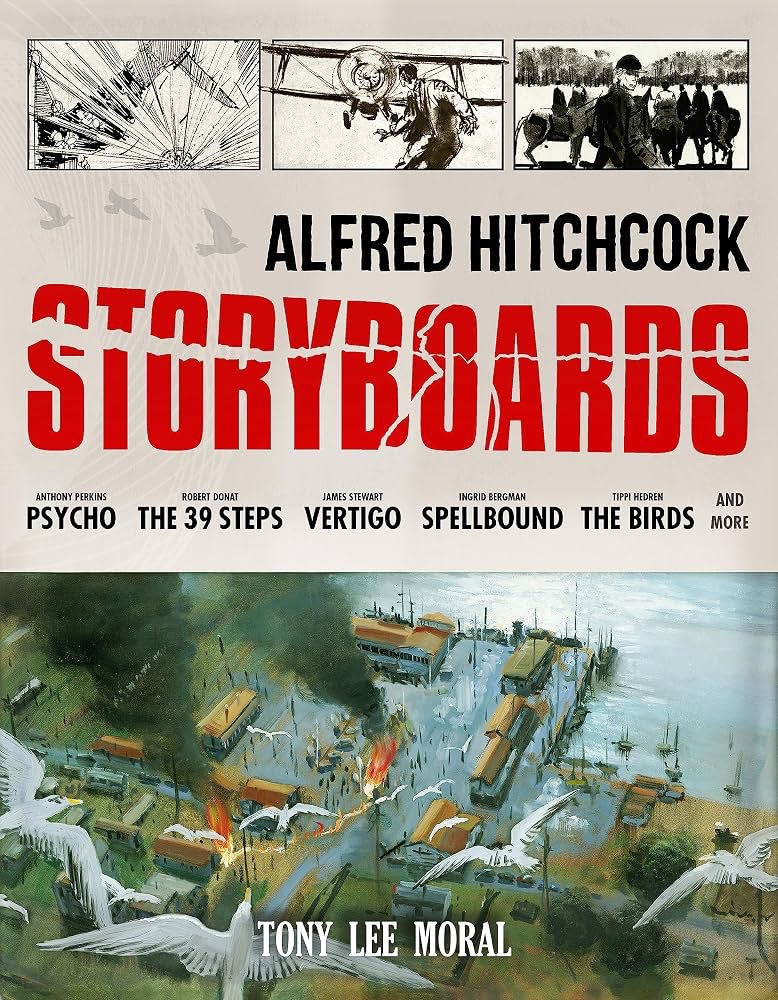
As I mentioned, Rear Window was not the first of Hitchcock’s films to take place on a single set. The single set provides its own challenges. My wife and I just screened Lifeboat and watched the “Making of Lifeboat” featurette to see what we could learn about the production. According to Hitchcock’s daughter Patricia Hitchcock O’Connell, the hard work was in the elaborate storyboard drawings, which he did for every film for pre-planning each shot. Imagine hand sketching each camera shot. His background in art direction was a bridge between the writing and the set design, even the editing and shape of the film. Hitchcock was known for having the film already shot in his head before the camera actually rolled.
Hitchcock was naturally very involved in the writing process of his films, though he isn’t often credited, his signature is very definitely on the scripts. Alma Reville, Hitchcock’s wife, was an intricate part of Hitchcock’s filmmaking process, as occasional co-writer, advising on scripts, casting and editing. She was a film editor when they met and he trusted her views.
Alfred Hitchcock in the mid 1960s was wrapping up his very successful television anthology show, Alfred Hitchcock Presents. Film-wise, Hitchcock was in a dry period. After The Birds and until Frenzy, Hitchcock made a series of films, that in my mind, did not have the Hitchcock magic. That’s rather disappointing because Hitchcock was still at the top of his game, he had the freedom to make any film he wanted and the pick of any actors. Who didn’t want to work with Hitchcock?
Something else was happening, the social mores were changing as the Hayes Code was no longer effective and being replaced by a film rating system. Hitchcock himself had been making films that pushed the margins. The 1960s should have been his decade, but after The Birds, his films weren’t connecting with his audience like the films he made in the 1950s, in my opinion, the Golden Era of Hitchcock, and Rear Window was a cornerstone of that period.
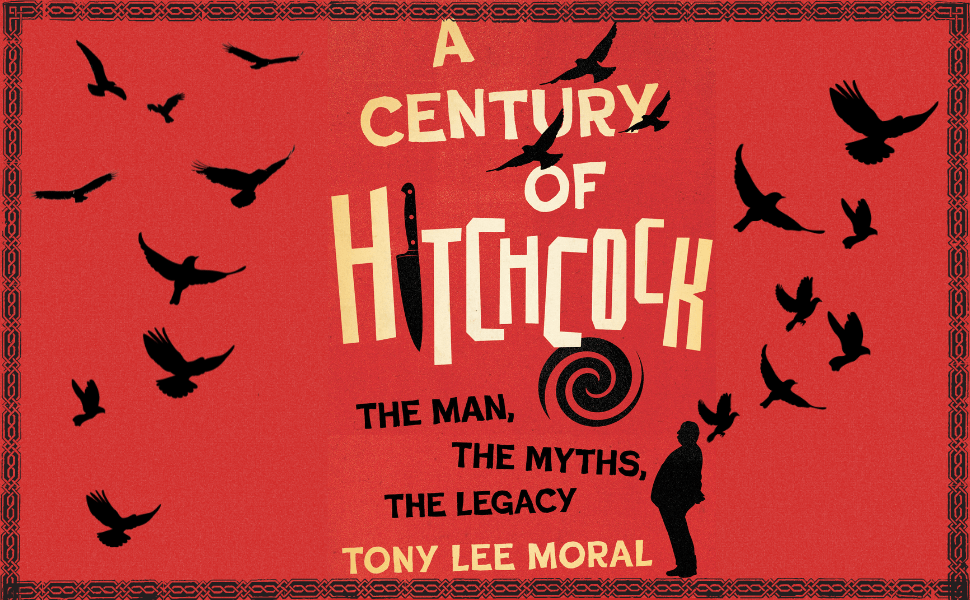
A CENTURY OF HITCHCOCK: The Man,
The Myths, The Legacy (2026) by Tony Lee Moral is a great look inside the Hitchcock legacy. “Hitchcock’s post-Marnie years were marked by a diminishing ability to secure compelling material and stars. His split with Bernard Hermann over the score for Torn Curtain reflected the growing tension between his vision and the shifting landscape of Hollywood filmmaking. It epitomized his difficulties in balancing creative ambition with professional relationships—a challenge that would persist until his final years.”
“I don’t think it [Marnie] was something that he was all that proud of,” said James H. Brown, assistant director/production manager. “I don’t think it was that good a project. Not comparable to other works be done, To Catch a Thief, Rear Window. Because the way it was shot, background photography, process photography, it was done at a time when television and commercials were far more interesting, motion pictures were being shot on location, wide lenses were being used, different techniques. The technique in its time was too old-fashioned….”
The 1950s raised the bar for Hitchcock. Even when he directed a smaller, lighter film like The Trouble With Harry (1955), expectations were still high. I watched this film very recently and although the scale of the film is much smaller and the sense of intrigue a bit whimsical, it’s an enjoyable film and still very Hitchcock.
[The Trouble With Harry and Family Plot are outliers in the Hitchcock collection. Both films have a lighter tone, but still have the macabre humor.]
The idea for Rear Window was based on “It Had to Be Murder”, a 1942 story in Dime Detective by Cornell Woolrich. While Woolrich sold the production rights to the story to Hitchcock and Stewart, who owned the film. When Woolrich died, the rights to the story were obtained by Sheldon Abend, who disregarded the deal Woolrich had made with Hitchcock and Stewart, and sued over his right to be compensated for the original story. In Stewart et al. v. Abend, DBA Authors Research Co., the United States Supreme Court ruled that “the successor copyright owner’s right to permit the creation of a derivative work passes to the heirs of the author of the work, who are not bound by the original author’s agreement to permit such use. Abend got some money and a producer credit on the remake of Rear Window starring Christopher Reeve.
John Michael Hayes was offered the job of working with Hitchcock on adapting the short story in Rear Window. To go a little deeper, a thirteen page treatment, based on the short story, by playwright/director Joshua Logan was sent to Hitchcock. Hayes wrote his screenplay incorporating elements from Logan’s treatment, but adding more character development and the relationship with Lisa Fremont. Hitchcock’s collaboration Hayes spanned four films before suddenly ending. Hayes was brought in Although Hitchcock worked with many talented writers, I believe his best work is reflected in the films with Hayes.
When interviewed about the end of his working relationship with Hitchcock, Hayes told Christopher Wehne, “He [Hitchcock] wasn’t for a moment willing to allow anyone to believe he couldn’t do it all on his own. I believe in application of credit where credit is due-if you’ve earned it, you need to be respected, regarded, and properly credited for it. At times in our work together, Hitchcock wasn’t willing to allow that.”
Rear Window was one of Hitchcock’s 1950s films that was out of circulation until the 1980s. After Hitchcock died, Universal executive Thom Mount went to see Pat Hitchcock O’Connell to discuss the films the family owned: Rope, Rear Window, The Trouble with Harry, The Man Who Knew Too Much, and Vertigo. Universal was offering $20 million for the right to distribute them for the next twenty years. These films had not been seen by the public and Universal had a plan for restoring and rereleasing the films theatrically. The home video market was about to explode with video rentals and sales.
I recall going to the theater in 1984 to see Rear Window, sitting in the dark and sharing the communal audience experience. There was laughter, gasps and anxious energy abound as we all saw this richly restored film, many for the first time. The best was to watch a film like this.
Alfred Hitchcock was born August 13, 1899. We are a few days away from his birthday, but we can celebrate the man and his film legacy any time we watch one of his films or an episode of his television show. He certainly was the Master of Suspense. In celebration of the Master’s birthday, my wife and I are watching a variety of Hitchcock films, including a few my wife has yet to see. Grab the popcorn and a soda!


 Ticket 2 Ride
Leave a comment