
One thing I’ve learned in this series of relooks at Rolling Stones albums is that I’m a tough critic. Hopefully, a fair critic, but as a longtime fan (60 years), I’ve developed some deep views on their work and their influence.
Despite their talent and experience, I’m particularly watchful when Mick & Keith coast, recording songs from their template of riffs and chord structures, instead of pushing themselves to create up to their history.
Bridges to Babylon (1997)
Bridges follows Voodoo Lounge (1994), which I felt was not as good as Steel Wheels (1989). I’ll save you the time of reading, Bridges is not as good as Voodoo. I believe that when Mick and Keith are distracted or disagreeable with each other, the songs become more generic and you get more “Mick” and “Keith” songs and fewer “Stones” songs. On this album, the bridges needed repairing or maybe one of them to cross it more frequently.
The producer’s chair needed to be enlarged as Jagger and Richards were joined by the return of Don Was, plus the Dust Brothers, Danny Saber, Rob Fraboni and Pierre de Beauport. Babyface worked on one track, but his contribution was not used.
After writing sessions in New York, London and Barbados, the band settled in Los Angeles at Ocean Way Studios, where the album was recorded from March to July, 1997.
Reportedly, the sessions were full of disharmony, mainly because of differences between Jagger and Richards, that were so bad that they recorded in different studios with their own musicians.
All but two songs are credited to Jagger/Richards. No Ronnie Wood credits.
“Flip the Switch” I want to say this song is pretty generic Stones. Fast, snarling and grungy. Not bad, but not near the best Stones’ album openers.
“Anybody Seen My Baby?” The lead single, with co-writing credits to k.d. lang and Ben Mink because it sounds too similar to “Constantly Craving”, which it obviously does. It’s nice to hear the Stones stepping out of their template to write something different.
“Low Down” Back to the more tried and true riffs. Album filler Stones.
“Already Over Me” This could have been a Stones classic, a very good ballad that could have been great. Some subtle touches that add some unique styling, but the Stones seem to want to play it safe.
“Gunface” Familiar Charlie snare, but the guitars are very dirty. In fact the guitars are the reason to listen to the song, whatever Jagger is singing about here.
“You Don’t Have to Mean it” A Richards vocal, an upbeat reggae song. As reggae, it’s average, nothing original. Change of pace. I’m totally indifferent here.
“Out of Control” This song promises something bigger than it delivers. The video winds us up, then disappoints.
“Saint of Me” An example of using their template and turning out something better. Hardly groundbreaking, but playing to their strengths.
“Might As Well Get Juiced” Combining the old and new. Beats and electronica, the combination with Richards swagger makes for an odd and ineffective result.
“Always Suffering” Combing country and blues into a ballad. The guitar work lifts it was a cliche.
“Too Tight” Uptempo rocker with smooth choruses. Pretty basic under the hood, but they dress it up nicely.
“Thief in the Night” it’s that point in the album, Keith and his winos at work. Slow shuffle, loose and boozy.
“How Can I Stop” More Keith, slower, more pleading. Almost seven minutes long.
Mick Jagger – lead vocals (all except 6, 12, 13), electric guitar (2, 5, 10), harmonica (7, 9), keyboards (8, 9), shaker (7), acoustic guitar (4, 8)
Keith Richards – guitar (all except 8, 12), backing vocals (1–4, 7, 10, 11), lead vocals (6, 12, 13), acoustic guitar (12), piano (12), handclaps (1)
Ronnie Wood – guitar (1–3, 6–8, 11–13), slide guitar (3, 5, 9), pedal steel guitar (10, 11), Dobro (4), baritone guitar (4)
Charlie Watts – drums (all tracks), backing vocals (10)
Darryl Jones – bass guitar (6, 10, 12), backing vocals (10)
Me’Shell Ndegeocello – bass guitar (8)
Danny Saber – bass guitar (5, 7), guitar (5), keyboards (5), clavinet (7), “reality manipulations” (7)
Jeff Sarli – bass guitar (1), acoustic bass (11, 13)
Don Was – bass guitar (4), keyboards (2, 7), Wurlitzer piano (7, 13)
Blondie Chaplin – bass guitar (3), backing vocals (all except 5, 9), shaker (2) maracas (3), piano (4, 11, 13), tambourine (1, 10–12)
Pierre de Beauport – bass six (8), Wurlitzer piano (12), Fender Rhodes piano (12)
Jamie Muhoberac – bass guitar (2), keyboards (2, 7, 8)
Doug Wimbish – backing vocals (10), bass guitar (9)
Waddy Wachtel – electric guitar (1–3, 7, 9, 11), guitar (8, 12, 13), acoustic guitar (2, 10), backing vocals (10)
Clinton Clifford – piano (6), Hammond B-3 organ (6)
Billy Preston – organ (8)
Benmont Tench – Hammond C-3 organ (4), keyboards (4), piano (10), Hammond B-3 organ (10)
Darrell Leonard – trumpet (3, 6, 12)
Wayne Shorter – soprano saxophone (13)
Joe Sublett – baritone saxophone (1), saxophone (3, 6, 12)
Biz Markie – rapping (2)
Bernard Fowler – backing vocals (all except 5, 9)
Jim Keltner – percussion (1, 4–7, 10–13), shaker (3), backing vocals (10)
Kenny Aronoff – bucket (4)
Mixing – Rob Fraboni, Tom Lord-Alge, Bob Clearmountain
Final thoughts
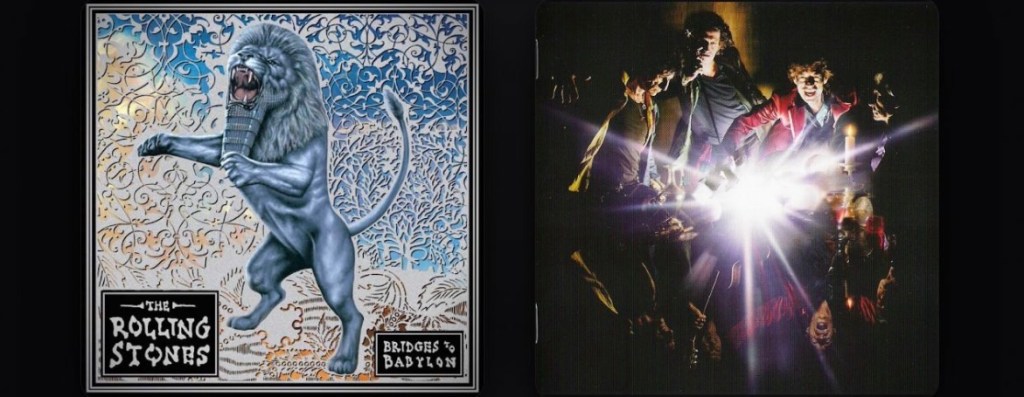
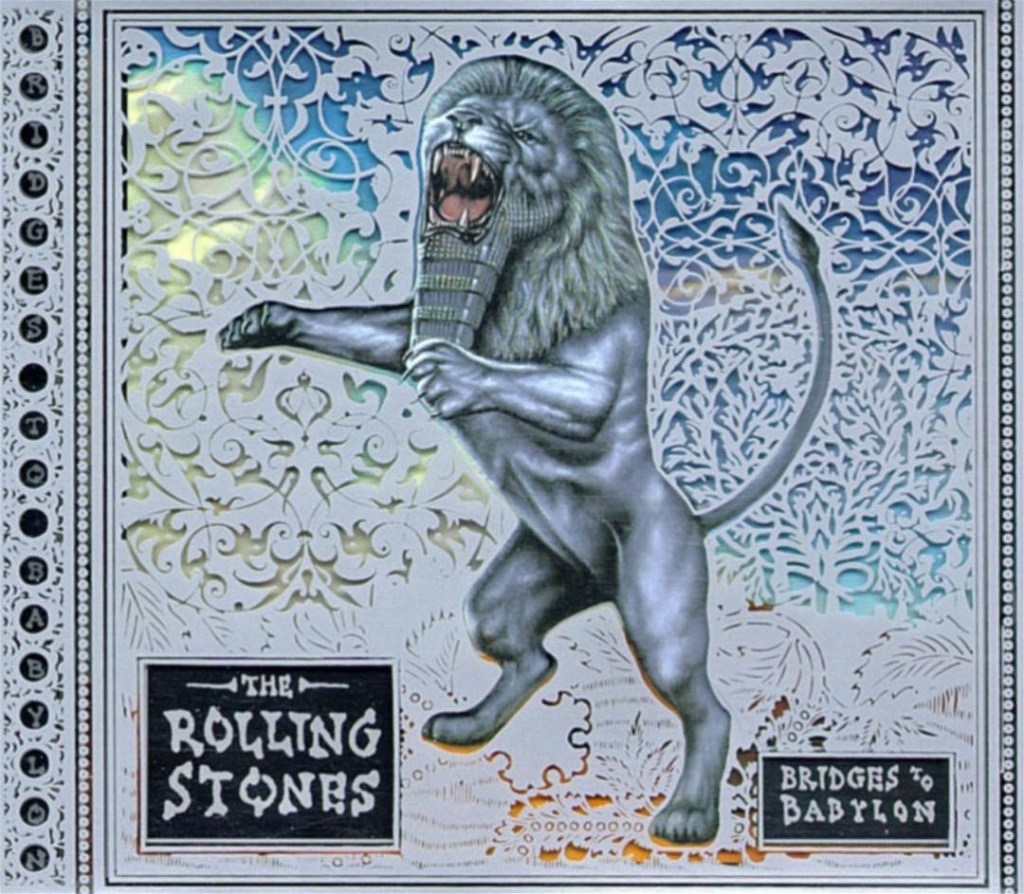
Bridges to Babylon is a tough album to figure out. From the unusual album artwork to the mix of song styles to the separate recording of Jagger and Richards to all the different hands in recording and mixing the album. If you are a newer fan of the band, you might not notice the familiarity of some of the songs or the style they fall back on, repeatedly. Still, they will throw out a fresh idea or push their innovation. The yin and yang of Jagger and Richards styles has fueled their song-craft and given us the blues-rock of their origin with infusion of contemporary pop sounds. Usually it succeeds, but sometimes it doesn’t. This album is a mess.
A Bigger Bang (2005)
The last studio album with Charlie Watts before he died in 2021. According to Richards, the only proper way a member of the Rolling Stones leaves the band is in a pine box. I suspect the coffin was something more than pine.
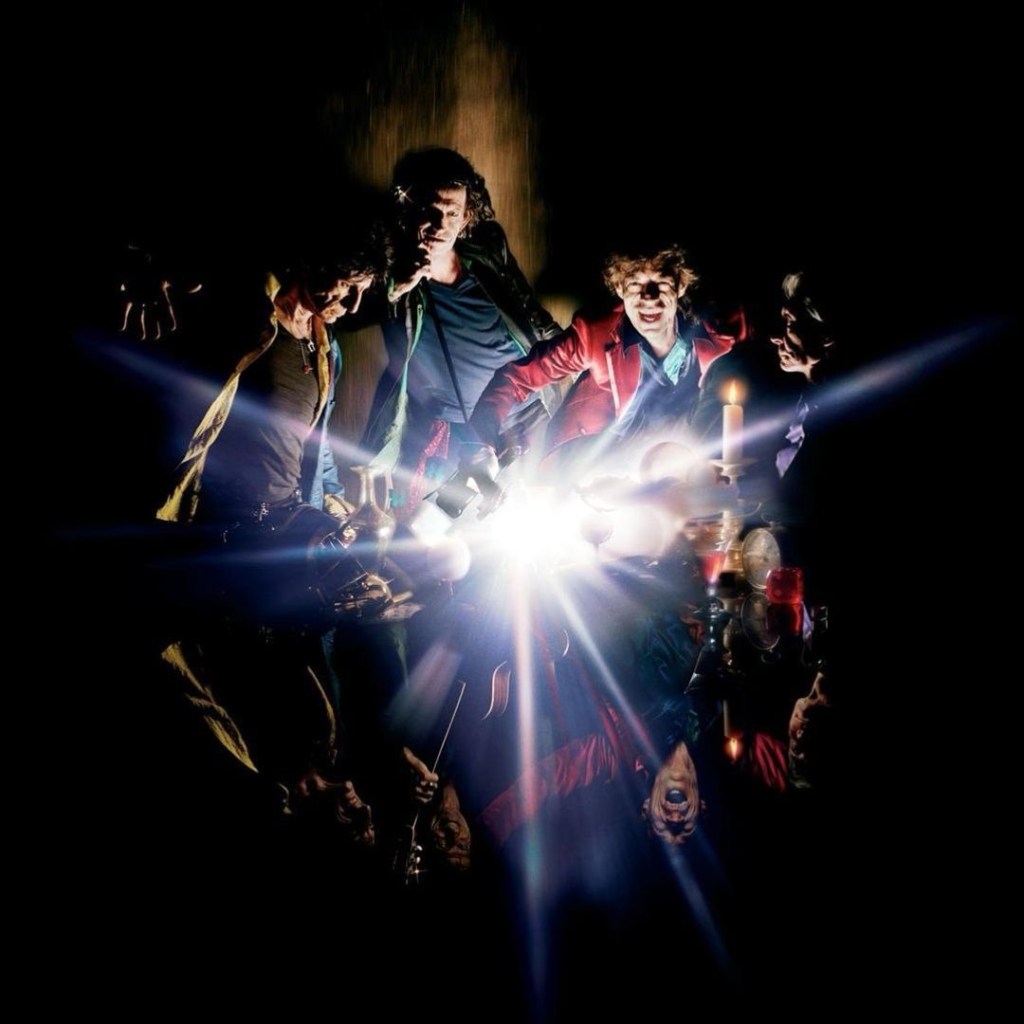
The gap between records seems to be getting longer, but my gut feeling is that time is not being used to write and hone new music. On A Bigger Bang, the energy is there, yet the songwriting is not. Give the Stones credit for not slowing down or stopping altogether. Their live-in-the-studio method of working through new songs brings the heat, but missing is the meat.
The Stones seem comfortable with Don Was behind the recording console as he’s back again. There are fewer producers, fewer guest musicians and fewer studios. I’m guessing there were fewer distractions and more focus on recording.
There are a handful of keepers, but numerous album fillers that weigh down the better tracks.
November 2004, 7-9 March 2005, 6-28 June 2005
Château de Fourchette in Pocé-sur-Cisse, France
Ocean Way Recording and The Village Recorder in Los Angeles
Produced by Don Was, Mick Jagger, Keith Richards
All songs written by Jagger/Richards
“Rough Justice” 3:11 Pretty raunchy song, great guitar interplay, especially Woody’s slide guitar. Not the greatest album opener, above average, but gets party going.
“Let Me Down Slow” 4:16 A likable song. Rocking, uptempo. It’s the chorus that resonates. More of these would be nice.
“It Won’t Take Long” 3:54 A tantalizing riff opens the song. Another very likable tune. Raw, angry guitars. Nicely done.
“Rain Fall Down” 4:54 Another very good, original riff powers this song. Sounds like classic Stones but it’s new.
“Streets of Love” 5:10 Not terribly original, but a fine ballad. The guitar work keeps it from becoming a cliched version of a weepy song.
“Back of My Hand” 3:32 A swampy, blues tune with harp and dobro. Could easily fit on Beggars Banquet.
“She Saw Me Coming” 3:12 Generic Stones blues-rock. Slowed down version of “Respectable.”
“Biggest Mistake” 4:06 Another likable song, a smooth, uptempo ballad.
“This Place Is Empty” 3:12 The obligatory Richards weepy ballad. Rather generic, but appreciate Keef trying to change it up a bit.
“Oh No, Not You Again” 3:46 Album filler
“Dangerous Beauty” 3:48 Album filler
“Laugh, I Nearly Died” 4:54 Slow, blues rocker.
“Sweet Neo Con” 4:33 A political song, Bluesy swagger, mean riffs. You call yourself a Christian
I think that you’re a hypocrite
You say you are a patriot
I think that you’re a crock of shit
“Look What the Cat Dragged In” 3:57 Borderline album filler. The Stone try to rock it up with guitar fills but use the same Stones-rocker-template.
“Driving Too Fast” 3:56 See the comment immediately above. Same kind of song.
“Infamy” 3:47 A nice Richards song. Bluesy, great Charlie beat, unique guitar riff. One of the more interesting Keef songs.
Mick Jagger – vocals, guitars, keyboard, vibraphone, bass guitar, harmonica, percussion, slide guitar, production
Keith Richards – guitars, backing vocals, lead vocals, bass guitar, piano keyboard, production
Charlie Watts – drums
Ronnie Wood – slide guitar, guitars
Darryl Jones – bass guitar (1–5, 8, 10, 12, 14, 15)
Chuck Leavell – piano (1, 5, 15), organ (3, 5, 8)
Matt Clifford – keyboard (4, 5), vibraphone (4, 5), organ (5), piano (5), programming (4, 5), string arrangement (5), production (5)
Blondie Chaplin – vocals (7, 16)
Don Was – piano (9)
Lenny Castro – percussion (14)
Final thoughts
I want to like every new Stones album. The trouble is, I play it a couple of times and then stick it into collection, rarely to be referenced again. I have to admit, looking at the song list, I couldn’t remember any of the songs, so it was like listening to this album for the first time.
There is plenty of Mick doing “Mick” things. He shouts, he growls, there’s indignation, romanticism, swagger and the whole routine. He’s very involved musically as he plays on every song except the Keith songs.
Too much filler, a comment I’ve made on Stones albums since Emotional Rescue. Whereas Bridges to Babylon was trying to infuse hipness into the music (Usually Jagger’s intent), A Bigger Bang is more about trying to do what they do well.
The problem with Stones albums their classic period is they construct these songs in the studio to fill out a record, not to create songs they will likely ever play again, songs that don’t populate a greatest hits collection or boost their legacy.



Leave a comment