

The previews are a bit deceiving, The Holdovers is not a laugh-out-loud film. It’s funny and smartly amusing in places, but this is a serious film about some quirky, damaged people.
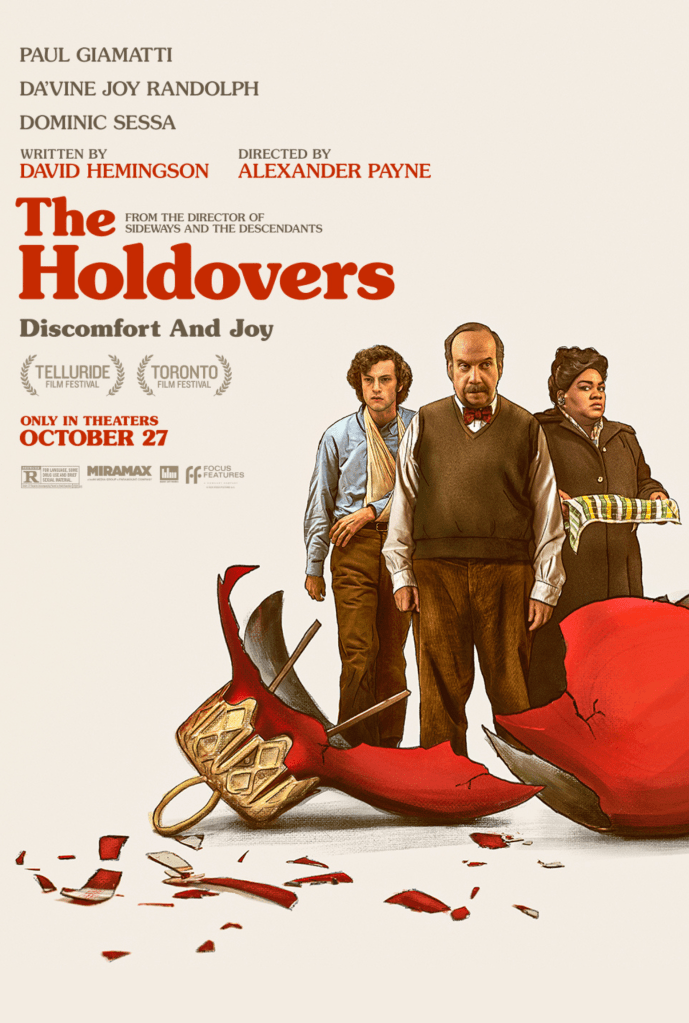
Written by David Hemingson and directed by Alexander Payne, The Holdovers takes place at Barton Academy, a boys prep school in 1970, as the Christmas break nears. Paul Giamatti stars as Mr Hunham, a longtime member of the faculty, disliked by most of the students and staff, he is selected to stay over the break to supervise the few students who must stay as well, “holdovers” as they are known.
Paul Giamatti as Paul Hunham
Dominic Sessa as Angus Tully
Da’Vine Joy Randolph as Mary Lamb
Carrie Preston as Miss Lydia Crane
Gillian Vigman as Judy Clotfelter
Tate Donovan as Stanley Clotfelter
Payne and Giamatti teamed up for the well-received Sideways (2004) another serious but sometimes absurd film, where Giamatti nabbed many accolades as the insecure and depressed teacher, who must break through the protective bubble he’s created to cushion reality. Payne co-wrote and directed this surprise critical and box office hit.
Later in The Holdovers, it is revealed that Mr. Hunham was a student at Barton, now a teacher of classics there, he seems a living reminder of the school’s original purpose and its founder. Barton is his life. Angus Tully is a Barton student, and one of Hunham’s students. They have a difficult relationship, that is to become even more tested, as Angus unexpectedly becomes one of the holdovers. Mary Lamb is the cafeteria administrator, who will be providing the meals for those staying over break. These three are the central characters in the film.
The film basically takes place during a two-week period. Each character we learn is carrying heavy, personal baggage. It’s during the two weeks that these characters, particularly Mr. Hunham and Angus, are forced to confront their own problems as they get to know each other and themselves. As holdovers, the power shifts between Mr. Hunham and Angus, as this becomes more than just a teacher babysitting a group of students. The other holdovers get the opportunity to leave, courtesy of a student’s, wealthy father, leaving Hunham, Angus, Mary and the school custodian as the only ones left at Barton.
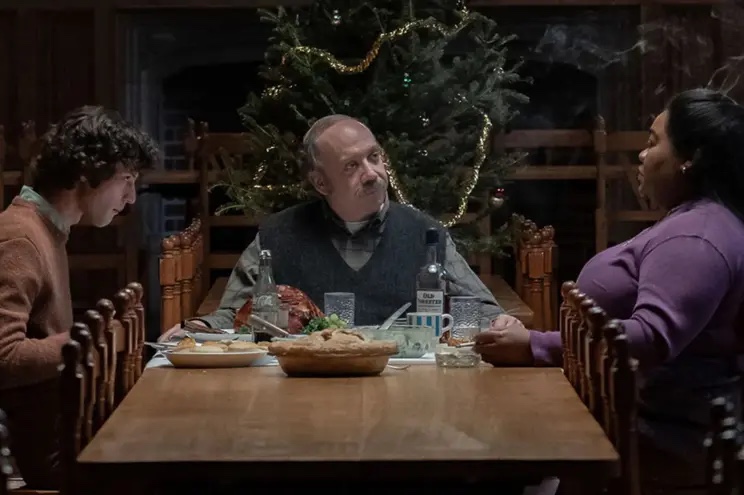
I’m not going to reveal much of the plot or the outcome. I recommend seeing this film. This quiet, little film, is one of the year’s best. The Holdovers is a character-driven story, one of those films that depends on fine acting, and a script that folds back the vulnerabilities of the characters to deliver. There is no CGI or big action, no blood or sex, no trippy photography or commercialized soundtrack. The viewer must quickly invest in the story premise and enjoy the characters.
It starts with the written word. The screenplay by Hemingson, based on an idea by Payne, never gives away too much. You think you know the characters and their backstories, but you don’t really know them until much later on. People aren’t really complicated or mysterious, we just keep our stories, especially our wounds, to ourselves. The Holdovers is about the trust, and respect, that develops between three people of different backgrounds who find that a tread of compassion and relatable loss establishes a bond between them.
Giamatti is wonderful as Mr. Hunham, a grumpy, esoteric, man of character, who has been beaten down by people of lesser character who had money and connections. His equalizer is his knowledge and love of teaching, even in a boys school. If you liked the neurotic, long-suffering, quick-witted Miles from Sideways, you will enjoy Giamatti here.
Da’Vine Joy Randolph as Mary turns in a quieter, but deeply moving performance as a single mother who is grieving her son, a graduate of Barton, who was killed in Vietnam. Her son did not have the resources pull to avoid the war, but he also didn’t shirk his responsibility either. No deferment or bone spurs. There is a thread of inequality and class privilege that runs silently, but in full view, throughout this film. In 1970, the meat grinder of Vietnam was consuming more of the lower economic class, and young men of color, than other socioeconomic groups. Mary is not a complainer, she’s a realist, but she grieves in silence, until it erupts.
This is Dominic Sessa’s first film, and he is delightful as Angus. He too, hides a painful story, one that is forced to the surface during the two week break. Angus and Mr. Hunham are alike enough that trust develops between them. Unlike Mary or Mr. Hunham, his pain has surfaced and is consuming him. He’s a young man from a difficult background that is on the cusp of being able to find his way in the world. I can relate to the precipice Angus finds himself and how intense that drive for understanding can also be your undoing. If this is an example of Sessa’s acting talent, the young man has a great career ahead.
The unspoken character in the film is the time it takes place. Payne’s choice of music and the look of the film are subtly early 1970s. It looks and feels the period, but not in an obvious way. The children of divorced parents had a tough time then, I know that for a fact. Congratulations to Hemingson who understands the awkwardness of being a teen and unforgiving life can feel. I’m still looking for those laugh out loud moments, so I’ll see the film again.
4.7/5 my score
Rottemtomatoes.com critics: 96%, audience: 92%
[If you enjoyed this blog, consider subscribing, you’ll get automatic notifications of a new blog. Also, if you like this blog, consider a”like.” Thanks for stopping by.]



 Ticket 2 Ride
Leave a comment