
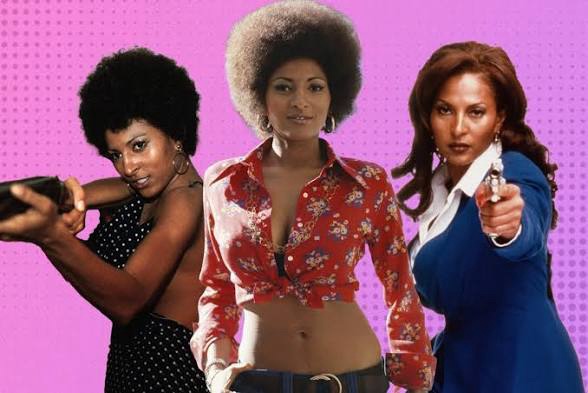
I’ve always admired Pam Grier, she was a kick-ass action star in low budget films. Known from the exploitation films of the early 1970s, she was tough and sexy, and never intended to be an actor. She went to L.A. to attend college and fell into acting as a way to pay for her education. She was interested in being behind the camera, not in front of it.

The TCM podcast: The Plot Thickens, hosted by Ben Mankiewicz, explores in-depth film stories, using interviews with the podcast subjects. Pam Grier was featured in the 2022 season of the podcast.
Grier also published her memoir, Foxy: My Life in Three Acts (2010, Springboard Press), which I finished reading for a second time. Grier is a survivor in Hollywood, of her peers from that era, she is one of the few, who with no experience, thrived and carved out a career where A list directors (Tim Burton, Quentin Tarantino) later sought her for parts in big films.
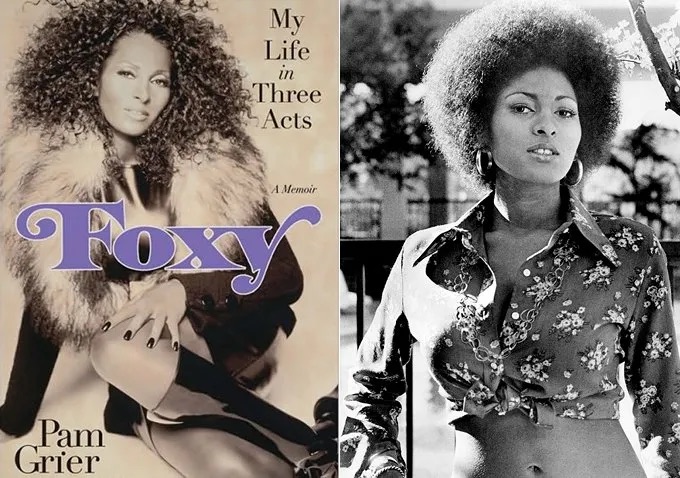
Grier was a child of an Air Force sergeant, who moved around the world, then settled in Denver where other family lived. Denver is the 1960s was as segregated as other urban area, the Grier family liked in a Black section of the city. In the TCM podcast, Grier tells of being sexually assaulted at a young age and how it caused her to stutter and withdraw. Only years later did she talk of that experience. She was raped on a date by a man who just took what he wanted; a reminder that women were supposed to take it, and be happy with it. She did grew through those ordeals, what choice did she have, and would find her voice and her presence. She would later use that voice as a singer in L.A., singing background in sessions, and her presence helped her in beauty contests to earn college tuition money.
She was pretty, and while she was told that, she didn’t want to hear it. “I made a decision. Being cute and getting attention were not good things, I decided. Cute girls got into trouble with boys. I would make sure I was not a cute or a pretty girl…I would mess up my hair and do what I could to throw off the ‘pretty girl’ label,” Grier writes.
Her first acting gig was in a Roger Corman film, The Big Doll House, a women-in-prison film, made in the Philippines on a minuscule budget. She was engaged to a basketball player named Lew Alcindor, who was becoming Kareem Abdul Jabbar. He wanted her to fit into his life and gave her an ultimatum. He told her that he would take care of her, most women wanted to hear, Grier said. His offer came with strings, to convert to Islam and become a “traditional” wife, something she had already chafed at with his growing expectations of her. “I really can’t have anyone taking care of me,” she told him. “That’s the master/slave syndrome, and I refuse to ever be oppressed or manipulated.” She loved him, and needed time to figure this out.
Corman hired her because of her look, she would be convincing as one of the tough convicts in the film. Corman took a chance. He also gave her a book on acting by Konstantin Stanislavsky, An Actor Prepares, which became her bible. She wrapped herself in the book while on location.
She was asked to remain in the Philippines to film another Corman flick. Women in Cages. Jump out of the plane, nowhere to land. She did her own stunts, nudity didn’t bother her. She wanted tuition money for UCLA film school. She found herself going halfway around the world.
Back in L.A., she found that she couldn’t reconcile herself to what Abdul Jabbar’s new religion required. He told her that he had another bride prepared for him, who would convert to Islam and be the kind of wife he wanted. That made her head spin.
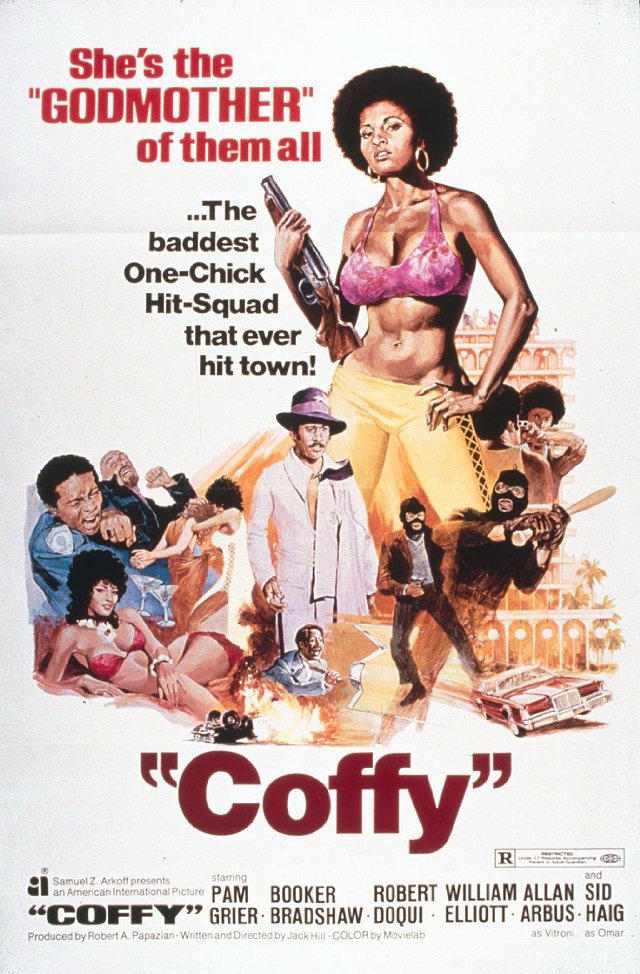
More American International Pictures films followed, including one she got to help develop, Coffey. Not only was it an action flick, she played a tough Black woman dealing out revenge. This was 1973, a film about a strong, resourceful, Black woman. Today, there are numerous woman action heroes, but it was a long road, and there are still pay/equity issues. Back in 1973, there was only Grier and her friend, Tamara Dobson (Cleopatra Jones).
Being a woman, and Black, in Hollywood didn’t really get easier with growing success. When he was quizzed by a producer why she continued to work hourly jobs between films, she had a fast reply. “Because actresses go from one project to the next and they only get paid when they work,” she writes. “I need steady money coming in. I have goals and I can’t be fitting from job to job, not knowing where my next paycheck is coming from.” Her mother taught her the importance of earning your way, of the value of education and of independence.
Blaxploitation films got a lot of pushback, especially in the Black community. Grier had a different take. “To me, what really stood out in the genre was women of color acting like heroes rather than depicting nannies or maids. We were redefining heroes as schoolteachers, nurses, mothers, and street-smart women who were proud of who they were. They were far more aggressive and progressive than the Hollywood stereotypes.”
Pam Grier didn’t need a big house in Beverly Hills, a fast sports car, or the glitz of stardom. Her main residence was a farmhouse in rural Colorado, her animals, a healthy life and genuine people around her.
Grier never married, although she was asked several times. She had relationships with a variety of men, not all of them from the entertainment world. Besides Abdul Jabbar, the other noticeable names include Richard Pryor and Freddie Prinze, men who developed tremendous drug problems. Grier had seen enough unhappy and unhealthy marriages around her, she didn’t want to be another statistic. Through the ups and downs of her career, relationships, deaths of people close to her, her own cancer diagnosis, Grier never lost sight of her goals and her determination to be happy in her life.
In speaking about Kareem, Freddie and Richard, she said on the podcast, “I didn’t fit a mold for all of them. That’s why it didn’t last, because I made the decision to love me more, grow more, not grow because someone tells me when to grow or how to grow.” She couldn’t – and wouldn’t – be what they wanted and needed. She wouldn’t do that for any man.
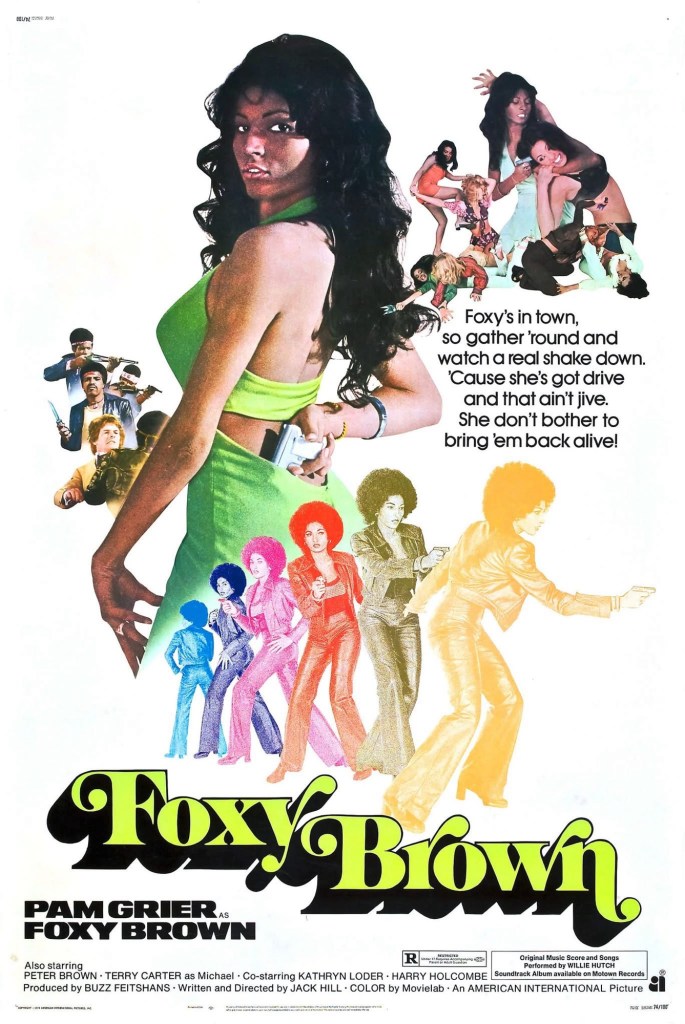
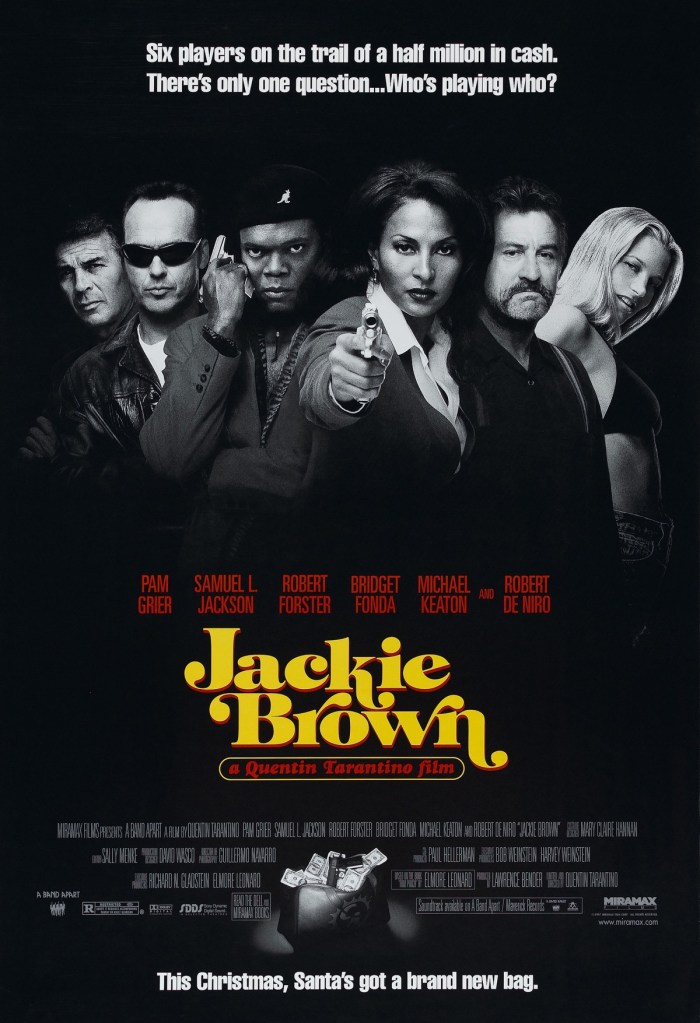
Her starring role in Jackie Brown, a role written expressly for her by Tarantino, came in midlife. When Tarantino sent her the script, she thought he wanted for the smaller, supportive role of Melanie. Quentin laughed. “Bridget Fonda is playing Melanie,” he said. “You’re Jackie Brown, Pam. I told you I was writing a script for you. I loved Foxy Brown, and I wrote this in your honor.”
What impresses me most about Pam Grier is how genuine she is. She never intended to be an actress, and even after a couple of roles, she still had her sight set on attending UCLA film school. What she found in those first films was something she was good at, but at the lowest rung of her profession. She’d have to buckle-down and learn. Her bible was helpful, yet it was experience, learning from other actors, and taking criticism that would make her better. Even low-budget films that hired non-actors, like herself, deserved her best effort.
“‘This is only a B movie, Pam,’ her costar in Women in Cages said. ‘You don’t have to work that hard. We can learn our lines in the morning.’ I passed, and she took off without me. I had no concept of categories like A, B, or C movies. A movie was a movie, and I intended to deliver an A performance, no matter what anybody else did. I analyzed each of my lines, why I was saying certain things, and I kept my acting goals in mind.”
When the blaxploitation era ended in 1976, Pam Grier found her work drying up. Mainstream films wouldn’t be ready for a strong, Black female action star for decades. She turned to television and worked like hell to get meaningful film parts. Even when she was hired for cliche roles, like the killer-hooker in Fort Apache The Bronx, she researched and went deep into the darkness of the character. She showed at the audition as the character and put a scare in those present. Paul Newman was impressed and immediately offered her the part. Not bad for someone with no acting training or experience ten years before, who embodied what Stanislavski is noted for saying, “there are no small parts, only small actors”.
Today at age 77, Grier works when she wants to. According to IMDb.com, she has acted in 111 role in her career. She never completed film school, her education was in front of the camera. Even when she was not in the scene, she observed, studied and learned from the other actors and the crew. From Paul Newman she learned: “Acting is about our humanness. It’s replicating a human being so closely. The goal is to move your audience, and make them have empathy towards you.”
Asked, how do you want your body of work to be remembered? “The equity that women have given to society was being ignored, and I wanted to bring it to film at every opportunity, whether it was comedy, drama, death or mayhem,” she says. “I wanted to show that women are resilient. I wanted people not to look at the color of my skin or the nappiness of my hair, but to see a female who knew how to survive.”
Maybe not always great art, but she gave her roles purpose and 100 percent each time out.

 Ticket 2 Ride
Leave a comment