
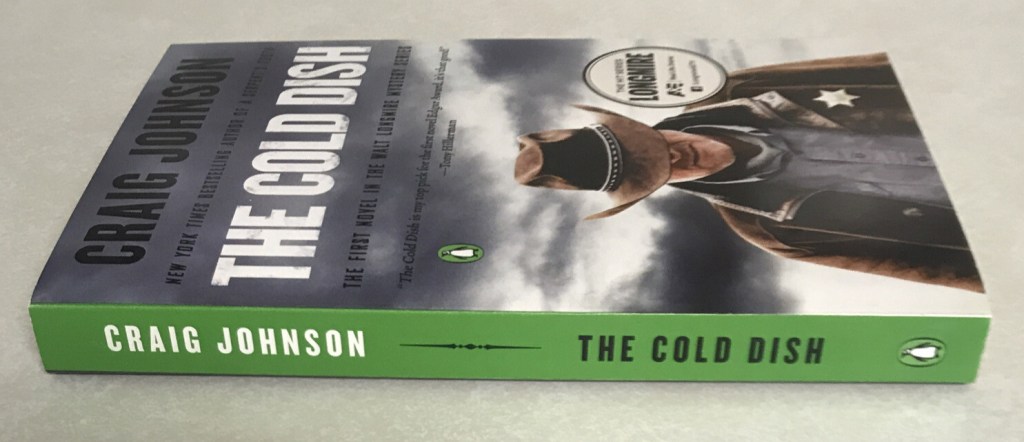
Have you ever reread a book, years and many books in a series later? I do that periodically, and you might recall the look back I did after watching the entire Longmire TV series. Looking back can be a learning experience with respect to a book or film series. Perceptions change, characters evolve, writing get better, and time does funny things to your memory.
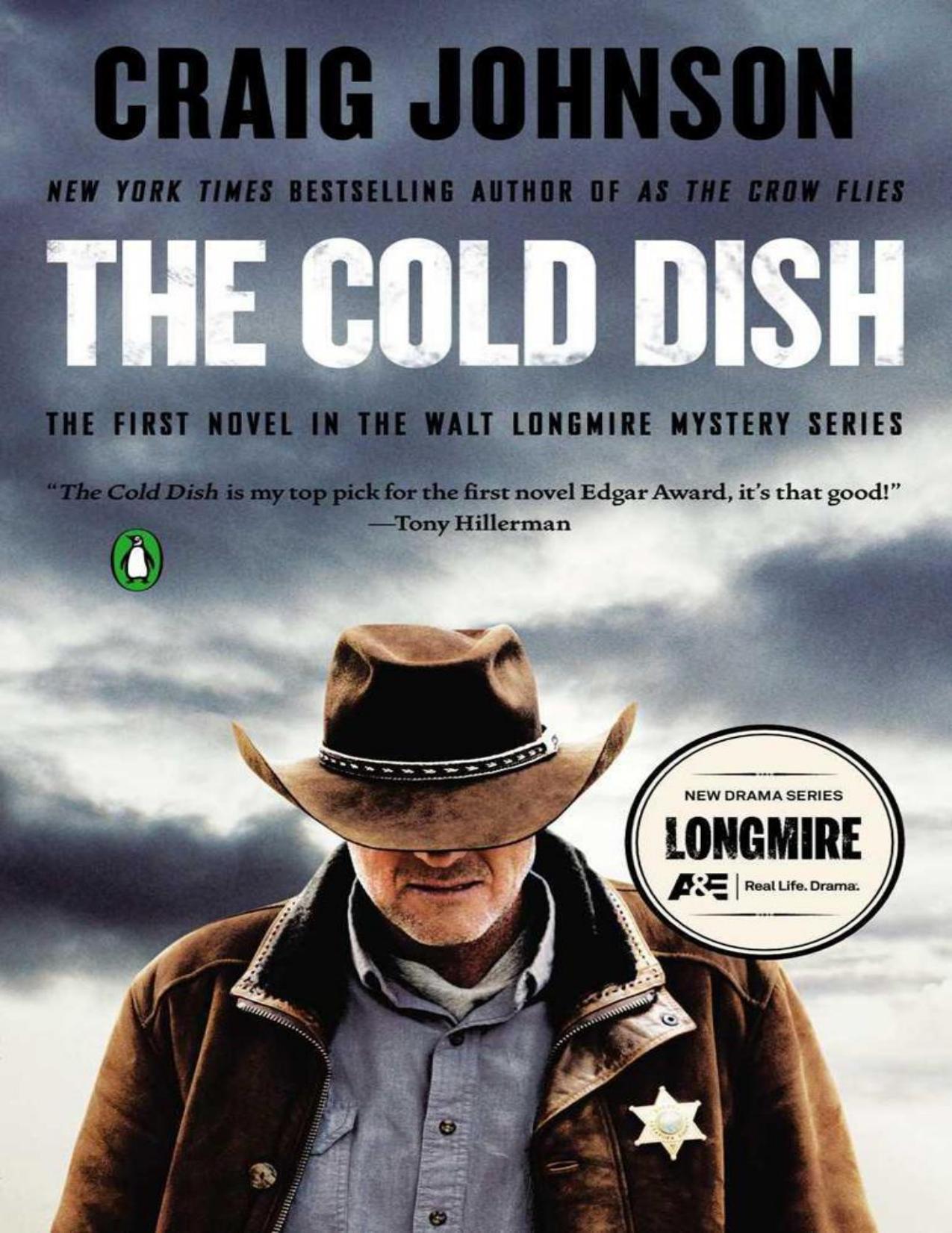
Published in 2004, The Cold Dish introduced us to Sheriff Walter Longmire and the characters of the fictional Absaroka County of Wyoming. Walt is a throwback, a lawman of another time. He hates newfangled technology, but thankfully he has others around him that embrace it. Wyoming is home to Walt. His education was at the University of Southern California and he served in Vietnam, but otherwise Wyoming is his perspective on the world. Walt is well-reader, he’s absorbed the classics, philosophy, poetry, he’s a thinker and curious – two great qualities for a lawman.
Walt Longmire is one of the most intuitive and grounded characters in all of the mystery series that I read. Few characters display the expansive palette that is Walt. It is through his eyes, his challenges, his strengths and his flaws, that flows the stuff of great drama and more subtle nuggets of truth.
Wyoming seems an odd location for a series of mystery books, but Absaroka County is the crossroads, or at least an off-ramp to the world. Technology and a global economy are to blame, as opportunity and tensions co-exist between cultures, economic classes, traditions verses the new age. While some people live and die in Absaroka County, many are drawn to the natural resources, history, culture and freedom. Absaroka County might just be the ideal place for a mystery series. Walt’s mysteries are not just limited to his county. Like Jessica Fletcher, mysteries are found elsewhere as life tales Walt into some very interesting directions, even the Vietnam of his past.
Craig Johnson has surrounded Walt with a diverse group of characters, where a good portion of the drama originates. Walt is a widower, losing his wife to cancer, and not adjusting well to his life without her. Cady, his adult daughter is a practicing attorney, who is currently in Philadelphia. Walt and Cady are close, but also knock heads. Walt’s best friend is Henry Standing Bear, owner of The Red Pony, they grew up together. The sheriff before Walt was Lucian Connally, a cantankerous and opinionated character who is around for assistance and unasked for advice. Victoria “Vic” Morretti is the undersheriff, quick tempered and a hell on wheels young woman, whose relationship with Walt changes the most during the course of the books.
Walt is conflicted between continuing to morn the passing of his wife three years ago and feeling the pangs of attraction to an old friend of his late wife. Everyone wants Walt to move forward with his life. Cady and Henry, always close, have conspired to push Walt along, Henry has arranged for some improvements to Walt’s bare-bones house, which he didn’t finish after Martha died, and Cady encouraged for Walt to get an answering machine, but he still doesn’t want a cellphone.
“Walt, we need to go over a few things.” This had an ominous tone to it. “There was a time when this particular lifestyle had its place, the grieving widower valiantly sallying forth through a sea of depression and cardboard. This gave way to the eccentric lawman era, but now, Walt my friend, you are just a slob.”
While the present seems to be about treading water, Walt is even unsure of what his future holds – does he run for reelection? What author Craig Johnson embeds in Walt is the delicate balance of being a political animal and working the voters, and doing his job even when it’s unpopular and ruffles that same electorate. Walt is the epitome of a “work in progress” human, and a series of never ending internal conflicts. Walt is not a badge-heavy cop, if there is a reasonable explanation, he’s willing to hear it, but chances are, Walt has already examined other possibilities and he’s not easy to mislead.
It was one of those beautiful, high-plains days, where the sky just blinks blue at the earth and you have to remind yourself to take it in.
Johnson had the idea for Walt, but it wasn’t until he built a log house, like Walt does for his wife, that he decided to take the story idea from head to paper. He had been collecting newspaper stories, real events and real people. That’s where the ideas derived. “I was looking for reality to base this story on,” Johnson said. Is Walt Longmire based on Craig Johnson? No, he said. But his wife said that Walt is what Craig aspires to be. Certainly, Walt has the writer’s knowledge and experience of living in Wyoming. I suspect Walt has more of Craig than he will admit.
Johnson lives in a sparsely populated part of the state (a sparse part of a spare area), and drove to the closest town to ask the local sheriff about sheriffing in a small town. Ten years later, Johnson said he’d written two very bad chapters, and that was it, till he ran into that sheriff again, who remembered that Johnson was going to write a book. That meeting spurred Johnson to start over on the book.
There were clouds at the mountains, and the snow pack reflected the sour-lemon sun into one of the most beautiful and perverse sunsets I had ever seen. The clouds were dappled like the hindquarters of an Appaloosa colt, and the beauty kicked just as hard.
What I like and what I sometimes do not like about Craig Johnson’s writing style is his economy of words. Pay attention or he might lose you. He’s not a flowery writer either, his expositions are tight and efficient, as lean as the Wyoming landscape.
I took a moment to think about the Old Cheyenne and how revenge doesn’t ever fit when there aren’t any bad guys. It wasn’t that revenge was a dish best served cold, it was that it was a dish best not served at all. I thought about what it was the Old Cheyenne really wanted; it wasn’t hard to figure out. The dead just want the same thing as the living: understanding.
Johnson said he had trouble selling The Cold Dish to a publisher. There didn’t seem to be a bidding war; all of them passed until Viking grabbed it up. Longmire represented the New West, a different take on a traditional American genre.
There are 30 Longmire publications, but only 22 official Longmire novels. Several are Longmire short stories or intended as ebooks.


 Ticket 2 Ride
Leave a comment