

Jeff Beck died in 2024. He was an enigma. After reading the new book by Brad Tolinski and Chris Gill, he is still difficult to understand. Blow By Blow is also the name of my favorite Beck album. The album, like Beck the musician, was hard to define. Jazz rock, fusion, prog rock, electronica, blues hard rock, R&B – elements of each, but entirely its own sound.
This sentence by the authors is very profound: “Beck was restless, never fully content with any success. This uncompromising drive for greatness defined him as an artist but also occasionally marked him as his own worst enemy.”
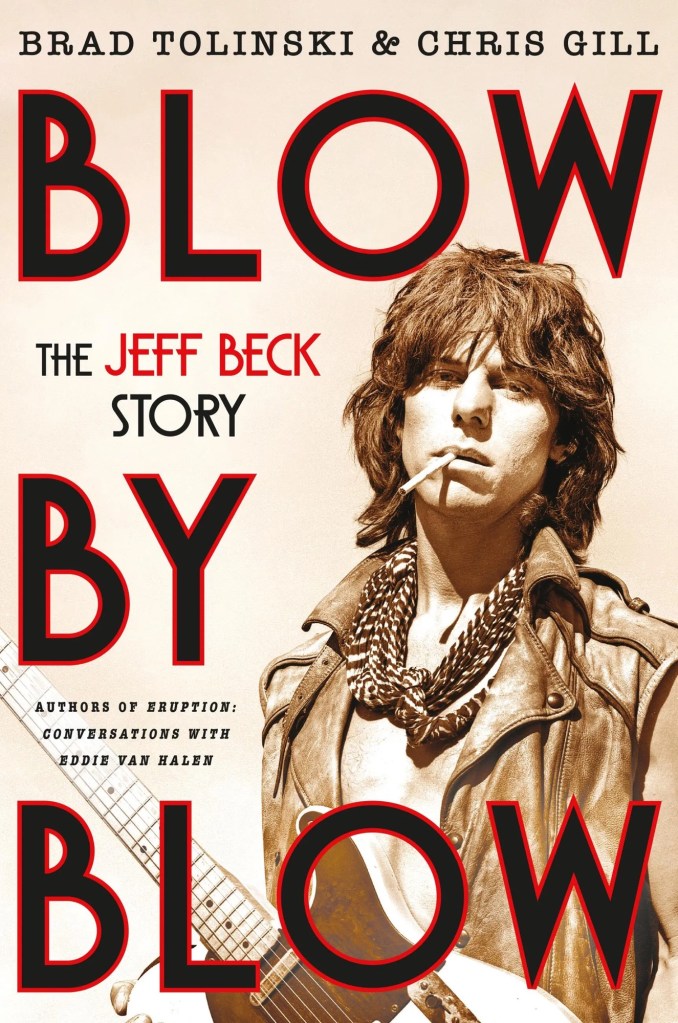
Blow By Blow: The Jeff Beck Story (2026, Da Capo) is the only Beck biography I’ve seen, so I don’t have anything to really compare it to, which is not surprising given how Beck kept his profile low and did his talking through his music. I’ve been a fan since the Jeff Beck Group days of the early 1970s, have all of his studio albums – but knew almost nothing about the guy. He was like a ghost.
The early part of the book is about Beck’s early years as a musician before and during his Yardbird days. While Beck was only in the band for less time than Eric Clapton, his tenure did more to shape the band’s sound as it evolved from Clapton’s American blues to the heavy, psychedelic blues associated with Jimmy Page. It’s ironic, Clapton gets criticism as never sticking with a band or the same sound very long, but truth be known, Beck would change his band lineup quicker than Slowhand played the opening guitar riff from “Layla”. Beck was known for completely changing his band from album to album, but did recycle a few players like pianist Max Middleton, vocalist Bobby Tench, bass player Mo Foster or Pino Pallindino, drummer Simon Phillips or Terry Bozzio, or keyboard player Tony Hyams or Jan Hammer.
Changing bands and musical genres kept the creative fires burning although he seemed quickly bored and apt to fire his band members in a callous manner. Beck had no career plan.
As an example, he longed to work with Carmine Appice and Tim Bogart of Vanilla Fudge in a power trio. Finally, they came together and made an album. While they did work on a second album (never finished) and tour the world, Beck had very little positive to say about the experience. He said it was a project five years too late, and he even bolted from a tour after the sixth show.
Tolinski & Gill trace Beck’s musical career through three main eras: the hard rock blues of The Yardbirds and the iterations of The Jeff Beck Group; the jazz-rock fusion albums of the mid and late 1970s; and the last period where Beck found electronic music and channeled his creativity through ambient soundscapes on such songs as “A Day in the Life” and “Somewhere Over the Rainbow.” Instead of raw power and shredding the blues, Beck found power in cleaner, more soulful string bending.
The most interesting section told Beck’s journey through jazz-rock fusion. Beck was a great player, but not a talented vocalist and he was hard-pressed to write his own songs. Beck had ideas, but he wasn’t a writer like Clapton or Page. Beck was also not a prolific worker. Years would pass between albums. Beck really loved to play live, and he worked sessions, although they were high-paying recording dates.
“The financial windfall from Blow by Blow and its 1975 tour enabled him to purchase Riverhall, a Grade II-listed historical sixteenth-century farmhouse estate nestled on eighty acres of wooded land in Wadhurst, East Sussex. It would remain Jeff’s home for the rest of his life.”
The three fusion albums in the 1970s, were my favorite Beck period. Since Beck didn’t sing, the idea of instrumental fusion albums was perfect for Beck, although his record company hated the idea. Blow By Blow and Wired were solid sellers, but the last album in the series, There and Back was not. The fusion period ran its course and left Beck struggling in the 1980s. Sessions with producers Bob Ezrin, Nile Rodgers, Steve Lukather and Sly Stone went nowhere. A reunion with former Jeff Beck Group vocalist Rod Stewart, and teaming up with Mick Jagger, and an aborted tour with Elton John were unsuccessful.
Beck didn’t release a lot of albums in his career, but he toured often, and he collaborated frequently with other musicians. I hope that some of those collaborations are released one day, like the sessions with Brian Wilson. Thankfully, his jams with the Rolling Stones, during the Black & Blue sessions were released with the anniversary edition of Black & Blue. Beck was under consideration to join the Stones then, a job that rightfully went to Beck’s old bandmate Ron Wood.
By the end of his life, Beck seemed to have found peace with himself as a player or stylist. “Where Were You” from Jeff Beck’s Guitar Shop illustrates his evolution in style and technique. “He sculpted the notes by manipulating his volume and tone knobs, dropping or lifting the vibrato bar with exacting precision, and delicately touching natural harmonics or lightly plucking artificial harmonics with his right hand while his left hand fretted notes. It was the antithesis of the reckless physical abandon and aggressive bravado that defined most rock guitar solos, by requiring the softest touch, utmost precision, and intense concentration, like playing a theremin.” Guitar Shop sold well and gave Beck some security and positive reviews. Beck felt the vitality and it gave him a sense of direction.
Emotion & Commotion (2010) not only sold well, being his best charting album since 1975, but it received five Grammy Award nominations, winning three. Beck wasn’t just a legacy rocker, he still had game.
The last paragraph in the book exemplifies the Jeff Beck legacy. “Only three beings were present at the private burial at Riverhall: Beck’s widow Sandra, their dog, and (Johnny) Depp. It was a fitting farewell for a man who never craved attention, only authenticity. No fanfare, no spectacle— just a quiet return to the place he loved, surrounded by the two souls who knew him best in his final days. Riverhall always served as more than a home; it was Beck’s sanctuary, his workshop, his stage, and his refuge. To be laid to rest there, beneath the Sussex sky he loved so dearly, was a final act of harmony. His last solo, played in peace.”
Final thoughts…
If you are looking to understand Jeff Beck, or at least know him as a person, forget it. Tolinski & Gill, who conducted interviews with Beck as well as his widow and associates, can’t peel away the layers of mystery.
Beck and Jimmy Page had a competitive relationship from before Page joined the Yardbirds. They appeared together on stage, but the authors didn’t list them ever working together on a project. Beck’s relationship with Eric Clapton seemed respectable, but never close. It’s unclear if Beck had any friends in the music biz.
Beck seemed to have an intense, but short attention span. Musical projects were embraced and then abandoned, even after completion, he sometimes dismissed his own work. He was that way with relationships, personal and professional, when they weren’t useful, he moved on. He did have two long romantic relationships in his life, including Sandra whom he married. Her remarks in the book are few.
If you are interested in Jeff Beck’s music, this is a decent book.







Leave a comment