
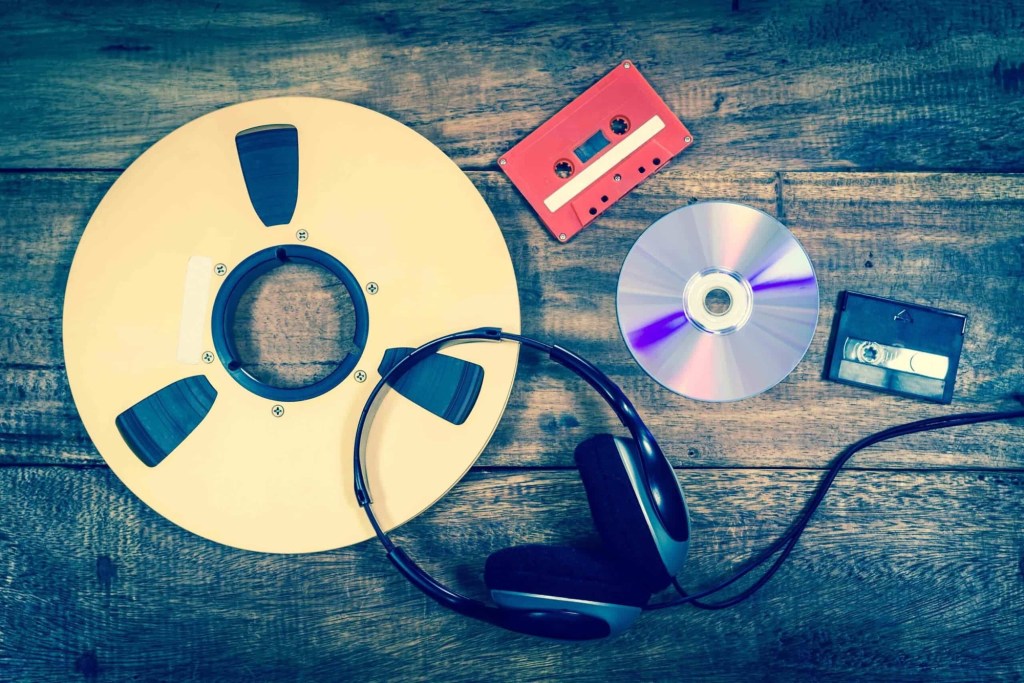
Ghosts of music past. Let’s open the vault to view inside…
I was listening to SiriusXM the other day and heard a guitar effect in the song and immediately thought of a time when that was popular. That got me to thinking about what other things are identifiable to a period in music.
Aside from a guitar effect, it could be a style of play, a particular musical instrument that suddenly appears on a rock song, an instrument adapted by new technology, a type of album art, a recording technique or new technology, a vocal style, concert stage presentation, or other affectation that is specific to a song or a band.
Contemporary music is always changing, adapting and influenced by technology, culture or recycled as an ingredient in a new genre of music.
Here are my initial five:
The talk box –
An early 70s gadget joining guitar sound with voice. From Wikipedia: a talk box directs sound from the instrument into the musician’s mouth by means of a plastic tube adjacent to a vocal microphone. The musician controls the modification of the instrument’s sound by changing the shape of the mouth, “vocalizing” the instrument’s output into a microphone. Joe Walsh and Peter Frampton are frequently pointed out as popularizing the talk box, while others have used it.
Best examples: Richie Sambora, Peter Frampton, Joe Walsh, Aerosmith
The extended drum solo –
As concertgoers, we waited patiently for the drummer to break into an extended drum solo about halfway through the concert. Initially, people seemed enthralled by this barrage of pounding and cymbal crashing, but it didn’t take long for the newness to wear off and the extended drum solo to be retired. Bands do sometimes give their bassists, keyboardists, and drummers very short solos, sometimes as a means of introducing them to the audience – here’s your closeup!
Best examples: Carl Palmer, Ginger Baker, John Bonham, Neil Peart, Phil Collins / Chester Thompson
The fuzz bass –
The early to mid 1960s. The first use of the sound is thought to be by the bass player on a Marty Robbins’ 1961 song “Don’t Worry” which was by accident. The overdrive, distorted sound could be achieved in several ways before the invention of the fuzz pedal.
Perhaps the most famous use of the sound was on The Beatles’ “Think For Yourself”, the George Harrison song from Rubber Soul. Bill Wyman of The Rolling Stones achieved a similar sound on “Under My Thumb” and “Think” from 1966. Producer Terry Melcher took Phil Volk’s bass line in “Hungry” and stacked several different versions of it including a fuzz bass track together for the Paul Revere & the Raiders’ 1966 hit. Producer Tony Visconti contributed a fuzzy bass to David Bowie’s “The Man Who Sold the World” in 1970.
The clavinet keyboard –
The clavinet had a great run from the mid 1960s to the early 1980s. It had a very recognizable sound and contemporary music picked up on.

“The sound is produced by a harp of 60 tensioned steel strings placed diagonally below the key surface. Each key pivots on a fulcrum point at the rear, with a spring to return it. Beneath each key, a metal holder grips a small rubber pad. Pressing a key forces the pad to fret the string like a hammer on a guitar.” – from Wikipedia
Stevie Wonder used the clavinet extensively in the early to mid-1970s for that electric-funky sound as his style changed to a more urban-funk. “Superstition” 1972
Led Zeppelin “Trampled Under Foot” 1975 John Paul Jones
The Rolling Stones “Doo Doo Doo Doo Doo (Heartbreaker)” 1973 Billy Preston plays the keyboard parts.
Fleetwood Mac “You Make Loving Fun” 1977 Christine McVie wrote and performed the keyboards.
The Captain & Tennille “Love Will Keep Us Together” 1973 Daryl Dragon
Backward tapes, reverse tape effects or backmasking –
Accidental use of musical tapes may have led to this psychedelic or avant-garde effect in recording. The Beatles are usually given credit for the first use of this technique. A voice or musical instrument played backwards provides a very different soundscape. Manipulating tape speed or pitch also was used to produce an otherworldly sound. Today, the sound effect can be achieved through more convenient digital recording software.
“Tomorrow Never Knows” 1966 is the song often credited with being the first example of the inclusion of backwards tape. Other Beatles songs include “Rain”1966, “Strawberry Fields Forever” 1967 and “Revolution 9” 1968.
Other examples of artists using this effect. “Are You Experienced?” 1967 by the Jimi Hendrix Experience, “Roundabout” 1971 by Yes.


Leave a Reply