

The Subtle Pleasures of Indiscretion (2026) is the latest installment (number 16) in the Isabel Dalhousie series, which is becoming one of my favorite Alexander McCall Smith series. The life of the owner/editor of the scholarly Review of Applied Ethics in Edinburgh, Scotland is filled with charming and thoughtful people. People seek her out for help with problems and issues. She’s not really a sleuth as much as
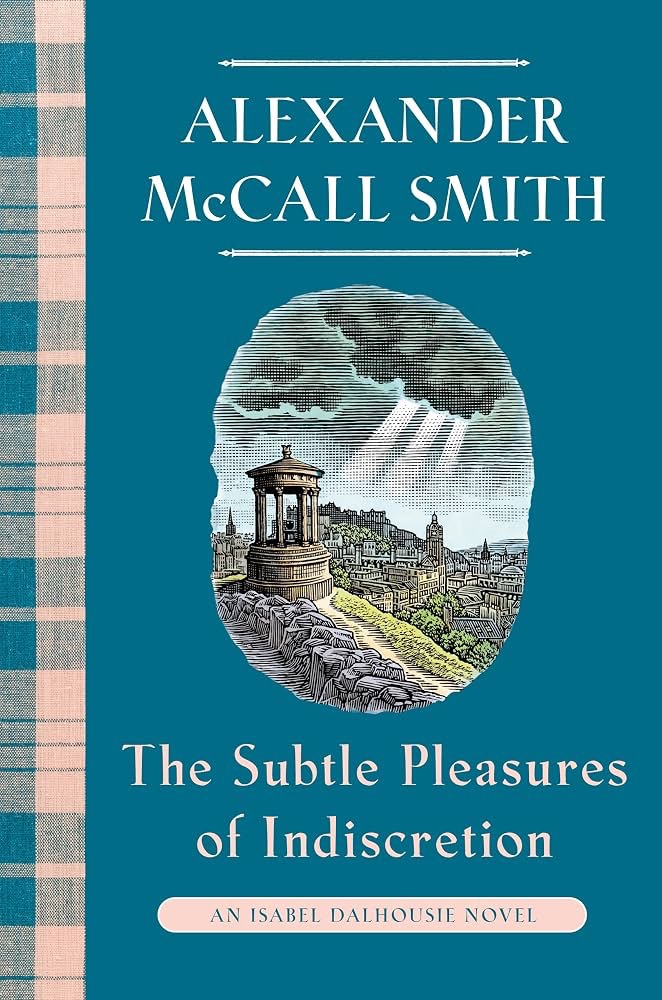
Isabel is a philosopher, an explorer of human behavior, who publishes inquiring articles by a variety of voices on issues of morality and behavior. She is married to a professional musician and teacher, a man younger than herself, with two young children, a temperamental housekeeper and Cat, her deli-owner niece, who collects and discards men including Jamie, Isabel’s husband.
Edinburgh is a popular setting for McCall Smith books. It seems a mixture of the traditional Scottish culture and the modern world. That gives Isabel a vast canvass of people from all walks of life wander into her view. I find much similarity between this series and The No. 1 Ladies’ Detective Agency. While one is set in Scotland and the other is Botswana, the tone and the quirkiness of the main characters are similar.
For the past five or six years I have delightfully enjoyed whatever Alexander McCall Smith has written. The Isabel Dalhousie books may be my favorite of his series. This series is difficult to explain to people unfamiliar with his books. These are less mysteries and more unraveling life’s misunderstandings and finding the answers to questions.
This series is difficult to explain to people unfamiliar with his books. These are less mysteries and more unraveling life’s misunderstandings and finding the answers to questions.
Sometimes the resolution is a discussion to understand motive, morals and responsibility. How can these philosophical dilemmas be entertaining or hold your interest? That’s the art of Alexander McCall Smith.
“It was sympathy, she decided, that made her feel that way. Our sympathy may be triggered by our imagining’s the gory circumstances. This was what Isabel called the moral wince-when the witnessing of human suffering touches a moral nerve. That came from moral imagination, which she felt was at the heart of our entire moral enterprise. If we can imagine how it is to be in the shoes of another, then the fate of the other will engage our emotions.“
Book number sixteen finds Isabel dealing with the usual home issues, professional issues and the issues of those who seek her out. From childhood biting to a threat to her marriage, to an ethical divide between two colleagues to someone from her past comes forward with a problem that gives Isabel cause to reexamine her own past behavior. If someone says, nothing happens in these books, they aren’t paying attention. There are dilemmas abound for Isabel to navigate.
What I enjoy most is how thoughtful these books are, the deep dig into human behavior, even with simple appearing things there is often much more below the surface. Even well-intending people make mistakes or fail to correctly interpret life in front of them, or simply do not have enough information to see an issue from multiple sides.
“A man who has just behaved badly, but who may not be completely or permanently bad. That was, strictly speaking, true, and Isabel realised that she had to be consistent in her moral conclusions and in the way she treated others.”
All of McCall Smith’s books deal with kindness and doing the right thing. But how do you weave compelling stories and interesting characters around such moralistic ideals. Again, that’s the art and talent of the author. I loved this book and look forward to his next one.
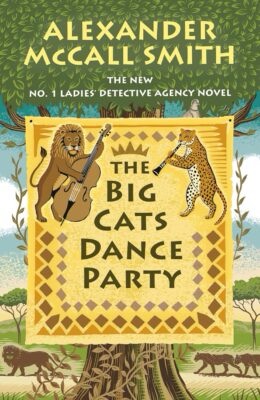
The Big Cats Dance Party (2026) is the 27th installment in The No. 1 Ladies’ Detective Agency series.
This series is one of my top five book series of all time. I value it that much, but I approach each book with an open mind and when I write a review, my words are honest and not sugarcoated.
This is a story about a case the lady detectives are working on, someone is thought to be spreading harmful information about an organization that assists and cares for elephants. They must travel to a smaller, more rural village where they can find who might have a grudge with the elephant organization. Mma Ramotswe and Mma Makutsi are accompanied on their journey by Mr. J.L.B. Matekoni, Mma Ramotswe’s husband. That leaves his garage in the hands of young mechanic Fanwell.
The other story concerns young Charlie, who is left in charge of the detective agency while the two ladies are away on their case. Charlie has grand visions of what the detective agency would be under his leadership. Given the responsibility to lead an investigation into a client’s business to find out why it is making too much profit, Charlie jumps into it. Meanwhile, Charlie’s friends act him to guarantee a concert they are planning. They tell him there’s no financial risk, so Charlie types out a letter on the detective agency letterhead supporting the concert – all without talking to Mma Ramotswe and Mma Makutsi.
The Big Cats Dance Party challenges the ladies on their case, and Charlie on his case and the cancellation of the concert – with him liable for the cancellation fee. Although the ladies find and talk with the person they believe is spreading the bad juju about the elephant organization, he does not admit it, so they must return home with no result.
Charlie is stumped on his case; he believes he’s solved the case, but he doesn’t know how to resolve the situation, so he gets counsel from a respected individual of the city. His concert dilemma remains.
With McCall Smith books, the resolution usually occurs in an unpredictable, but logical way at the very end of the book. Problems are solved, but there’s also a human element that transcends the case or the personal situation of the character. Not exactly a fable, but the characters are left with a gentle lesson that peaks through the story. That’s one of the main qualities about how McCall Smith writes. There’s a gentleness and a politeness that is not corny or trite; these characters are not perfect and very quirky, which makes them believable and characters we care about.
I’m already looking forward to the next Alexander McCall Smith novel, whichever series he picks.




Leave a Reply